Airport in South Dakota
Sioux Falls Regional Airport (FSD / KFSD) is a regional airport serving South Dakota directly.
Current local time at the airport is 17:55:43.
Daylight saving time changes in South Dakota, United States
South Dakota has 2 listed IANA time zones. 2 observe daylight saving time changes in 2026.
Next change: November 1, 2026
Clock moves back from 02:00 to 01:00 local time.
Best Time to Call South Dakota
Business hours in South Dakota (9 AM-5 PM local time) fall at these local times elsewhere:
- Sao Paulo: 11:00 AM - 7:00 PM ( Convenient)
- Frankfurt: 4:00 PM - 12:00 AM (next day) ( Partial overlap)
- Johannesburg: 4:00 PM - 12:00 AM (next day) ( Partial overlap)
- Singapore: 10:00 PM - 6:00 AM (next day) ( Outside normal hours)
- Hong Kong: 10:00 PM - 6:00 AM (next day) ( Outside normal hours)
- Istanbul: 5:00 PM - 1:00 AM (next day) ( Partial overlap)
- Auckland: 3:00 AM (next day) - 11:00 AM (next day) ( Outside normal hours)
Times shown reflect current UTC offsets and may shift by up to an hour around daylight saving transitions.
Time Difference from South Dakota
Compare time in South Dakota with major cities worldwide.
Current Time in Cities of South Dakota, United States
About Time in South Dakota
The Town Split Down the Middle
South Dakota is roughly halved between Central time in the east and Mountain time in the west, with the boundary generally tracing the Missouri River until it reaches the state capital, Pierre, where the line continues south while the river itself bends southeast. That divergence produces one of the odder results of American time zone mapping: the small city of Fort Pierre, sitting just across the river from the capital, is itself split by the boundary, with its northern half on Mountain time and its southern half on Central time, according to the exact federal statute defining the line. Few American cities of any size are divided this way, with residents on opposite ends of the same town technically keeping different clocks for part of the year.
The boundary itself was defined with unusual precision by federal regulators, who described it as following the Missouri River south from the North Dakota line to a specific historic railway crossing near Pierre, then cutting southwesterly to the corner of a particular survey section in Jones County before continuing south along county lines to the Nebraska border. That level of surveyor's detail reflects just how much the boundary had to bend and thread its way through existing towns and counties rather than following a single clean geographic feature for the length of the state.
A Bill That Almost Passed, Then Kept Failing Anyway
South Dakota lawmakers have tried repeatedly since at least 2016 to lock the state into permanent daylight saving time, and the closest they came was on their very first attempt. Senate Bill 60, introduced that year, would have made daylight saving time the state's permanent year round clock; it cleared committee comfortably but failed on the Senate floor by a single vote, 17 in favor to 16 opposed, short of the majority needed to pass. Supporters argued at the time that South Dakotans were simply tired of losing weeks to adjustment every spring and fall, and pointed to Arizona and Hawaii as states already managing fine without the twice yearly change, though those two states had opted for permanent standard time rather than permanent daylight time.
Subsequent sessions produced a steady stream of similar bills that took a more cautious approach, written as trigger laws rather than immediate changes. House Bill 1214 in 2021 and House Bill 1042 in 2022 both proposed that South Dakota would permanently observe daylight saving time only once the state attorney general certified that federal law had been amended to actually allow it, since current federal statute permits states to opt into permanent standard time but not permanent daylight time without an act of Congress. Each of these bills has stalled at some stage of the process, leaving South Dakota, like most states pushing the same idea, still legally required to change its clocks twice a year while its legislature waits on Washington to make the first move.
A Mountain Chosen for Its Light
When sculptor Gutzon Borglum went looking for a site to carve the likenesses of four American presidents into the Black Hills, the decision that ultimately mattered most was not the size of the rock but the direction it faced. Borglum initially favored a nearby formation called the Needles, but rejected it once he judged the granite too thin and fractured to support large scale carving. He settled instead on the peak that would become Mount Rushmore specifically because its southeast facing surface caught direct sunlight for most of the day, an arrangement the National Park Service itself has described as an ideal lighting condition for both the carving process and the finished monument.
That orientation shaped the entire fourteen year construction effort that followed, from ground breaking in October 1927 to the final work halted by lack of funding in October 1941, the same year Borglum himself died and left his son Lincoln to complete the project. Because the mountain absorbed strong sunlight through most of the working day, crews of about thirty men at a time, roughly four hundred in total over the life of the project, were able to see the emerging details of each face with enough clarity and contrast to carve with precision, a practical benefit of solar geometry that Borglum had recognized from his very first scouting trips through the Black Hills.
Frequently Asked Questions
What time zone is South Dakota in?
South Dakota does not keep a single clock. Its territory uses 2 different UTC offsets: UTC-5 (CDT), UTC-6 (MDT). Sioux Falls, the main city, follows America/Chicago, so check the local time of a specific city before planning a call or a trip.
Is the time in South Dakota the same as in Washington?
No. Sioux Falls, the main city of South Dakota, is currently 1 hour behind Washington, the capital of United States.
Do clocks change in South Dakota?
Yes. The next clock change in South Dakota is on November 1, 2026, when clocks move back from 02:00 to 01:00 local time.
What is the main city of South Dakota?
Sioux Falls is the main city of South Dakota, with a population of about 171,544. The time, sunrise and sunset shown on this page are based on Sioux Falls.
Which airport is closest to Sioux Falls?
Sioux Falls Regional Airport (FSD) serves Sioux Falls directly. Flight arrival and departure times there are shown in local time.
Beyond the Clock

Why the Moon’s Phases Don’t Actually Change Its Size
A thin crescent looks small enough to disappear. A full moon looks like it's swelling on the horizon. Neither impression is true. The Moon's diameter is 3,474 kilometers on every night of the month, whether it's a sliver or a full disc, and nothing in

Why Saturn’s Rings Are Disappearing From View in 2025 and 2026
Saturn's rings turned edge-on to Earth on March 23, 2025, at 12:04 p.m. EDT, and for weeks the planet looked like a plain yellow ball through backyard telescopes. This is not decay or destruction. It is a geometric alignment called a ring plane crossing, and
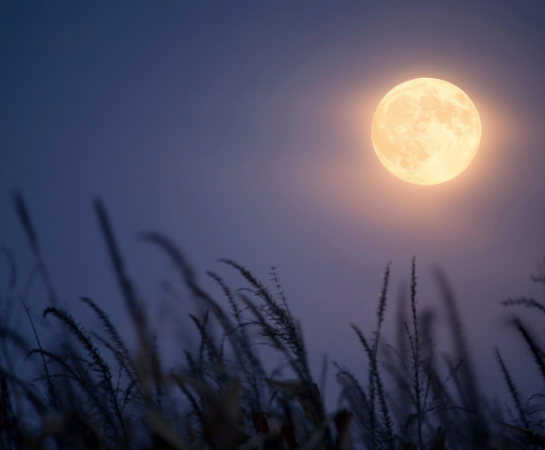
What Is a Harvest Moon and Why It Rises at Almost the Same Time Several Nights Running
On most nights of the year, the Moon rises roughly 50 minutes later than it did the night before. Around the Harvest Moon, that gap collapses to as little as 10 minutes in parts of the UK and Canada, and rarely more than 30 minutes
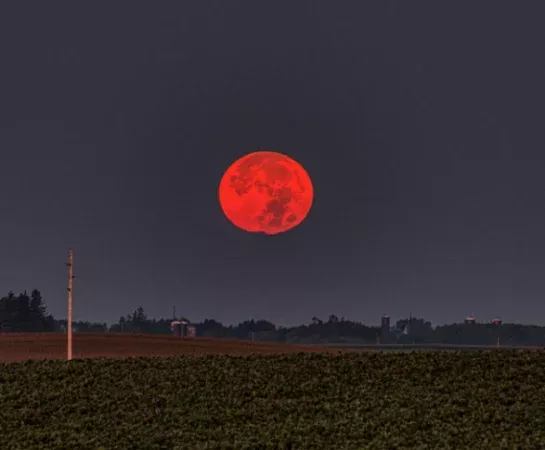
What Is a Blood Moon and Why Does the Moon Turn Red
On the night of August 27, 2026, the Moon came within a hair of disappearing entirely. Earth's shadow covered 96.2% of its surface, a partial eclipse so deep that skywatchers across the Americas, Europe, and Africa watched it turn a rusty, almost total red without

When Does a Day Actually Begin? Midnight, Sunrise, and Sunset Across Cultures
Hebcal, the widely used Jewish calendar service, lists Saturday, December 5, 2026 as 25 Kislev 5787, the first day of Hanukkah. The first Hanukkah candle is lit the evening before, on Friday, December 4. This is not an error. The Hebrew date changes at sunset,

The Hour That Happens Twice: What Actually Occurs at 1:30 AM When Clocks Fall Back
At 1:59:59 a.m. on Sunday, November 1, 2026, clocks in New York will not tick over to 2:00. They will jump back to 1:00:00 a.m., and the next 60 minutes will replay. Every time from 1:00 to 1:59 happens twice that night, once on Eastern

Why the International Space Station Runs on UTC Instead of Local Time
Astronauts aboard the International Space Station see the sun rise and set 16 times in a 24-hour period, once every 90 to 93 minutes, as the station circles Earth at roughly 28,000 kilometers per hour. No conventional time zone survives contact with that kind of

Standard Time vs Daylight Time: What’s the Actual Difference
Most people assume "Standard Time" is the normal, default setting and "Daylight Time" is some separate seasonal overlay that temporarily replaces it. That mental model is backwards in a way that federal law makes explicit, and once you see the actual legal language, the whole
Time Tools
Quick access to timers, stopwatch, world clock and time zone tools.
Time Guides
Read useful guides about time zones, calendars, finance and astronomy.


