Inside almost every quartz watch, a sliver of crystal shaped like a tiny tuning fork vibrates exactly 32,768 times per second. The number looks arbitrary until you write it in binary: 32,768 is 2 to the 15th power. Halve it fifteen times and you get exactly one pulse per second, which is all a watch needs to move its second hand. That single design choice, made in the early years of electronic watches, is why the same frequency now also ticks inside phones, laptops and the real-time clock chips of countless other devices.
That number answers only half the question. The other half is physical: why quartz vibrates at all, why engineers stopped at 2^15 rather than another power of two, and why a watch built around such a stable oscillator still drifts by seconds each month.
Why Quartz Vibrates: The Piezoelectric Effect
In 1880, the brothers Jacques and Pierre Curie showed that squeezing certain crystals, quartz among them, produces an electric voltage across their faces. The following year, mathematician Gabriel Lippmann predicted the reverse: apply a voltage, and the crystal deforms. The Curies confirmed it experimentally. Together, the direct and converse effects are called piezoelectricity, from the Greek word for pressing.
That two-way coupling is what makes a quartz oscillator possible. A small circuit applies voltage to the crystal, which flexes. The flexing produces a voltage of its own, which the circuit amplifies and feeds back. The loop settles at the crystal’s natural resonant frequency, set by its shape, size and the angle at which it was cut from the raw quartz. Because quartz is mechanically stiff and loses very little energy per vibration, that resonance is extremely sharp. Datasheets for 32,768 Hz watch crystals list quality factors (Q) of about 70,000 to 90,000. In practical terms, a struck crystal would keep ringing for tens of thousands of cycles before its vibration noticeably faded.
From Laboratory Clock to Wristwatch
The first quartz clock was built at Bell Telephone Laboratories in New York and shown publicly in October 1927. Warren Marrison and J.W. Horton were developing frequency standards for telephone and radio networks, and their crystal oscillated at 50,000 Hz. The hard problem was not making quartz vibrate but counting the vibrations: the frequency was far too high to display directly. Marrison’s key step was an electronic frequency divider that reduced the signal until it was slow enough to drive a synchronous motor. By the 1940s, time standard laboratories around the world had switched from precision pendulum clocks to quartz.
Shrinking that system into a wristwatch took another 42 years. Seiko released the Quartz Astron 35SQ in Tokyo on December 25, 1969, priced at 450,000 yen, with a rated accuracy of ±5 seconds per month. That works out to about ±0.17 seconds per day. Mechanical watches certified as chronometers by the Swiss testing body COSC are allowed to drift between −4 and +6 seconds per day, so the first quartz wristwatch was rated about 35 times tighter than a certified mechanical chronometer.
Why 32,768 Hz: Binary Division Meets Battery Life
Fifteen halvings to one second
A digital divider is a chain of flip-flops, each of which outputs one pulse for every two it receives. Each stage halves the frequency, so the number of stages needed is the power of two that matches the crystal.
32,768 Hz ÷ 2^15 = 1 Hz
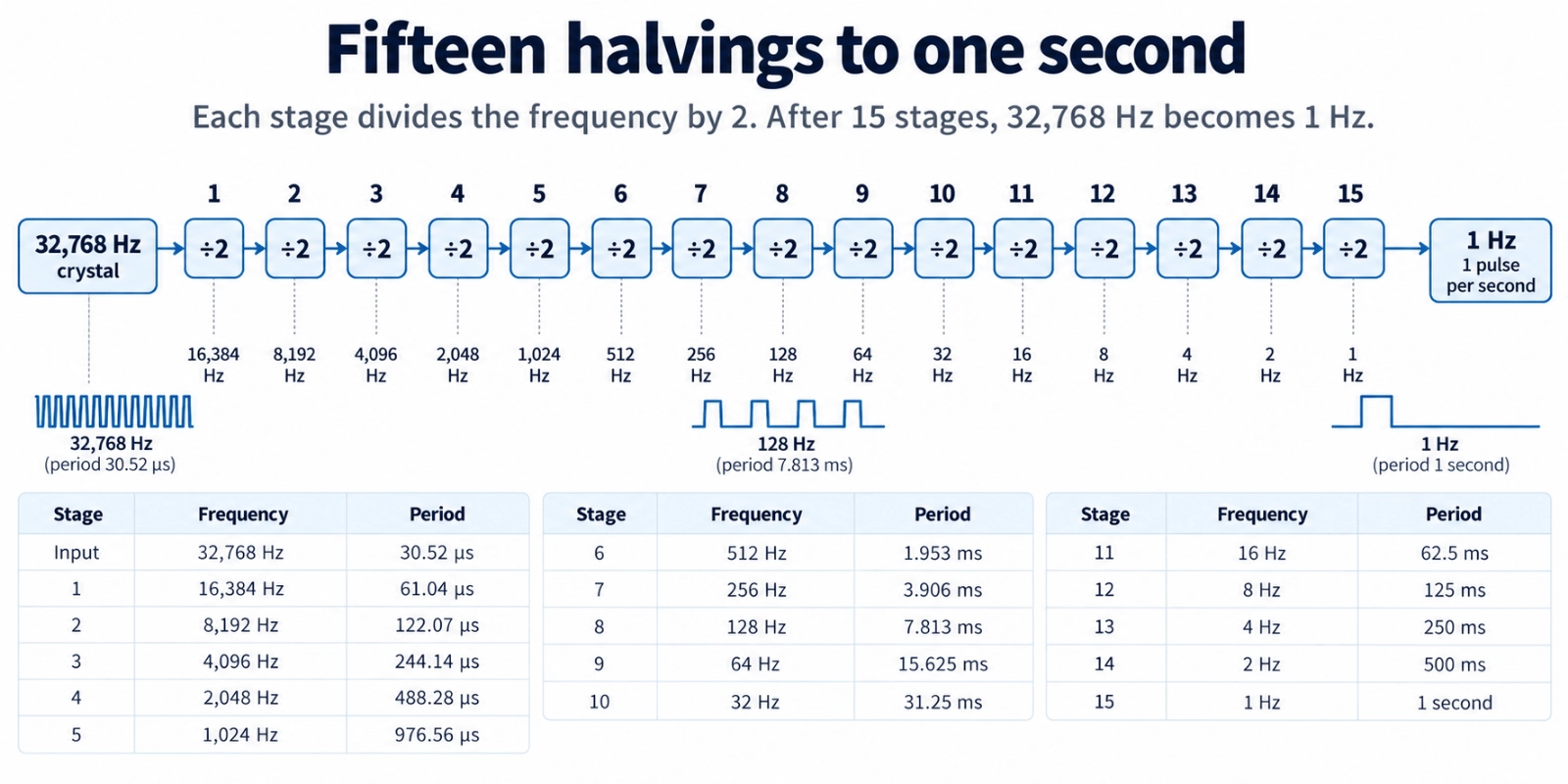
Any power of two would divide cleanly, so the binary argument explains why the frequency is 2^15 rather than, say, 30,000. It does not explain why it is 2^15 rather than 2^14 or 2^16. That part comes from physics and power.
The trade-off between size and power
An oscillator circuit draws more current the faster it runs, so for a device living on a coin cell for years, lower is better. But a lower frequency requires a physically larger crystal, because resonant frequency rises as the vibrating element gets smaller. The 32 kHz range is the compromise: the tuning-fork crystal is only a few millimeters long, small enough for a wristwatch, while the oscillator stays frugal enough to run for years on a tiny battery. Datasheets cap the drive level of the crystal itself at 1 µW, a millionth of a watt.
The tuning-fork shape matters too. Its two tines flex in opposite directions, so the motion largely cancels at the base where the crystal is mounted. Little energy leaks into the mounting, which helps keep the Q high in such a small part. Once watch chips standardized on 32,768 Hz, mass production made these crystals cheap and universal, and the same part became the default timebase for real-time clock chips in computers and phones. That last step was driven by economics: other powers of two work just as well electrically, but none has the same production volume behind it.
| Oscillator | Frequency | Power of two? | Context |
|---|---|---|---|
| Marrison and Horton quartz clock (1927) | 50,000 Hz | No | Laboratory frequency standard |
| Standard watch tuning-fork crystal | 32,768 Hz | Yes, 2^15 | Nearly all quartz watches and real-time clocks |
| Citizen Caliber 0100 AT-cut crystal (2019) | 8,388,608 Hz | Yes, 2^23 | Rated ±1 second per year |
| Cesium atom (definition of the SI second) | 9,192,631,770 Hz | No | Atomic time standard |
From Pulses to Hands: The Stepping Motor
In an analog quartz watch, the final 1 Hz signal drives a tiny stepping motor. Each pulse turns the rotor half a revolution, and a gear train converts that into a 6° jump of the second hand, since 360° divided by 60 seconds equals 6°. That is why a quartz second hand ticks rather than sweeps. Moving the hand in one short burst per second, instead of continuously, keeps the motor’s energy use low.
Why a Quartz Watch Still Drifts
A crystal resonating 32,768 times per second sounds perfect, but tiny frequency errors add up. Watch engineers express them in parts per million (ppm), and the conversion to seconds is simple.
1 ppm ≈ 2.6 s per 30-day month
1 ppm ≈ 31.5 s per year
Astron’s ±5 s per month ≈ ±1.9 ppm
Citizen 0100’s ±1 s per year ≈ ±0.03 ppm
Three sources of error dominate.
1. Manufacturing tolerance, corrected digitally
Off-the-shelf 32,768 Hz crystals are typically specified at ±20 ppm at 25 °C, which would mean about 1.7 seconds per day if left uncorrected. Watchmakers do not grind each crystal to perfection. Instead, the crystal is made to run slightly fast, and the watch chip is programmed at the factory with a correction. During a regulation period of around a minute, an inhibition circuit deletes a set number of oscillator pulses before they reach the divider, pulling the average rate onto target. Patents, including ones filed by the Swiss movement maker ETA, describe this method. It lets an inexpensive crystal produce a watch accurate to seconds per month.
2. Temperature: a quartz watch only ever runs slow
Tuning-fork crystals have a parabolic temperature curve. They run at their fastest at a turnover temperature near 25 °C, and slower at every temperature above or below it. Datasheets give a typical curvature of −0.034 ppm per °C squared.
At 15 °C or 35 °C: −0.034 × 10² = −3.4 ppm ≈ −8.8 s per month
At 5 °C or 45 °C: −0.034 × 20² = −13.6 ppm ≈ −35 s per month
The square in the formula has a practical consequence: a temperature error never makes the watch gain time. A watch left on a cold windowsill and one left on a hot dashboard both lose time, and doubling the distance from 25 °C quadruples the loss. High-accuracy quartz movements attack this directly with temperature compensation, and Seiko rates certain Grand Seiko 9F quartz models at ±5 seconds per year.
3. Aging
A crystal’s frequency also creeps as it settles in its package. Typical datasheets allow up to ±3 ppm in the first year at 25 °C, which corresponds to as much as about 95 seconds over that year if nothing compensated for it.
Going Faster to Get More Accurate
The most accurate autonomous quartz watches abandon the tuning fork altogether. Citizen’s Caliber 0100, introduced in 2019, uses an AT-cut crystal vibrating at 8,388,608 Hz, which is 2^23 and exactly 256 times the standard watch frequency. AT-cut crystals are far less sensitive to temperature over everyday conditions, and Citizen rates the movement at ±1 second per year without any radio or satellite correction. The cost is the same trade-off that put 32,768 Hz in the first place: the faster crystal draws much more power, which Citizen offsets with solar charging and power-saving circuitry. The comparison shows what 32,768 Hz really optimizes: battery life first, accuracy second.
Even ±1 second per year is far from atomic performance. A cesium clock defines the second by counting 9,192,631,770 oscillations of a cesium atom, and the best atomic standards are many orders of magnitude more stable than any quartz crystal, as explained in how accurate atomic clocks are. That gap is also why a quartz watch and a phone slowly disagree: the phone’s own 32,768 Hz crystal drifts just like the watch’s, but the phone quietly resets itself from network time servers, while a standalone watch has nothing to correct it. The mechanics of that mismatch are covered in why your phone, computer and watch show different times, and the synchronization protocol behind it in how NTP keeps computers in sync.