Major Airports in Chile
- Andrés Sabella Gálvez International Airport (ANF) - 00:14:14
- Carriel Sur International Airport (CCP) - 00:14:14
- Comodoro Arturo Merino Benítez International Airport (SCL) - 00:14:14
- Diego Aracena International Airport (IQQ) - 00:14:14
- El Tepual International Airport (PMC) - 00:14:14
- La Araucanía International Airport (ZCO) - 00:14:14
- Mataveri International Airport (IPC) - 00:14:14
- President Carlos Ibáñez International Airport (PUQ) - 00:14:14
Daylight saving time changes in Chile
Chile has 3 listed IANA time zones. 1 of them observe daylight saving time changes in 2026. 2 keep a stable UTC offset throughout the year.
Next change: April 3, 2027
Clock moves back from 00:00 to 23:00 local time.
Best Time to Call Chile
Business hours in Chile (9 AM–5 PM local time) fall at these local times elsewhere:
- Beijing: 8:00 PM – 4:00 AM (next day) ( Partial overlap)
- Paris: 2:00 PM – 10:00 PM ( Partial overlap)
- Toronto: 8:00 AM – 4:00 PM ( Convenient)
- Seoul: 9:00 PM – 5:00 AM (next day) ( Partial overlap)
- Mexico City: 6:00 AM – 2:00 PM ( Partial overlap)
- Cairo: 3:00 PM – 11:00 PM ( Partial overlap)
- Bangkok: 7:00 PM – 3:00 AM (next day) ( Partial overlap)
Times shown reflect current UTC offsets and may shift by up to an hour around daylight saving transitions.
Time Difference from Chile
Compare time in Chile with other countries.
Countries in the Same Time Zone as Chile
Most Popular Cities in Chile
Holidays in Chile
Official national public holidays. Regional and religious observances may vary by area.
About Time in Chile
At Noon in Valparaíso, a Black Ball Fell Five Meters
Chile's first official time signal for navigation began operating in Valparaíso on 1 March 1894. A black ball was raised on a mast in front of the Naval School and dropped at noon. A contemporary hydrographic notice, reproduced in Spain's official gazette, described the ball as about 1.1 meters in diameter with a five-meter drop. It was raised partway five minutes before the signal and taken to the top shortly before release, giving ships in the harbor time to prepare their chronometers.
The procedure even had an error protocol. If the ball failed to fall with the required accuracy, it was raised again and another drop was made five minutes later. A ship could request a signal at another hour, except on Sundays and holidays. By 1900 the noon gun fired from Fort Covadonga had been coordinated with the Naval School signal so that the visual drop and the gunshot were simultaneous. Harbor time could now be checked by sight or sound.
The system then moved into electrical and radio distribution. The Navy created a formal time station in 1902, and the service later passed to the Hydrographic Institute. In 1918 a naval radio station at Playa Ancha began broadcasting a time signal by radiotelegraphy. Mechanical signals intended for ships had become an electronic service capable of reaching receivers far beyond the harbor.
In 1927 the state went further and standardized how public institutions were to write time. Decree 5,693 ordered postal and telegraph services, railways, steamship lines, ministries, courts and other public offices to use a continuous 24-hour count. It explicitly removed the need for morning, afternoon and night labels, and allowed midnight to appear as either 0 or 24 depending on whether an interval began or ended there. The same decree ordered seasonal clock changes to be executed according to signals from the pendulums of the Lo Espejo Observatory.
The 2010 Maule Earthquake Changed the Length of the Day
The magnitude 8.8 Maule earthquake began at 06:34:11 UTC on 27 February 2010 and ruptured a section of the plate boundary nearly 500 kilometers long. The movement was large enough for geophysicists to model an effect on the rotation of the entire planet.
Richard Gross of NASA's Jet Propulsion Laboratory estimated that the redistribution of mass caused by the earthquake should have shortened Earth's day by about 1.26 microseconds. The same calculation estimated a shift of roughly eight centimeters in Earth's figure axis, the axis around which the planet's mass is balanced.
The figure axis is not the same thing as the geographic north-south axis and the calculation did not mean that clocks suddenly lost a visible fraction of a second. A microsecond is one millionth of a second, and ordinary civil timekeeping would never reveal the change. The result belongs to geophysical rotation models, where movements of large masses inside Earth can alter its moment of inertia and therefore its rotation rate by extremely small amounts.
For Chilean chronology, the earthquake is notable for a reason that goes beyond the timestamp of the disaster itself. One of the parameters modeled after one of the country's largest recorded earthquakes was the length of the planetary day.
Chile Tried an Entire Year Without Winter Time
In January 2015 the government announced that the seasonal return to winter time would be suspended and that the then summer clock would remain in force throughout the year. The decision turned the normal twice-yearly clock change into a national policy experiment affecting transport, schools, energy use, public safety and daily routines.
The Ministry of Energy subsequently created an interministerial monitoring process with the United Nations Development Programme and invited public feedback. When the results were presented in early 2016, the official assessment reported several indicators moving in different directions. It cited an approximately 1 percent saving in electricity consumption and a 2.4 percent national decrease in recorded crime, while school absenteeism in June 2015 was 2.4 percent higher than in June 2014. Those figures were observations used in the policy review, not proof that the clock setting alone caused each change.
The one-time regime did not survive unchanged. In 2016 the country restored a winter-time period, initially limited to three months. Magallanes then followed a different path: from 2017 the region kept the advanced clock throughout the year rather than making the seasonal change used across most of continental Chile.
Aysén joined that arrangement in 2025. An official non-binding regional consultation received 13,094 responses, with more than 94 percent supporting permanent summer time. The resulting decree placed Aysén alongside Magallanes on permanent UTC-3. Under the decree issued in July 2026, those two southern regions keep that regime indefinitely, while seasonal changes for the rest of continental Chile and western insular Chile are scheduled through April 2029.
ALMA Needs an Atomic Clock to Become Part of an Earth-Sized Telescope
At the ALMA observatory in northern Chile, precise time is not mainly about telling astronomers when an observation begins. It is part of the instrument itself. ALMA combines radio signals received by dozens of antennas, and for Very Long Baseline Interferometry those signals must also be matched with observations recorded at radio telescopes thousands of kilometers away.
In 2014 ALMA installed a hydrogen maser atomic clock as part of the project that allowed its 66 antennas to operate as a phased array and participate in the Event Horizon Telescope. The combined ALMA signal is time-stamped against the maser before the data are sent for processing with identically timed recordings from other observatories. Without an extremely stable frequency reference, the distant recordings could not be coherently combined as parts of one virtual telescope.
The scale of the requirement is reflected in ALMA's own technical summary, which describes the maser in terms of a possible drift of about one second in three million years. In February 2024 the observatory announced the replacement of its hydrogen maser with a new unit, again emphasizing that the device provides the stable frequency reference needed to synchronize cosmic signals across global VLBI networks.
This timing infrastructure helped turn ALMA from a powerful Chile-based interferometer into a critical component of an Earth-sized observing system. Here, a clock is not attached to astronomy as an administrative accessory. Its stability determines whether signals captured on different continents can be treated as one observation.
La Silla Waited 126 Years for 111.7 Seconds of Totality
The total solar eclipse of 2 July 2019 crossed ESO's La Silla Observatory during the observatory's fiftieth year of operation. ESO calculated that totality at the summit would begin at 16:39:23.6 Chilean local time, reach maximum at 16:40:19.6 and end at 16:41:15.3. The total phase lasted 1 minute 51.7 seconds.
The historical spacing of total eclipses at that exact site is remarkable. ESO's eclipse catalogue gives the previous total solar eclipse at La Silla as 16 April 1893, twenty-six years before the observatory even existed, and the next as 28 August 2231. The 2019 event was therefore the only total solar eclipse visible from La Silla during a 338-year interval between those two neighboring entries.
Because the event occurred at an operating astronomical observatory, its chronology was published with unusually fine precision. ESO listed the beginning and end of partial phases, both contacts of totality, the instant of maximum eclipse and the later sunset, providing local Chilean time, Universal Time and Central European Summer Time side by side.
The sequence also turned the observatory's own history into part of the event. La Silla was inaugurated in 1969, reached its fiftieth anniversary in 2019, and hosted about one thousand visitors for a total eclipse that will not return to the site for more than two centuries. For less than two minutes, a place built to measure the sky became one of the precisely timed astronomical events it normally studies.
Frequently Asked Questions
How many time zones does Chile have?
One. The whole of Chile follows America/Santiago, so every city shows the same local time as the capital, Santiago.
Is Chile ahead of or behind GMT?
Chile is currently 3 hours behind GMT (UTC-3).
Does Chile use summer time?
Yes. Santiago uses UTC-4 in standard time and UTC-3 during daylight saving time, and is currently on summer time. 2 of the country's 3 time zones never change their clocks, so the gap between some regions shifts during the year.
How many public holidays does Chile have in 2026?
Chile has 16 national public holidays in 2026, when banks and government offices are usually closed. Some regions may also have their own local holidays.
How do I dial a phone number in Chile from abroad?
From a mobile phone, type +56 and then the local number without the leading 0 used for domestic calls, if it has one. From a landline, replace the plus sign with your exit code: 011 from the US and Canada, or 00 from most of Europe, for example 00 56 followed by the number.
What language is spoken in Chile?
The main language of Chile is Spanish.
Beyond the Clock

Working Hours by Country: How Long Is the Workday and the Work Year Around the World
The average worker in Mexico puts in about 2,200 hours a year. The average worker in Germany puts in about 1,340. The gap of roughly 860 hours equals more than 21 standard 40-hour weeks, close to five extra months of full-time work. Most "who works

The Planning Fallacy: Why Tasks Take Longer Than You Expect and How to Correct It
In a 1994 study, 37 psychology students estimated how long it would take them to finish their honors theses. Their average answer was 33.9 days. They also gave a best-case estimate, 27.4 days on average, and a worst-case estimate, "if everything went as poorly as

How Americans Spend Their 24 Hours: What the Time Use Survey Shows
The average American age 15 and over logs about 9 hours of sleep a day, spends just over 5 hours on leisure and works 3 hours. That last number looks wrong until you see how it is built, and nearly every headline figure from the

Pomodoro Technique: Why 25 Minutes and When a Different Interval Works Better
The most famous number in time management started as a workaround. In the late 1980s Francesco Cirillo, a university student who could not make himself study, used a tomato-shaped kitchen timer to test a small question: could he work for two minutes without interruption? Twenty-five

Total Solar Eclipse on August 2, 2027: Where, When, and Why It Lasts So Long
On Monday, August 2, 2027, the Moon's shadow will cross southern Spain, North Africa and the Arabian Peninsula, producing the second-longest total solar eclipse of the 21st century. At its maximum, in southern Egypt near Luxor, the Sun will be completely covered for about 6

When Does Winter Start: Meteorological vs Astronomical Seasons
Winter 2026 starts twice in the Northern Hemisphere. Meteorological winter begins on Tuesday, December 1, 2026. Astronomical winter begins at the December solstice, on Monday, December 21, 2026 at 20:50 UTC, which is 3:50 p.m. Eastern and 12:50 p.m. Pacific. Both answers are correct. They
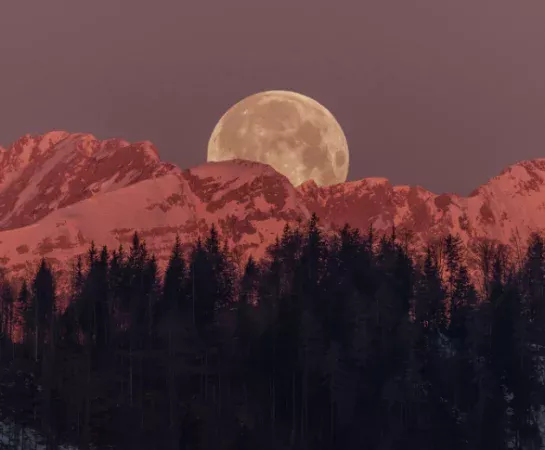
What Is a Supermoon and When Is the Next One
Every time a supermoon rises, the same statistic gets repeated: 14% bigger, 30% brighter. It's in almost every news segment and nearly every listicle, and it's also a comparison almost nobody in the audience will ever actually witness, because it measures the single closest possible
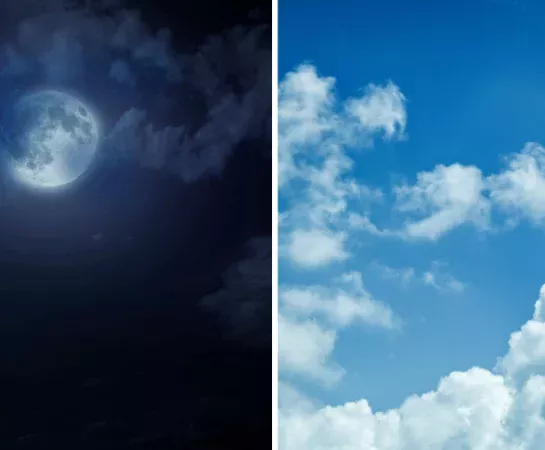
Why the Sky Is Blue During the Day and Black at Night
Sunlight is white. Air is, as far as anyone can tell by looking through a window, colorless. And yet every clear afternoon the same 400,000-kilometer column of gas above your head reads as a specific, saturated blue, then goes black within an hour of sunset.
Time Tools
Quick access to timers, stopwatch, world clock and time zone tools.
Time Guides
Read useful guides about time zones, calendars, finance and astronomy.


