Major Airports in Venezuela
- Arturo Michelena International Airport (VLN) - 19:39:22
- Del Caribe Santiago Mariño International Airport (PMV) - 19:39:22
- General José Antonio Anzoategui International Airport (BLA) - 19:39:22
- General Manuel Carlos Piar International Airport (PZO) - 19:39:22
- Jacinto Lara International Airport (BRM) - 19:39:22
- La Chinita International Airport (MAR) - 19:39:22
- Maiquetía Simón Bolívar International Airport (CCS) - 19:39:22
Daylight saving time in Venezuela
Venezuela has 1 listed IANA time zones. None of them observe daylight saving time in 2026. The UTC offset remains stable throughout the year.
Best Time to Call Venezuela
Business hours in Venezuela (9 AM–5 PM local time) fall at these local times elsewhere:
- Beijing: 9:00 PM – 5:00 AM (next day) ( Partial overlap)
- Paris: 3:00 PM – 11:00 PM ( Partial overlap)
- Toronto: 9:00 AM – 5:00 PM ( Convenient)
- Seoul: 10:00 PM – 6:00 AM (next day) ( Outside normal hours)
- Mexico City: 7:00 AM – 3:00 PM ( Partial overlap)
- Cairo: 4:00 PM – 12:00 AM (next day) ( Partial overlap)
- Bangkok: 8:00 PM – 4:00 AM (next day) ( Partial overlap)
Times shown reflect current UTC offsets and may shift by up to an hour around daylight saving transitions.
Time Difference from Venezuela
Compare time in Venezuela with other countries.
Countries in the Same Time Zone as Venezuela
Most Popular Cities in Venezuela
Holidays in Venezuela
Official national public holidays. Regional and religious observances may vary by area.
About Time in Venezuela
The Meridian Through Villa de Cura Defined the First National Clock
The national time service took shape around a geographic choice that suited the country unusually well. When the Hora Legal de Venezuela service was established in 1912, the reference selected was the meridian at 67 degrees 30 minutes west, passing near Villa de Cura in Aragua. That longitude corresponds exactly to a mean-time offset of four hours and thirty minutes behind Greenwich. Rather than choosing one of the neighboring whole-hour meridians, the early system placed the legal clock close to the longitudinal center of the territory.
The decision was closely tied to the Observatorio Cagigal in Caracas. Founded in 1888 as an astronomical and meteorological observatory, the institution used positional astronomy and precision clocks to determine time. From 1912 it supplied astronomical time determinations to the national telegraph service, giving distant offices access to a common reference instead of leaving individual towns or institutions to maintain independent local clocks.
Historical time-zone data preserves the transition in remarkable detail. Before the national standard, Caracas was represented by a local mean-time offset of approximately UTC-4:27:44, later regularized very slightly to UTC-4:27:40. On 12 February 1912 the standard became UTC-4:30. The difference was only a little more than two minutes, which shows how closely the chosen Villa de Cura meridian matched the astronomical time already being kept around the capital.
The choice also illustrates an important stage in the history of civil time. The clock was no longer defined separately for each longitude, but it had not yet been forced into a whole-hour international offset. UTC-4:30 was effectively a compromise between astronomical geography and national standardization, and it remained the legal basis for more than half a century.
Thirty Minutes Changed Hands Three Times
On 1 January 1965, the legal offset moved from UTC-4:30 to UTC-4. The new reference was the 60th meridian west, associated with the eastern part of the country near Punta Playa in the Orinoco Delta. Contemporary legal documentation and later technical histories connect the reform with the international preference for standard zones expressed as whole-hour differences from Greenwich. The practical result was simple: every clock advanced by thirty minutes.
That arrangement lasted for almost forty-three years. Decree No. 5,693, published in Official Gazette No. 38,819 in November 2007, restored the 67 degrees 30 minutes west meridian and UTC-4:30. The transition occurred on 9 December at 03:00, when clocks were set back thirty minutes. Official explanations emphasized the relationship between the working day, school schedules and morning daylight. The change was not daylight saving time. It altered the permanent standard offset.
The half-hour system lasted until another national adjustment in 2016. A severe electricity shortage coincided with low reservoir levels affecting hydroelectric generation, and the government introduced several measures intended to reduce demand. One of them was a return to UTC-4. At 02:30 on 1 May, the clock advanced directly to 03:00, removing thirty minutes from that civil night.
UTC-4 has remained the standard since then. No seasonal daylight-saving system is used, so the same offset applies throughout the year. The historical sequence is therefore not a conventional summer-time pattern: UTC-4:30 and UTC-4 were competing definitions of the permanent national clock, adopted at different periods for geographic, administrative and energy-policy reasons.
Noon on the Clock Is Not Noon in the Sky
The consequences of those thirty-minute decisions can be seen directly in the Sun. The Cagigal Observatory is located near 66 degrees 56 minutes west longitude. Converting that longitude into mean solar time gives an offset close to UTC-4:28, almost exactly between the modern whole-hour standard and the historic Villa de Cura reference.
Under UTC-4:30, the civil clock in Caracas was very close to local mean solar time. Ignoring the seasonal equation of time, the Sun's average meridian passage occurred only a few minutes from 12:00. Under the present UTC-4 standard, mean solar noon arrives roughly twenty-eight minutes after 12:00 by the civil clock. The change did not alter the Sun, of course. It altered where the government placed the numbered hours relative to the solar day.
This difference is useful when interpreting sunrise and sunset schedules. Moving from UTC-4:30 to UTC-4 shifts every solar event thirty minutes later on the displayed clock even though the astronomical event occurs at exactly the same physical instant. Sunrise, solar noon and sunset all appear thirty minutes later after such a reform. A time-zone change can therefore alter daily schedules without changing the amount of daylight available.
The historic Caracas Mean Time preserved in time-zone databases provides an independent check on the calculation. Its offset of about UTC-4:27:40 corresponds closely to the longitude of the capital. Modern civil time deliberately sacrifices that local astronomical fit in exchange for a simple whole-hour relationship with UTC.
From Telegraph Synchronization to a Shortwave Time Signal
The Cagigal Observatory did more than determine the correct hour. It became part of the infrastructure used to distribute it. The original service sent astronomical determinations to the Central Office of National Telegraphs, allowing telegraph stations to synchronize against a common source. Radio later made it possible to distribute the same reference continuously over much greater distances.
The service eventually operated under the call sign YVTO. Historical technical records describe shortwave transmissions first associated with 6100 kHz and later with 5000 kHz. By 2010, the Bureau International des Poids et Mesures still listed YVTO among the world's UTC time-signal stations and documented a continuous transmission on 5000 kHz from Caracas.
The signal carried more information than a simple spoken announcement. BIPM documentation describes one-second pulses produced by 1 kHz modulation, a distinct 800 Hz tone marking the minute, an omitted pulse at second 30 and voice announcements identifying the station and stating the hour, minute and second near the end of each minute. A listener with suitable radio equipment could therefore compare a local clock directly with an official reference signal.
The technology maintaining that reference also evolved. Astronomical transit observations and precision mechanical clocks were gradually supplemented by quartz systems and then cesium atomic standards. Historical technical documentation from the observatory records cesium clocks entering service in the 1980s, while newer atomic equipment was acquired in the 2000s. The principle remained unchanged: establish a stable reference, compare it with international standards and distribute it to users who need their clocks to agree.
That continuity makes the observatory an important part of the history of practical timekeeping in northern South America. The same institution moved from determining time by observing the sky to maintaining it with atomic frequency standards, while the means of distribution progressed from telegraph lines to radio and digital systems.
Two Total Eclipses Turned Falcón Into a Laboratory of Minutes and Seconds
On 3 February 1916, the path of a total solar eclipse crossed northern Venezuela. The Cagigal Observatory sent a scientific expedition to Tucacas in Falcón, where astronomers made astronomical, meteorological and photometric observations before and during the event. Their published records are unusually valuable because the observation times were stated in the UTC-4:30 local standard then in force.
The team recorded first contact shortly before 10 a.m. local time and totality around 11:27 to 11:29. More than the celestial geometry was measured. Meteorological observations showed the temperature falling from about 34.2 degrees Celsius to 25 degrees Celsius as the eclipse approached totality, a drop of roughly 9.2 degrees. The observers also measured the reduction in sky brightness and recorded which stars became visible during the darkened interval.
Eighty-two years later, on 26 February 1998, another total eclipse crossed the same broad part of the country. NASA's calculations placed northwestern Venezuela directly inside the umbral path. Maracaibo, although about 50 kilometres south of the center line, experienced almost three minutes of totality with the Sun high in the early-afternoon sky. The shadow then crossed the Paraguaná Peninsula before continuing into the Caribbean.
The recurrence allowed researchers to compare two eclipses observed in Falcón under different atmospheric conditions and with very different instruments. A later peer-reviewed study reconstructed the 1916 observations and compared them with measurements made in 1998. The 1998 event produced a temperature decline from approximately 30.9 to 25.2 degrees Celsius at the study location, smaller than the drop recorded at Tucacas in 1916. The researchers also found substantial differences in visual extinction and sky brightness between the two eclipses.
These records turn two short astronomical events into long-term scientific data. Totality lasted only minutes, yet accurate timing made it possible to compare temperature, atmospheric transparency and illumination across an interval of more than eight decades. They also preserve an unexpected link between astronomy and civil time: the 1916 measurements were recorded under UTC-4:30, the same half-hour standard that disappeared in 1965, returned in 2007 and was abandoned again in 2016.
Frequently Asked Questions
How many time zones does Venezuela have?
One. The whole of Venezuela follows America/Caracas, so every city shows the same local time as the capital, Caracas.
Is Venezuela ahead of or behind GMT?
Venezuela is currently 4 hours behind GMT (UTC-4).
Does Venezuela use summer time?
No. Venezuela does not observe daylight saving time, so its clocks stay at UTC-4 all year. Its time difference with countries that do change their clocks still shifts by an hour in spring and autumn.
How many public holidays does Venezuela have in 2026?
Venezuela has 15 national public holidays in 2026, when banks and government offices are usually closed. Some regions may also have their own local holidays.
How do I dial a phone number in Venezuela from abroad?
From a mobile phone, type +58 and then the local number without the leading 0 used for domestic calls, if it has one. From a landline, replace the plus sign with your exit code: 011 from the US and Canada, or 00 from most of Europe, for example 00 58 followed by the number.
What language is spoken in Venezuela?
The main language of Venezuela is Spanish.
Beyond the Clock

When Do the Clocks Change in 2026: US, UK, and EU Dates
The clocks fall back twice this autumn on the two sides of the Atlantic, one week apart. The United Kingdom and every European Union country end summer time on Sunday, October 25, 2026. The United States and most of Canada end daylight saving time on

What Time Zone Is Mexico In and Why It Stopped Changing Its Clocks
Mexico uses four time zones, and since October 30, 2022, most of the country keeps the same time all year. Mexico City, Guadalajara and Monterrey stay at UTC−6 in January and in July. Cancún stays at UTC−5, Los Cabos and Mazatlán at UTC−7. The only

Why Israel Changes Its Clocks on a Different Schedule Than Europe
Israel's clocks now fall back on the same day the European Union's do, the last Sunday of October, a deliberate alignment written into a 2013 law. But the two systems still don't match. Israel springs forward on the Friday before the EU's last Sunday of

Why Japan Never Adopted Daylight Saving Time
The premise behind that headline needs a small correction before the story even starts. Japan did try daylight saving time, for four full years, complete with clocks moving forward and back on a fixed schedule. What Japan never did was choose it. The distinction between

Why the Earliest Sunset Comes Before the Winter Solstice
In New York, the Sun sets earliest on Monday, December 7, 2026, at about 4:28 PM. The shortest day comes two weeks later. The solstice falls at 20:50 UTC on December 21 (3:50 PM EST), and on that day New York gets roughly 9 hours

Total Solar Eclipse on August 2, 2027: Where, When, and Why It Lasts So Long
On Monday, August 2, 2027, the Moon's shadow will cross southern Spain, North Africa and the Arabian Peninsula, producing the second-longest total solar eclipse of the 21st century. At its maximum, in southern Egypt near Luxor, the Sun will be completely covered for about 6
What Is a Supermoon and When Is the Next One
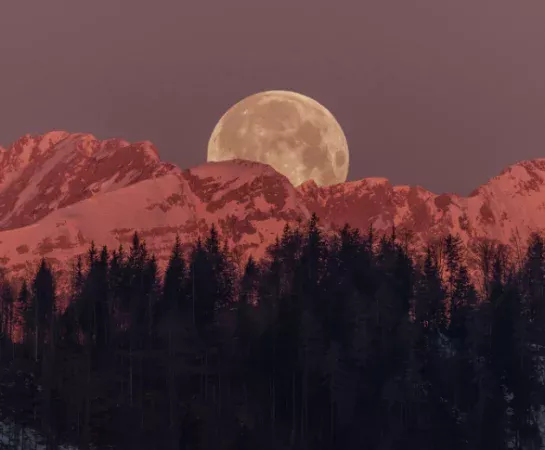
Every time a supermoon rises, the same statistic gets repeated: 14% bigger, 30% brighter. It's in almost every news segment and nearly every listicle, and it's also a comparison almost nobody in the audience will ever actually witness, because it measures the single closest possible
Why the Sky Is Blue During the Day and Black at Night
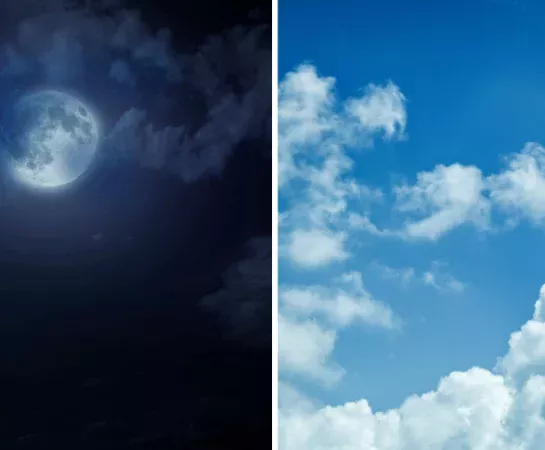
Sunlight is white. Air is, as far as anyone can tell by looking through a window, colorless. And yet every clear afternoon the same 400,000-kilometer column of gas above your head reads as a specific, saturated blue, then goes black within an hour of sunset.
Time Tools
Quick access to timers, stopwatch, world clock and time zone tools.
Time Guides
Read useful guides about time zones, calendars, finance and astronomy.


