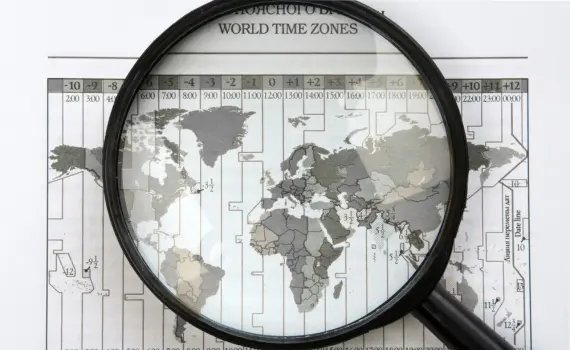
Time zones often look straightforward on paper: the world is divided into hourly offsets, and countries simply choose the one that matches their location. A closer look quickly reveals that the system is far less tidy.
India operates on UTC+5:30. Nepal uses UTC+5:45. Parts of Australia follow UTC+9:30, while Newfoundland in Canada uses UTC−3:30. If time zones are supposed to work in neat one-hour steps, where do these extra 30 or 45 minutes come from?
The answer lies in the fact that modern timekeeping is shaped by far more than astronomy. National borders, economics, administrative needs, population centers, and political decisions all influence how countries choose their official time.
In theory, that formula should produce a clean global system of one-hour time zones separated by longitude.
Real-world timekeeping rarely follows that model exactly. Countries organize official time around economics, population centers, administrative convenience, and political priorities as much as geography.
Why India Uses UTC+5:30
India is one of the best-known examples of a non-standard time offset. The country follows a single national standard, Indian Standard Time (IST), set at UTC+5:30.
Geographically, India stretches across a substantial east-west distance, creating noticeable differences in sunrise and sunset times between regions. In theory, the country could operate with multiple time zones, as several other large nations do.
Instead, India chose a compromise: one national clock shifted by an extra half hour. That approach placed the official standard closer to the country’s geographic center while avoiding the complexity of multiple internal time zones.
Debates about introducing additional time zones in India still appear from time to time, particularly because eastern and western regions experience daylight quite differently.
Why Nepal Uses UTC+5:45
Nepal takes the idea even further.
The country uses UTC+5:45, making it one of the few places in the world with an official 45-minute offset. This is not a random quirk or a technical anomaly.
Nepal’s standard time is historically linked to a meridian near Kathmandu, but geography is only part of the explanation. The decision also reflects a distinct national identity. Maintaining a separate standard keeps Nepal’s official time 15 minutes ahead of neighboring India rather than fully aligned with it.
As a result, Nepal became one of the clearest examples of how geography, history, and state identity can influence something as ordinary as the time displayed on a clock.
Why Australia Uses Non-Standard Time Offsets
Australia shows how complex national time systems can become even inside a single country.
While many countries follow neat hourly offsets, Australia mixes multiple systems at once. South Australia uses UTC+9:30, creating a half-hour difference that does not fully align with neighboring regions.
The system becomes even less straightforward during daylight saving time. Some Australian states move their clocks seasonally while others keep the same standard year-round.
As a result, traveling between Australian regions can sometimes involve unexpected clock changes despite remaining inside the same country.
This is closely connected to how large countries organize multiple time zones.
| Country or Region | Official Time Zone | Offset Type |
|---|---|---|
| India | UTC+5:30 | 30-minute offset |
| Nepal | UTC+5:45 | 45-minute offset |
| South Australia | UTC+9:30 | 30-minute offset |
| Newfoundland (Canada) | UTC−3:30 | 30-minute offset |
Why Half-Hour Time Zones Create Practical Challenges
Non-standard offsets may look like a minor detail, but they create real complications in global coordination.
International meetings, airline schedules, software systems, financial markets, and remote teams often depend on fast time calculations between countries.
A missed half-hour difference can easily cause scheduling errors, delayed meetings, or incorrect automated timestamps in international systems.
A 30-minute or 45-minute difference is easier to overlook than a full-hour shift, especially when people assume time zones always change in neat hourly steps.
That is one reason modern global infrastructure relies heavily on UTC coordination behind the scenes.
Why the Global Clock Is Less Symmetrical Than It Looks
At first glance, time zones appear to be a clean scientific system built entirely around Earth’s rotation.
The real system is far more irregular. Geography matters, but so do politics, economics, national identity, administrative convenience, and historical decisions.
That is why the world does not operate entirely on neat one-hour offsets. Half-hour and 45-minute time zones exist because countries organize time around human priorities as much as astronomical logic.
What looks simple on a classroom map is actually the result of decades of compromise between astronomy, geography, politics, and the practical realities of running modern societies.