Major Airports in Saint Barthelemy
- St. Jean Airport (SBH) - 18:41:45
Daylight saving time in Saint Barthelemy
Saint Barthelemy has 1 listed IANA time zones. None of them observe daylight saving time in 2026. The UTC offset remains stable throughout the year.
Best Time to Call Saint Barthelemy
Business hours in Saint Barthelemy (9 AM–5 PM local time) fall at these local times elsewhere:
- Beijing: 9:00 PM – 5:00 AM (next day) ( Partial overlap)
- Paris: 3:00 PM – 11:00 PM ( Partial overlap)
- Toronto: 9:00 AM – 5:00 PM ( Convenient)
- Seoul: 10:00 PM – 6:00 AM (next day) ( Outside normal hours)
- Mexico City: 7:00 AM – 3:00 PM ( Partial overlap)
- Cairo: 4:00 PM – 12:00 AM (next day) ( Partial overlap)
- Bangkok: 8:00 PM – 4:00 AM (next day) ( Partial overlap)
Times shown reflect current UTC offsets and may shift by up to an hour around daylight saving transitions.
Time Difference from Saint Barthelemy
Compare time in Saint Barthelemy with other countries.
Countries in the Same Time Zone as Saint Barthelemy
Most Popular Cities in Saint Barthelemy
Holidays in Saint Barthelemy
Official national public holidays. Regional and religious observances may vary by area.
About Time in Saint Barthelemy
Before Gustavia Had a Clock Face, It Had a Drum and a Bell
Public time in Swedish-era Gustavia was heard before it was read. A historical account preserved by the St Barthélemy Society records that, before the town had its familiar belfry, the garrison drummer was used to summon Sunday worship at 9, 10 and 11 o'clock. The sequence was simple but effective: an official sound carried a scheduled hour through a settlement where personal watches could not be assumed.
The surviving Swedish belfry emerged from that environment. France's Ministry of Culture dates the structure to the late eighteenth century and records that its cast-iron bell was made in Stockholm in 1799. The bell announced important events on the island. More detailed Swedish heritage research associates the construction with judge Anders Bergstedt, describes reconstruction in 1831 and further repair after the hurricane of 1837.
The bell also served as a daily time signal. Local historical documentation records ringing at 6 in the morning and 8 in the evening, giving Gustavia two audible reference points around which work, worship and domestic routines could be organized. This was public synchronization without a visible dial. A person only needed to be within hearing distance.
The clock face came much later. During renovation in 1931, a clock was installed in the belfry facing toward the town, with striking at each quarter-hour. By then a structure originally built around a church bell had become a conventional civic timekeeper. The transformation is easy to miss because the eighteenth-century tower and the twentieth-century clock now appear to belong together.
The chronology matters when interpreting the landmark. The bell belongs to the Swedish colonial period; the visible clock does not. For more than a century, Gustavia's belfry communicated time primarily through sound, first as a bell associated with events and daily markers, and only later through hands moving around a dial.
America/St_Barthelemy Is a Modern Identifier, Not a Nineteenth-Century Clock
French law now defines legal time in Saint-Barthélemy with unusual clarity. Decree No. 2017-292 establishes French legal time from a national realization of Coordinated Universal Time and specifies that Saint-Barthélemy is four hours behind that reference. Unlike metropolitan France, the article governing the collectivity contains no seasonal summer-time adjustment. The legal display is therefore UTC-4 throughout the year.
The database identifier used by software needs more careful reading. In current IANA material, America/St_Barthelemy is linked to America/Port_of_Spain because the clocks represented by those zones agree for the period that matters to the main database, especially after 1970. In the supplementary backzone file, that link inherits Port of Spain's modeled local mean time of 4 hours, 6 minutes and 4 seconds behind Greenwich before 2 March 1912.
That value is geographically wrong for Gustavia if it is interpreted as the island's own local mean solar time. The U.S. National Geospatial-Intelligence Agency places Fort Gustavia at approximately 62 degrees 51.1 minutes west. Converting that longitude at four minutes per degree gives a theoretical local mean time of about 4 hours, 11 minutes and 24 seconds behind Greenwich, more than five minutes different from the inherited Port of Spain value.
This does not prove that every nineteenth-century clock in Gustavia showed precisely GMT-4:11:24. Longitude-derived mean time is an astronomical calculation, while actual civil practice can depend on local rules, institutions and individual clocks. It does prove something important about the database: the Port of Spain pre-1912 value should not be mistaken for researched Saint-Barthélemy clock history merely because modern software accepts America/St_Barthelemy.
IANA explicitly warns that backzone lies outside the normal scope of the database, covers only a small part of pre-1970 history and is less reliable. For archival records from the Swedish period or the early decades after the 1878 return to France, a modern zone identifier is therefore not enough to establish the historical local time. The original document, its institutional context and any contemporary time convention deserve priority over an automatic database conversion.
The Lighthouse Identifies Itself in Exactly Twelve Seconds
Time appears in Gustavia's navigation infrastructure in a completely different form. The official NGA List of Lights identifies Fort Gustavia light by the characteristic Fl(3) WRG 12s. In plain terms, the light produces a group of three flashes, with white, red or green visible according to direction, and the complete pattern repeats every twelve seconds.
The published sequence is precise: a one-second flash, 1.5 seconds of darkness, another one-second flash, another 1.5-second eclipse, a third one-second flash, then six seconds of darkness. Add the intervals and the pattern closes at exactly twelve seconds. The timing is not intended to tell a mariner what hour it is. It gives the beacon a recognizable temporal signature that can be distinguished from other lights at night.
Colour adds positional information to the rhythm. The NGA listing assigns different red, white and green sectors around the light, so a vessel's bearing changes the colour observed while the twelve-second sequence remains recognizable. Gustavia's lighthouse is therefore a compact navigational code built from direction, colour and elapsed time. A clock measures when an event occurs; this light uses measured time to tell a navigator which signal is being seen.
A Swedish Battery Became a Meteorological Site Before Irma Crossed the Island
Fort Gustav III began as military infrastructure. The French Ministry of Culture dates the surviving Swedish battery to 1787 and lists its present use as a meteorological station, with the site assigned to the national meteorological service. Ramparts, a powder magazine, a sentry post and a bakery survive from a defensive installation whose hilltop position later proved equally useful for observing the atmosphere.
That meteorological role gained particular significance on 6 September 2017. Météo-France records Hurricane Irma crossing Saint-Barthélemy while maintaining Category 5 intensity, with sustained winds around 285 kilometres per hour during its passage through the northern Lesser Antilles. At 11:00 a.m. Atlantic Standard Time, the U.S. National Hurricane Center reported that Irma's eye had already passed over Saint-Barthélemy and gave a minimum pressure observation of 915.9 millibars from the island.
The NHC bulletin also demonstrates how modern weather chronology avoids local-time ambiguity. Its 11:00 a.m. AST issue is simultaneously timestamped 15:00 UTC. An aircraft observation described as occurring around 12Z belongs to about 8:00 a.m. on Saint-Barthélemy's UTC-4 clock. Aircraft, satellites, island instruments and forecast centers can therefore be aligned on one UTC timeline even when reports are also written for people reading local clocks.
The pressure observation should not be assigned automatically to the Fort Gustav station. The NHC advisory states that 915.9 millibars was reported on Saint-Barthélemy but does not identify the instrument in that sentence. The distinction is important in historical meteorology: a precise number and a precisely known observing site are separate pieces of evidence. The island's time history is unusually good at exposing that difference, from a Swedish bell that once marked communal hours to a hurricane record assembled from instruments synchronized across the Atlantic.
Frequently Asked Questions
How many time zones does Saint Barthelemy have?
One. The whole of Saint Barthelemy follows America/St_Barthelemy, so every city shows the same local time as the capital, Gustavia.
Is Saint Barthelemy ahead of or behind GMT?
Saint Barthelemy is currently 4 hours behind GMT (UTC-4).
Does Saint Barthelemy use summer time?
No. Saint Barthelemy does not observe daylight saving time, so its clocks stay at UTC-4 all year. Its time difference with countries that do change their clocks still shifts by an hour in spring and autumn.
How many public holidays does Saint Barthelemy have in 2026?
Saint Barthelemy has 12 national public holidays in 2026, when banks and government offices are usually closed. Some regions may also have their own local holidays.
How do I dial a phone number in Saint Barthelemy from abroad?
From a mobile phone, type +590 and then the local number without the leading 0 used for domestic calls, if it has one. From a landline, replace the plus sign with your exit code: 011 from the US and Canada, or 00 from most of Europe, for example 00 590 followed by the number.
What language is spoken in Saint Barthelemy?
The main language of Saint Barthelemy is French.
Beyond the Clock

Why the Moon’s Phases Don’t Actually Change Its Size
A thin crescent looks small enough to disappear. A full moon looks like it's swelling on the horizon. Neither impression is true. The Moon's diameter is 3,474 kilometers on every night of the month, whether it's a sliver or a full disc, and nothing in

Why Saturn’s Rings Are Disappearing From View in 2025 and 2026
Saturn's rings turned edge-on to Earth on March 23, 2025, at 12:04 p.m. EDT, and for weeks the planet looked like a plain yellow ball through backyard telescopes. This is not decay or destruction. It is a geometric alignment called a ring plane crossing, and
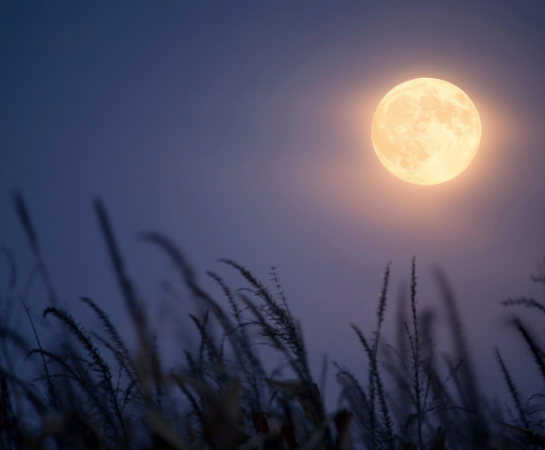
What Is a Harvest Moon and Why It Rises at Almost the Same Time Several Nights Running
On most nights of the year, the Moon rises roughly 50 minutes later than it did the night before. Around the Harvest Moon, that gap collapses to as little as 10 minutes in parts of the UK and Canada, and rarely more than 30 minutes
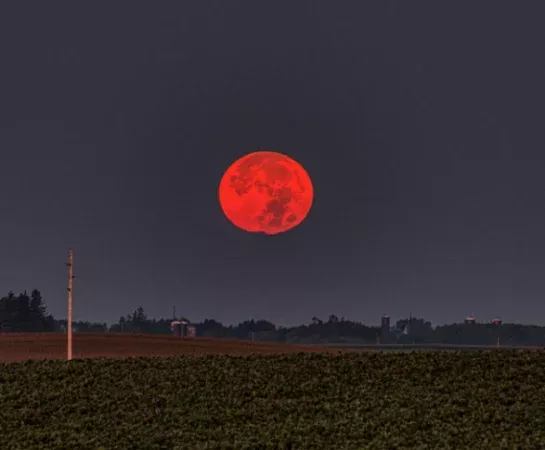
What Is a Blood Moon and Why Does the Moon Turn Red
On the night of August 27, 2026, the Moon came within a hair of disappearing entirely. Earth's shadow covered 96.2% of its surface, a partial eclipse so deep that skywatchers across the Americas, Europe, and Africa watched it turn a rusty, almost total red without

India vs US Time Difference: Why the Gap Changes Twice a Year
For most of the year, India is 9 hours 30 minutes ahead of New York. From November 1, 2026 to March 14, 2027, it is 10 hours 30 minutes ahead. India's clocks do not change in either case. The whole difference comes from the United

Why Israel Changes Its Clocks on a Different Schedule Than Europe
Israel's clocks now fall back on the same day the European Union's do, the last Sunday of October, a deliberate alignment written into a 2013 law. But the two systems still don't match. Israel springs forward on the Friday before the EU's last Sunday of

Why North Korea Changed Its Time Zone Twice in One Decade
North Korea turned its clocks back 30 minutes on August 15, 2015, breaking from South Korea and Japan to create its own "Pyongyang Time," then reversed the entire move less than three years later, on May 5, 2018, realigning with Seoul again. Both changes were

Why India’s Time Zone Is Exactly 5:30 Off UTC
India runs on a single clock from the Arabian Sea to the Myanmar border, a stretch of roughly 3,000 kilometers, and that clock sits at a UTC offset almost nobody outside the region can round off in their head. UTC+5:30 isn't a rough approximation or
Time Tools
Quick access to timers, stopwatch, world clock and time zone tools.
Time Guides
Read useful guides about time zones, calendars, finance and astronomy.


