Major Airports in Faroe Islands
- Vágar Airport (FAE) - 00:23:26
Daylight saving time changes in Faroe Islands
Faroe Islands has 1 listed IANA time zones. 1 of them observe daylight saving time changes in 2026.
Next change: October 25, 2026
Clock moves back from 02:00 to 01:00 local time.
Best Time to Call Faroe Islands
Business hours in Faroe Islands (9 AM–5 PM local time) fall at these local times elsewhere:
- Beijing: 4:00 PM – 12:00 AM (next day) ( Partial overlap)
- Paris: 10:00 AM – 6:00 PM ( Convenient)
- Toronto: 4:00 AM – 12:00 PM ( Outside normal hours)
- Seoul: 5:00 PM – 1:00 AM (next day) ( Partial overlap)
- Mexico City: 2:00 AM – 10:00 AM ( Outside normal hours)
- Cairo: 11:00 AM – 7:00 PM ( Convenient)
- Bangkok: 3:00 PM – 11:00 PM ( Partial overlap)
Times shown reflect current UTC offsets and may shift by up to an hour around daylight saving transitions.
Time Difference from Faroe Islands
Compare time in Faroe Islands with other countries.
Countries in the Same Time Zone as Faroe Islands
Most Popular Cities in Faroe Islands
Holidays in Faroe Islands
Official national public holidays. Regional and religious observances may vary by area.
About Time in Faroe Islands
October Starts a Three-to-Five-Month Clock Inside the Hjallur
In the Faroe Islands, one of the most distinctive ways of measuring time happens inside a wooden drying house. After sheep are slaughtered in autumn, cuts of mutton are hung in a ventilated hjallur, where they pass through a sequence of fermentation and drying controlled not by a thermostat or fixed recipe but by wind, humidity and temperature.
Ethnobiological research describes three traditional stages. The first, visnaður, begins after only a few days as the surface starts to dry. The second stage, ræstur, is less predictable. The meat has become fermented and semi-dry, with the strong aroma and flavor regarded locally as desirable. This stage is often reached around Christmas. Full drying produces skerpikjøt, generally after a total process of roughly three to five months.
Those intervals cannot simply be programmed on a calendar. October, when autumn slaughter traditionally begins the process, has an average temperature around 7 degrees Celsius, but actual conditions can range far above or below that value. If the early drying period is too cold, fermentation develops differently and flavor suffers. If it is too warm, undesirable microbial growth can make the meat unsafe. Humidity and airflow also determine whether the surface dries quickly enough while fermentation continues inside.
This is why two pieces of mutton hung on the same nominal date in different years may not become ræst on exactly the same day. Faroese food knowledge requires reading the state of the meat together with the weather. Smell, texture, surface appearance and the conditions inside the hjallur all matter more than simply counting weeks.
The technique grew out of an island economy in which fresh food availability changed strongly through the seasons and salt was not traditionally the principal preservation method for meat. Before household freezers became widespread in the late 1960s and early 1970s, wind drying and fermentation transformed the autumn slaughter into protein that could be stored and eaten through later parts of the year.
Fish followed a related but faster clock. Research on ræstur fiskur records fish becoming fermented after roughly two to three weeks under favorable conditions. Summer and early autumn were often avoided because warm, humid weather increased the risk of fly larvae. Faroese even had a term for unsuitable muggy conditions, maðkarveður, literally weather associated with maggots.
The preservation system therefore turned weather itself into a processing instrument. A modern refrigerator maintains a chosen environment continuously. The hjallur does the opposite: it exposes food to the surrounding North Atlantic air, and the producer succeeds by understanding when that changing air has carried the meat from one stage to the next.
On 1 December 2020, a Subsea Kite Sent Tidal Electricity into the Faroese Grid
Between the islands, time can be measured by another repeating process: tidal currents. Narrow sounds accelerate the movement of water between different parts of the archipelago, creating strong streams whose direction and speed change through the tidal cycle.
That predictability has made the Faroes a testing ground for an unusual form of renewable energy. In Vestmannasund, the strait between Streymoy and Vágar, a subsea device developed by Minesto does not sit stationary like a conventional underwater turbine. It behaves more like a kite flying in a current.
The wing is tethered to the seabed and steered autonomously through a figure-eight trajectory. Hydrodynamic lift drives it across the flow much faster than the surrounding water itself. A turbine mounted on the wing therefore encounters a higher relative water speed, and the electricity travels through the tether and subsea cable toward shore.
During commissioning in 2020, the 100-kilowatt DG100 system became the first tidal kite of its kind to supply electricity to the Faroese grid. Utility company SEV announced the milestone on 1 December after installation and commissioning work had begun during the autumn.
The significance of tidal generation lies partly in its clock. Wind can weaken unexpectedly and clouds can interrupt solar production, but astronomical forcing makes the broad timing of tides predictable far in advance. Output still varies through each cycle because current speed rises, reaches a maximum and falls again before reversing direction, but the recurrence itself can be forecast.
That creates a different problem for an electricity system. A tidal plant does not produce a constant block of power, yet its strongest and weakest periods can be anticipated. Grid operators can therefore plan around a renewable source whose variability has a known rhythm.
The experiment did not end with the first connection. A second seabed foundation, cable and shore infrastructure were installed in 2022, and later Dragon-class tidal kites continued operating in Vestmannasund. By summer 2026, an upgraded Dragon 4 had been producing continuously over several months, with the developer reporting that actual tidal flows at the site were stronger than earlier models had predicted.
The underlying resource has existed for as long as water has moved through the Faroese sounds. What changed in 2020 was the ability to convert that recurring natural timetable directly into synchronized electrical output for an island grid.
14 April Was the Old Date to Watch for Puffins Coming Home
Faroese bird knowledge once attached strikingly specific calendar dates to the annual return of seabirds. The Atlantic puffin provides one of the clearest surviving examples. The Faroe Marine Research Institute records an old expectation that puffins returned around summarmáli, 14 April.
Modern biological observations broadly fit that seasonal window. Puffins begin arriving at breeding colonies from around mid-April and generally lay a single egg in May. Adults share incubation for about five to six weeks, alternating between the burrow and feeding trips at sea.
Another traditional marker was Syftunsøka on 2 July, historically associated with the period when the chick was expected to be approaching fledging. The actual date varies with food conditions and the timing of laying, so the traditional calendar should not be read as an exact biological deadline. It records the part of the year in which generations of observers expected a particular stage of the breeding cycle.
By mid-August, the seasonal transformation is largely complete. Faroese research describes adults and young leaving the land and dispersing over the North Atlantic. Surveys show just how dramatic the change can be. Historical estimates found about 1.31 million puffins in the wider Faroese marine study area during June through August, compared with only tens of thousands during autumn and very few through winter.
The bird therefore divides the Faroese year into two radically different landscapes. In summer, cliffs and slopes contain dense colonies and surrounding waters become feeding grounds for breeding adults. In winter, those same nesting sites are largely empty while the birds remain far out at sea.
Long-term counts have also turned this seasonal rhythm into a scientific time series. On Skúvoy, seabirds have been counted for more than half a century. Data beginning in the early 1970s show major long-term declines and sharp changes in puffin and guillemot abundance, particularly around the late 1980s and early 2000s, alongside periods of partial recovery.
That record makes the old dates useful in a new way. A traditional observer wanted to know when birds would return. Modern researchers ask whether they return in the same numbers, whether breeding succeeds and whether shifts in ocean productivity and prey availability are changing a cycle that once seemed dependable enough to attach to named days.
The Dancing Year Begins in October and Stops at Shrovetide
The Faroese chain dance has no instrumental accompaniment. The rhythm comes from voices, feet and the long narrative ballads known as kvæði. Its traditional calendar is equally distinctive: the National Museum of the Faroe Islands describes a regular dancing season extending from October until Shrovetide.
That timing places the dance in the darkest part of the North Atlantic year. Rather than being a festival performed on one annual date, it historically belonged to repeated winter gatherings. Long ballads could contain hundreds of verses, and the chain could continue as the lead singer carried the narrative forward while everyone joined the refrain.
The leader controls more than the text. Pace and movement have to remain coordinated through changes in narrative intensity, and the chain responds collectively. There is no separate drummer or orchestra keeping external time. The temporal structure of the performance is generated by the sung verse and the recurring steps themselves.
Lent traditionally interrupted the dancing season. That creates a cultural year with a clear opening and closing interval: regular chain dancing from autumn through winter, then a pause associated with the religious calendar. Contemporary associations preserve this pattern, with organized sessions often beginning in October and continuing until the fast.
Ólavsøka adds a different exception. During the national celebrations in Tórshavn at the end of July, chain dancing takes place in the middle of the bright summer season. After the communal midnight singing as 29 July begins, people can continue into traditional dancing. The occasion reverses the usual seasonal logic by moving a winter-associated practice into one of the year's brightest periods.
The survival of the dance is also a form of chronological storage. Many ballads preserve narratives that circulated orally across generations before being systematically written down. Their performance does not merely remember old texts. Each repetition requires singers to reproduce sequence, melody and hundreds of lines in the correct order while a group converts that remembered sequence into movement.
For About Two Minutes in 2015, the Faroes Were One of the Few Inhabited Places Inside the Moon's Shadow
On 20 March 2015, the Faroe Islands briefly occupied a rare astronomical position. A total solar eclipse crossed the North Atlantic, but the Moon's umbra touched very little inhabited land. NASA's reconstruction shows the Faroe Islands and Svalbard inside the path of totality while the rest of Europe experienced only a partial eclipse.
The geometry was unusually favorable for the archipelago. Greatest eclipse globally occurred at 09:46:47 UTC, with a maximum central duration of approximately 2 minutes 47 seconds over the North Atlantic. The center line passed close enough to the Faroes for observers there to experience roughly two minutes of complete darkness, with local duration varying by position.
The event had been predictable to the second long before anyone knew whether Faroese weather would cooperate. That contrast is especially sharp in an archipelago famous for rapidly changing cloud, fog and rain. Celestial mechanics could specify when the shadow would arrive, but no astronomical calculation could guarantee that an observer standing underneath it would see the Sun.
As the eclipse approached, the solar disc gradually disappeared. Totality itself compressed the most dramatic physical changes into a tiny interval: direct sunlight vanished, the sky darkened, temperature and illumination fell, and the solar corona became visible wherever cloud permitted.
Spacecraft observed the event on a completely different scale. ESA's Proba-V satellite recorded the eclipse shadow moving across Europe, while the umbra swept over the North Atlantic and the Faroese archipelago. A person on the ground experienced darkness for minutes; from orbit, the same event appeared as a moving region of reduced illumination crossing thousands of kilometers.
The eclipse did not create a lasting local calendar in the way puffin breeding or the winter dance season does. Its significance is almost the opposite. Tides, birds, fermentation and cultural seasons return. Totality at one specific island is rare. On 20 March 2015, an event calculated through long astronomical cycles intersected the Faroes for only a few minutes and then moved on.
Frequently Asked Questions
How many time zones does Faroe Islands have?
One. The whole of Faroe Islands follows Atlantic/Faroe, so every city shows the same local time as the capital, Tórshavn.
Is Faroe Islands ahead of or behind GMT?
Faroe Islands is currently 1 hour ahead of GMT (UTC+1).
Does Faroe Islands use summer time?
Yes. Tórshavn uses UTC+0 (WET) in standard time and UTC+1 (WEST) during daylight saving time, and is currently on summer time.
How many public holidays does Faroe Islands have in 2026?
Faroe Islands has 14 national public holidays in 2026, when banks and government offices are usually closed. Some regions may also have their own local holidays.
How do I dial a phone number in Faroe Islands from abroad?
From a mobile phone, type +298 and then the local number without the leading 0 used for domestic calls, if it has one. From a landline, replace the plus sign with your exit code: 011 from the US and Canada, or 00 from most of Europe, for example 00 298 followed by the number.
What language is spoken in Faroe Islands?
The main languages of Faroe Islands are Faroese and Danish.
Beyond the Clock

Options Expiration Time: When Do Options Actually Expire
Ask five options traders when a contract expires and you'll likely get three different answers, and all three will sound confident. Some will say 4:00 PM. Others will say 4:15 PM. A few old-timers will insist it's actually Saturday. All of them are half right,

Best Time to Trade Silver: When the Market Actually Moves
The single best window to trade silver runs from roughly 8:30 a.m. to noon Eastern time, when London's afternoon session overlaps with the COMEX floor in New York and the day's biggest US economic releases land at 8:30 a.m. sharp. That much silver shares with
What Time Does the Stock Market Open in Your Time Zone
The New York Stock Exchange opens at 9:30 AM. That single fact is true every trading day of the year, and it's also close to useless on its own, because 9:30 AM Eastern Time lands at a different clock reading in nearly every other country
Circuit Breakers: How Long Does the Market Pause When It Crashes
On April 7, 2025, the S&P 500 swung 8.5% in a single session, one of the widest intraday ranges since March 2020. It closed down just 0.2%. No circuit breaker fired. Five years earlier, in March 2020, the same index tripped the exact same 7%

Why the Moon’s Phases Don’t Actually Change Its Size
A thin crescent looks small enough to disappear. A full moon looks like it's swelling on the horizon. Neither impression is true. The Moon's diameter is 3,474 kilometers on every night of the month, whether it's a sliver or a full disc, and nothing in
Why Saturn’s Rings Are Disappearing From View in 2025 and 2026
Saturn's rings turned edge-on to Earth on March 23, 2025, at 12:04 p.m. EDT, and for weeks the planet looked like a plain yellow ball through backyard telescopes. This is not decay or destruction. It is a geometric alignment called a ring plane crossing, and
What Is a Harvest Moon and Why It Rises at Almost the Same Time Several Nights Running
On most nights of the year, the Moon rises roughly 50 minutes later than it did the night before. Around the Harvest Moon, that gap collapses to as little as 10 minutes in parts of the UK and Canada, and rarely more than 30 minutes
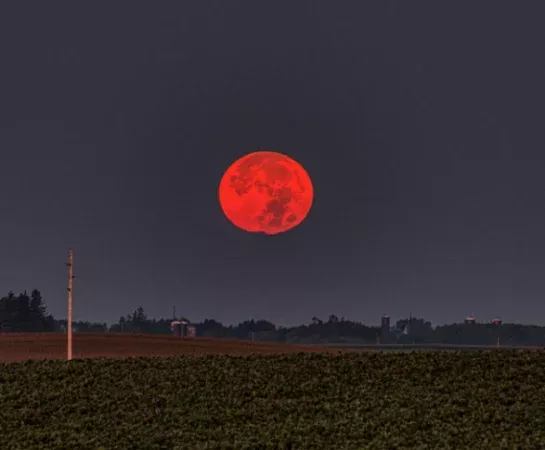
What Is a Blood Moon and Why Does the Moon Turn Red
On the night of August 27, 2026, the Moon came within a hair of disappearing entirely. Earth's shadow covered 96.2% of its surface, a partial eclipse so deep that skywatchers across the Americas, Europe, and Africa watched it turn a rusty, almost total red without
Time Tools
Quick access to timers, stopwatch, world clock and time zone tools.
Time Guides
Read useful guides about time zones, calendars, finance and astronomy.


