Major Airports in Togo
- Lomé–Tokoin International Airport (LFW) - 23:37:43
Daylight saving time in Togo
Togo has 1 listed IANA time zones. None of them observe daylight saving time in 2026. The UTC offset remains stable throughout the year.
Best Time to Call Togo
Business hours in Togo (9 AM–5 PM local time) fall at these local times elsewhere:
- Beijing: 5:00 PM – 1:00 AM (next day) ( Partial overlap)
- Paris: 11:00 AM – 7:00 PM ( Convenient)
- Toronto: 5:00 AM – 1:00 PM ( Outside normal hours)
- Seoul: 6:00 PM – 2:00 AM (next day) ( Partial overlap)
- Mexico City: 3:00 AM – 11:00 AM ( Outside normal hours)
- Cairo: 12:00 PM – 8:00 PM ( Partial overlap)
- Bangkok: 4:00 PM – 12:00 AM (next day) ( Partial overlap)
Times shown reflect current UTC offsets and may shift by up to an hour around daylight saving transitions.
Time Difference from Togo
Compare time in Togo with other countries.
Countries in the Same Time Zone as Togo
Most Popular Cities in Togo
Holidays in Togo
Official national public holidays. Regional and religious observances may vary by area.
About Time in Togo
April 27, 1960: Togo Becomes a Sovereign State
Togo's road to independence ran through two different colonial administrations. What had been the German protectorate of Togoland was split between Britain and France after German defeat in the First World War, and the French administered zone, known as French Togoland, gradually gained self government through the 1950s, becoming an autonomous republic within the French Union in 1956. Elections in April 1958 favored full independence over continued association with France, bringing Sylvanus Olympio and his party to power as the territory prepared for full sovereignty.
Togo formally became an independent state on April 27, 1960, with Olympio as its first head of government. The Independence Monument in the capital, Lomé, was erected that same day to mark the occasion, and April 27 has been observed as the country's national day ever since. The neighboring British administered zone of Togoland took a different path, voting to join the Gold Coast rather than become independent on its own, and became part of Ghana when that country achieved independence in 1957, permanently dividing the historic Togoland region between two modern states.
A Door Facing the Winter Sunset: Timekeeping in Koutammakou's Earthen Towers
In the Koutammakou region of northeastern Togo, the Batammariba people build distinctive two story mud tower houses known as takienta, structures so architecturally striking that UNESCO inscribed the surrounding landscape as a World Heritage Site in 2004. Each takienta is laid out with clear symbolic and directional meaning, its various parts compared by the Batammariba themselves to parts of the human body, and the dwellings often carry a masculine orientation to the south and a feminine orientation to the north.
Tradition also requires that a takienta's main door always face west, deliberately aligned to represent the setting sun on the winter solstice, embedding a specific astronomical moment directly into the architecture of everyday family life. Because a takienta is considered to have a natural lifespan, older structures are regularly retired and their earthen material folded into new construction, so that the community's relationship to this solar orientation is renewed with each generation rather than fixed permanently in any single building. The rhythm of village life is further marked by initiation ceremonies tied to the stages of youth and adulthood, reinforcing a broader calendar of communal ritual layered on top of the solar alignment built into the houses themselves.
The Cathedral That Once Worked as a Lighthouse
Completed in 1902 during the period of German colonial rule, the Cathedral of the Sacred Heart in Lomé is one of the oldest surviving landmarks of the city and a striking example of neo Gothic architecture built with imported European materials on the West African coast. For several decades the cathedral served a second, more practical function beyond its religious one.
During the 1930s and 1940s, a navigational range light was mounted on the cathedral's northwest tower, helping ships approaching Lomé's harbor line up safely with a second light closer to the wharf. This dual role, sacred building by day and maritime timekeeping aid by night, reflected how few dedicated navigational structures the young colonial port possessed, making the cathedral's tower a practical stand in for a proper lighthouse at a moment when precise, reliable signals mattered enormously to ships trying to time their approach to the coast safely.
One Week in July: The Evala Wrestling Festival
Every year in mid July, the town of Kara in northern Togo and its surrounding villages fill with drumming, singing and crowds gathered to watch young men of the Kabye ethnic group take part in Evala, a wrestling competition that doubles as a rite of passage into adulthood. Participants, typically between about eighteen and twenty years old, spend the preceding week isolated from their families, undergoing physical and mental preparation alongside a series of ritual obligations before the public matches begin.
The timing of Evala is fixed each year to this same narrow window in July, giving the festival a predictable place in the annual calendar that draws visitors from across Togo and increasingly from abroad. Togolese officials have in recent years sought recognition of Evala on UNESCO's list of intangible cultural heritage, and the tradition carries real political weight in the country, since several of Togo's modern leaders, including two successive presidents from the Kabye community, are known to have gone through the initiation themselves in their youth.
Eighty Years on One Peg: The CFA Franc
On December 26, 1945, France ratified the Bretton Woods Agreement and declared a new currency for its African colonies, the CFA franc, which Togo has used continuously ever since, first as a colony and then as an independent state after 1960. From the very beginning the currency was defined by a fixed exchange rate guaranteed by the French treasury rather than by markets, an arrangement intended to spare the colonies the effects of a French currency devaluation happening at the same moment.
Remarkably, that fixed rate has been formally changed only twice in eighty years, once in 1948 and again in 1994, along with a purely technical adjustment when France itself switched from the franc to the euro. Supporters argue this extraordinary long term stability has shielded Togo and its neighbors from the currency volatility and runaway inflation seen elsewhere in the region, while critics counter that tying monetary policy to a fixed external rate for eight decades has limited the flexibility Togo might otherwise have to adjust its own economy, a debate that continues alongside ongoing proposals to replace the CFA franc with a new regional currency.
The Assassination of Sylvanus Olympio
Sylvanus Olympio, an Ewe businessman educated at the London School of Economics who had risen to lead the Unilever company's operations across West Africa before turning to politics, became Togo's first prime minister in 1958 and its first president when the office was created in 1961. His government's refusal to absorb a large group of demobilized soldiers returning from French colonial wars into Togo's small national army left him with dangerous enemies inside the very military meant to protect him.
In the early hours of January 13, 1963, a group of these soldiers, led by Emmanuel Bodjolle and Sergeant Etienne Eyadema, moved against the presidential residence near Lomé's Atlantic shoreline. Olympio fled on foot and was shot dead before dawn outside the gate of the United States embassy in Lomé, making him the first head of state assassinated in a coup anywhere in postcolonial Africa. The coup installed Nicolas Grunitzky as president, while Eyadema, one of the soldiers involved that night, would himself seize power in a later, bloodless coup in 1967 and go on to rule Togo for nearly four decades.
Frequently Asked Questions
How many time zones does Togo have?
One. The whole of Togo follows Africa/Lome, so every city shows the same local time as the capital, Lomé.
Is Togo ahead of or behind GMT?
Neither. Togo currently keeps the same time as GMT (UTC+0).
Does Togo use summer time?
No. Togo does not observe daylight saving time, so its clocks stay at UTC+0 all year. Its time difference with countries that do change their clocks still shifts by an hour in spring and autumn.
How many public holidays does Togo have in 2026?
Togo has 13 national public holidays in 2026, when banks and government offices are usually closed. Some regions may also have their own local holidays.
How do I dial a phone number in Togo from abroad?
From a mobile phone, type +228 and then the local number without the leading 0 used for domestic calls, if it has one. From a landline, replace the plus sign with your exit code: 011 from the US and Canada, or 00 from most of Europe, for example 00 228 followed by the number.
What language is spoken in Togo?
The main languages of Togo are French, Ewe and Hausa.
Beyond the Clock

The Planning Fallacy: Why Tasks Take Longer Than You Expect and How to Correct It
In a 1994 study, 37 psychology students estimated how long it would take them to finish their honors theses. Their average answer was 33.9 days. They also gave a best-case estimate, 27.4 days on average, and a worst-case estimate, "if everything went as poorly as

What the Research Actually Says About the “23 Minutes to Refocus” Claim
"It takes 23 minutes and 15 seconds to refocus after an interruption" shows up in productivity apps, management slide decks, and posts about deep work. The figure is real, and it comes from a serious researcher. It does not mean what it is usually taken

Why the 40-Hour Work Week Exists: From 10-Hour Days to Ford’s 1926 Experiment
The 40-hour week looks like a natural unit of work, but the number was never derived from a measurement of how much work is best. It is the product of two separate fights: one over the length of the day, which ended at eight hours,

How Americans Spend Their 24 Hours: What the Time Use Survey Shows
The average American age 15 and over logs about 9 hours of sleep a day, spends just over 5 hours on leisure and works 3 hours. That last number looks wrong until you see how it is built, and nearly every headline figure from the

Why the Earliest Sunset Comes Before the Winter Solstice
In New York, the Sun sets earliest on Monday, December 7, 2026, at about 4:28 PM. The shortest day comes two weeks later. The solstice falls at 20:50 UTC on December 21 (3:50 PM EST), and on that day New York gets roughly 9 hours

When Does Winter Start: Meteorological vs Astronomical Seasons
Winter 2026 starts twice in the Northern Hemisphere. Meteorological winter begins on Tuesday, December 1, 2026. Astronomical winter begins at the December solstice, on Monday, December 21, 2026 at 20:50 UTC, which is 3:50 p.m. Eastern and 12:50 p.m. Pacific. Both answers are correct. They
What Is a Supermoon and When Is the Next One
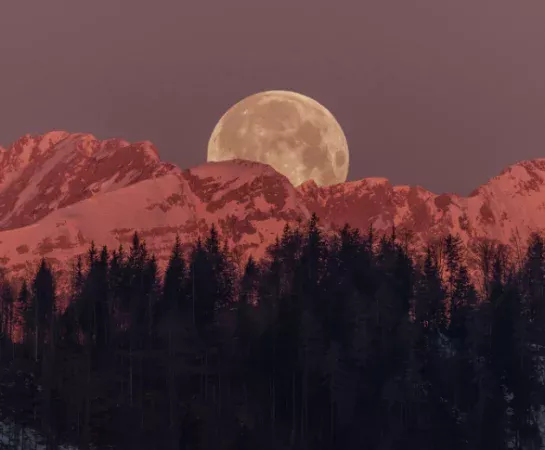
Every time a supermoon rises, the same statistic gets repeated: 14% bigger, 30% brighter. It's in almost every news segment and nearly every listicle, and it's also a comparison almost nobody in the audience will ever actually witness, because it measures the single closest possible

Why the Sky Is Blue During the Day and Black at Night
Sunlight is white. Air is, as far as anyone can tell by looking through a window, colorless. And yet every clear afternoon the same 400,000-kilometer column of gas above your head reads as a specific, saturated blue, then goes black within an hour of sunset.
Time Tools
Quick access to timers, stopwatch, world clock and time zone tools.
Time Guides
Read useful guides about time zones, calendars, finance and astronomy.


