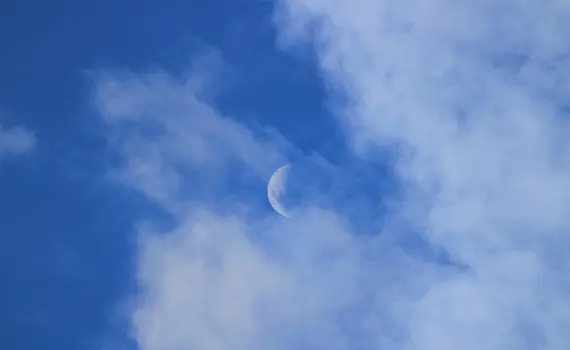
Seeing the Moon in daylight can feel strange because people often think of the Moon as something that belongs to the night. In reality, the Moon is not tied to nighttime. It is visible whenever three conditions come together: it is above the horizon, it is bright enough to stand out against the sky, and the Sun is lighting the part of the Moon that faces Earth.
The Moon does not disappear during the day. Most of the time, it is simply harder to notice because the daylight sky is bright. When the Moon’s position, phase, and brightness are favorable, it can appear clearly in the blue sky, sometimes for several hours before sunset or after sunrise.
This makes the daytime Moon a useful reminder that the sky is not divided into separate day and night objects. The Sun, Moon, planets, and stars are all part of the same sky. What changes is visibility.
The Moon Is Visible When It Is Above the Horizon
The Moon can appear during the day because part of its orbit regularly places it above the horizon while the Sun is also above the horizon. Daylight does not prevent the Moon from physically being in the sky. It only makes the sky brighter.
The Moon rises and sets at different times throughout the month because it moves eastward in its orbit around Earth. Each day, it generally rises later than it did the day before. That shifting schedule means there are many days when the Moon is up during daylight hours.
This is why the Moon can be visible in the morning on some days and in the afternoon or early evening on others. Its appearance depends less on “day” or “night” and more on where the Moon is in its orbit relative to the Sun and Earth.
The same broader sky geometry affects why sunrise and sunset times change through the year, because what we see in the sky always depends on position, angle, and the observer’s place on Earth.
The Moon can appear in daylight because visibility is not controlled by night alone. It depends on position, phase, brightness, and contrast against the sky. worldtimedata
Why the Moon Does Not Need Darkness to Be Seen
The Moon is visible because it reflects sunlight. It does not produce its own light, but its surface is bright enough to reflect sunlight back toward Earth. At night, that reflected light stands out sharply against a dark background. During the day, the same reflected light must compete with sunlight scattered through the atmosphere.
The main difference between the night Moon and the daytime Moon is not the Moon itself, but the background behind it. A dark sky gives the Moon strong contrast. A bright blue sky reduces that contrast, but it does not always erase it.
If the Moon is high enough, bright enough, and far enough from the Sun in the sky, it can still be visible in daylight. That is why the daytime Moon often looks pale or washed out rather than bright white. It is not weaker in itself; it is being seen against a brighter background.
Why Some Moon Phases Are Easier to See in Daylight
The Moon’s phase plays a major role in daytime visibility. Around the first quarter and last quarter phases, the Moon is often far enough from the Sun in the sky to be visible while still reflecting enough sunlight to stand out. These phases are among the easiest times to spot the Moon during the day.
A waxing crescent can sometimes be visible after sunrise or before sunset, but it is thinner and less bright. A gibbous Moon can also be seen in daylight when conditions are favorable. The full Moon, however, is less commonly seen high in the daytime sky because it is generally opposite the Sun: it rises near sunset and sets near sunrise.
This is why the full Moon can be misleading. It is visually bright, but its position in the sky usually places it mostly in the night. A half Moon may look less dramatic, but its geometry often makes it easier to see during daylight hours.
The reason is explained by how the Moon’s phases work: the phase is not just about how much of the Moon looks lit, but also about the Moon’s position relative to the Sun and Earth.
Why the Daytime Moon Looks Pale
The daytime Moon often looks faint because the atmosphere scatters sunlight across the sky. That scattered sunlight creates the blue background we see during the day. Against that bright background, the Moon has less contrast than it does at night.
This is why the Moon can be obvious one moment and nearly invisible a few minutes later. Thin clouds, haze, humidity, glare, or the Moon’s distance from the Sun in the sky can change how easily the eye picks it out.
The Moon is usually easiest to see during the day when the sky is clear, the Moon is higher above the horizon, and it is not too close to the Sun. Looking too near the Sun is dangerous and should be avoided, but the general point is that separation matters: the farther the Moon appears from the Sun, the easier it can be to notice.
Daytime visibility is therefore a question of contrast. The Moon has to be bright enough compared with the sky around it. At night, that is easy. During the day, it depends on atmospheric conditions and geometry.
Why the Moon Rises Later Each Day
The Moon’s changing daily schedule comes from its orbit around Earth. As it moves eastward along its orbit, Earth must rotate a little farther each day before the Moon appears in the same part of the sky. That is why moonrise usually happens later from one day to the next.
This shifting schedule creates the pattern people notice: sometimes the Moon is visible after sunset, sometimes late at night, sometimes before sunrise, and sometimes during the day. There is no fixed “Moon time” that repeats every 24 hours in the same way.
This is also why the daytime Moon is not rare. It is a normal part of the Moon’s monthly cycle. People miss it because they are less likely to scan the sky during the day, and because the Moon can be pale against the bright atmosphere.
Why You Usually Cannot See Stars During the Day
The Moon can sometimes be visible in daylight because it is relatively close to Earth and reflects enough sunlight to stand out. Most stars are far too faint to compete with the daytime sky. They are still above the horizon at certain times, but the scattered sunlight in Earth’s atmosphere overwhelms them.
This helps explain why the daytime Moon is possible while the daytime stars are usually invisible. Visibility is not only about whether an object exists in the sky. It is about how much light reaches the eye compared with the brightness of the background.
The Moon is bright enough to cross that threshold under the right conditions. Most stars are not.
Why the Daytime Moon Connects Astronomy With Everyday Time
The daytime Moon is one of the easiest astronomical events to overlook because it happens in plain sight. It does not require a telescope, a rare alignment, or a special event. It only requires looking up at the right time.
That makes it a useful example of how astronomical time appears in ordinary life. The Moon’s phase, rise time, position, and visibility are all part of a repeating celestial cycle, but the result feels immediate and visual: a pale Moon hanging in a blue sky.
The deeper lesson is that day and night are not separate sky systems. They are different lighting conditions on the same moving Earth. The Moon can belong to daylight because the Moon is not controlled by darkness. It is controlled by orbit, sunlight, and geometry.
The Moon Was Never Only a Night Object
The Moon appears during the day because it is often above the horizon while the Sun is also up. Its visibility depends on phase, reflected sunlight, separation from the Sun, atmospheric clarity, and contrast against the bright sky.
That is why a daytime Moon can look surprising even though it is completely normal. The Moon has not appeared in the wrong part of the day. We are simply seeing a familiar object under different lighting conditions.
The night sky makes the Moon dramatic. The daytime sky makes it subtle. Both views come from the same simple fact: the Moon is always moving around Earth, whether we remember to look for it or not.