Days in Alofi are currently getting longer, about 6 minutes longer than a week ago.*
* Calculated from sunrise and sunset times; actual visible daylight can vary slightly with weather, elevation and atmospheric conditions.
Key Facts About Time in Alofi
- One of the last large cities in the world to start each new day.
- Its antipode, the point exactly opposite on Earth, is on land, in Niger.
- Has never used daylight saving time.
- Replaced local solar time with a standard time zone on 1 July 1964.
Time Difference from Alofi
Compare time in Alofi with major cities worldwide.
When the Time Difference with Alofi Changes
Clocks change on different dates around the world, so the gap between Alofi and these places is not the same all year. Next 12 months; dates in Alofi time.
Best Time to Call Alofi
Business hours in Alofi (9 AM-5 PM local time) fall at these local times elsewhere:
- New York: 3:00 PM - 11:00 PM ( Partial overlap · 2 h shared)
- Los Angeles: 12:00 PM - 8:00 PM ( Partial overlap · 5 h shared)
- London: 8:00 PM - 4:00 AM (next day) ( Outside normal hours)
- Dubai: 12:00 AM (next day) - 8:00 AM (next day) ( Outside normal hours)
- Mumbai: 1:30 AM (next day) - 9:30 AM (next day) ( Partial overlap · 30 min shared)
- Tokyo: 5:00 AM (next day) - 1:00 PM (next day) ( Partial overlap · 4 h shared)
- Sydney: 7:00 AM (next day) - 3:00 PM (next day) ( Convenient · 6 h shared)
in Alofi today, it is:
- New York: 6:00 PM outside working hours
- Los Angeles: 3:00 PM working hours
- London: 11:00 PM night
- Dubai: 3:00 AM (next day) night
- Mumbai: 4:30 AM (next day) night
- Tokyo: 8:00 AM (next day) outside working hours
- Sydney: 10:00 AM (next day) working hours
Times are for today. Clock changes shift them on some dates: see when the time difference changes.
Public Holidays Affecting Alofi
Official national holiday observed in Niue.
Daylight saving time in Alofi
Alofi uses the IANA time zone identifier Pacific/Niue. The current local offset is UTC-11 / -11.
Alofi does not observe daylight saving time in 2026. The UTC offset remains stable throughout the year.
Time Zone History of Alofi
Alofi follows the Pacific/Niue time zone. According to the IANA time zone database, these are the standard times it has used:
- Until 1 July 1964: local mean time, UTC−11:20
- From 1 July 1964: UTC−11, the current standard time
Alofi has never used daylight saving time.
About Time in Alofi
Alofi, the capital of Niue, uses UTC−11 all year with no daylight saving time. The small island in the South Pacific shares this offset with American Samoa and Midway, and is among the last inhabited places on Earth to finish each calendar day.
Twenty Minutes Off the Hour
Niue kept one of the rarest offsets in the world well into the 1960s. Under New Zealand administration, the Cook Islands Amendment Act 1952 set Niue's standard time at 11 hours 20 minutes behind Greenwich, very close to the island's natural local time.
The move to a whole-hour offset came later. A further Cook Islands Amendment Act in 1962 changed Niue's standard time, and the time zone database now dates the switch to UTC−11 to about 1 July 1964, when clocks moved forward 20 minutes.
A Date Corrected in 2021
For years the database placed that change in 1978. In 2021 a contributor checking editions of The Air Almanac, a navigation publication, found Niue still listed at UTC−11:20 in April 1964 but at UTC−11 by August 1964. The record was corrected, and mid-1964 is now used as the best estimate. It is a small example of how the history of time zones is still being reconstructed from printed sources.
Last to See the Sunset
Alofi lies on the west coast of the island at about 169.9 degrees West, so its natural solar time is about 11 hours 20 minutes behind Greenwich. On UTC−11 the clock runs roughly 20 minutes ahead of the sun. Solar noon falls between about 12:03 in late October and 12:33 at the end of January.
At 19.1 degrees South, inside the tropics, the longest day in December lasts about 13 hours 19 minutes, with the latest sunset around 19:04 in early January. In June the day is about 11 hours 1 minute long and sunrise comes as late as 06:52.
Time Differences From Alofi
- Pago Pago: always the same time.
- Avarua and Honolulu: 1 hour ahead.
- Auckland: 23 hours ahead in the New Zealand winter, 24 hours in summer, so the clock reads the same hour on the next day.
- Apia: 24 hours ahead, the same clock time one calendar day later.
- Los Angeles: 3 hours ahead in winter, 4 hours in summer.
Sun & Daylight in Alofi
Alofi lies at 19.05° S, 169.92° W in the Southern Hemisphere and the Western Hemisphere, about 2,121 km (1,318 mi) from the Equator, in the tropical latitude zone.
Sun Time vs Clock Time
Standard time in Alofi, UTC−11, is based on the 165° W meridian, while the city lies at 169.92° W. So on standard time the clock runs about 20 minutes ahead of local solar time.
Solar noon, the moment the sun is highest in the sky, comes as early as 12:03 (around November 2) and as late as 12:33 (around February 10) by the local clock.
Golden Hour & Blue Hour Today
Approximate times from today's sunrise and sunset; the light itself depends on weather.
Airport Serving Alofi
Niue International Airport (IUE / NIUE) is the main airport serving Alofi: a regional airport about 3 km (2 mi) from the city centre.
Current local time at the airport is 12:25:58.
Antipode of Alofi
The point on Earth exactly opposite Alofi lies at 19.05° N, 10.08° E, on land in Niger. The nearest populated place is Arlit, Niger, about 290 km away. The nearest major city is Kano, Nigeria, about 800 km away.
When it is noon by the sun in Alofi, it is midnight by the sun at its antipode.
Frequently Asked Questions
What time zone is Alofi in?
Alofi follows the Pacific/Niue time zone, the official IANA identifier used by computers and databases worldwide to track local time accurately. Right now, this puts Alofi at UTC-11.
What time is it in Alofi right now?
The current local time in Alofi is 12:25:58 on Saturday, 21 November 2026. The clock at the top of this page shows the live time and updates every second.
Does Alofi observe daylight saving time?
No. Alofi stays on UTC-11 all year and does not change its clocks.
How far ahead or behind UTC is Alofi?
Alofi is currently UTC-11, meaning local time is 11 hours behind Coordinated Universal Time (UTC).
Has Alofi ever used daylight saving time?
No. According to the IANA time zone database, clocks in Alofi have never been moved forward for summer.
Which airport serves Alofi?
Niue International Airport (IUE) is the main airport serving Alofi, about 3 km away. The current local time at the airport is 12:25:58.
Beyond the Clock

How Many Seconds Are in a Year? Four Correct Answers
A year has 31,536,000 seconds if it has 365 days and 31,622,400 if it is a leap year. Those are the answers for the calendar on your wall, and for 2026, a common year, the first one is exact. But "a year" means different things

TAI, GPS Time and UTC: Why Three Atomic Time Scales Disagree by Seconds
International Atomic Time (TAI), Coordinated Universal Time (UTC) and GPS time all count the same unit: the SI second, defined by the caesium atom. None of them runs faster than the others. Yet they do not show the same time. TAI runs 37 seconds ahead

How Radio-Controlled Clocks Set Themselves: WWVB, DCF77 and MSF
On the night of October 25, 2026, millions of wall clocks in Europe will move their hands back an hour with nobody touching them. A week later, on November 1, clocks across the United States will do the same (both dates are in our 2026

Why Scheduled Jobs Break at Daylight Saving Time
On Sunday, November 1, 2026, the local time 1:30 AM happens twice in New York. The first 1:30 AM is 05:30 UTC on Eastern Daylight Time. The second is an hour later, 06:30 UTC on Eastern Standard Time. Four and a half months later, on
Why Days Get Shorter Fastest Around the Equinox
In London, the day loses about four minutes of daylight every 24 hours in late September. Three months later, around the winter solstice, it changes by only a few seconds a day. The shortening is not steady, and at most latitudes it is not fastest

Full Moon Names by Month: Where Beaver Moon and Cold Moon Come From
The November 2026 full moon, the Beaver Moon, peaks at 9:53 AM Eastern Time on Tuesday, November 24. The December full moon, the Cold Moon, follows at 8:28 PM Eastern on Wednesday, December 23. In UTC that moment already falls on December 24, so in

Why the Moon’s Phases Don’t Actually Change Its Size
A thin crescent looks small enough to disappear. A full moon looks like it's swelling on the horizon. Neither impression is true. The Moon's diameter is 3,474 kilometers on every night of the month, whether it's a sliver or a full disc, and nothing in
Why Saturn’s Rings Are Disappearing From View in 2025 and 2026
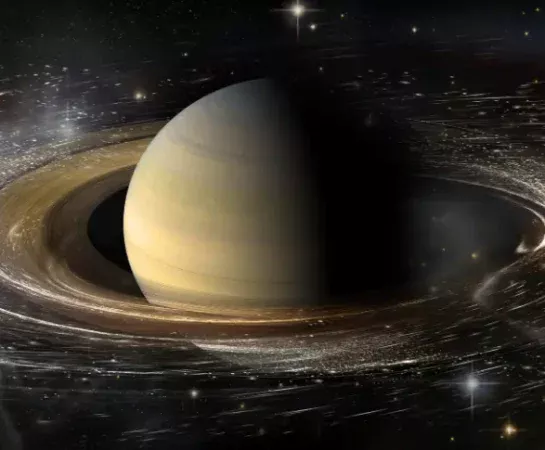
Saturn's rings turned edge-on to Earth on March 23, 2025, at 12:04 p.m. EDT, and for weeks the planet looked like a plain yellow ball through backyard telescopes. This is not decay or destruction. It is a geometric alignment called a ring plane crossing, and


