Current Time in WET (Western European Time)
23:17:52
Saturday, 21 November 2026
Abbreviation:
WET (Western European Time)
UTC Offset:
UTC+0 (GMT+0)
In use:
until 28 March 2027;
the rest of the year WEST, UTC+1
DST:
No
IANA zone:
Europe/Lisbon
About:
WET is used in Faroe Islands, Portugal and Spain; the largest cities on it: Lisbon and Tórshavn.
whole country only part of the country cities on WET
Time Difference from WET (Western European Time)
Compare time in WET (Western European Time) with major cities worldwide.
-8h
-6h
-6h
-5h
-5h
-3h
-3h
Same time
+1h
+1h
+1h
+1h
+2h
+4h
+7h
+8h
+8h
+9h
+11h
When the Time Difference with WET Changes
Clocks change on different dates around the world, so the gap between WET and these places is not the same all year. Next 12 months; dates in Lisbon time.
- 14–28 Mar 2027: the difference with Los Angeles, Chicago, New York and Toronto is 1 hour smaller than usual.
- 31 Oct – 7 Nov 2027: the difference with Los Angeles, Chicago, New York and Toronto is 1 hour smaller than usual.
Los Angeles
-8h most of the year
-7h 14–28 Mar 2027, 31 Oct – 7 Nov 2027
Chicago
-6h most of the year
-5h 14–28 Mar 2027, 31 Oct – 7 Nov 2027
New York, Toronto
-5h most of the year
-4h 14–28 Mar 2027, 31 Oct – 7 Nov 2027
Sydney
+11h until 28 Mar 2027
+10h 28 Mar – 3 Apr 2027
+9h 3 Apr – 2 Oct 2027
+10h 2–31 Oct 2027
+11h from 31 Oct 2027
Lisbon changes its clocks by 1 hour on 28 Mar 2027 and 31 Oct 2027. Mexico City, Sao Paulo, Buenos Aires, Johannesburg, Dubai, Bangkok, Singapore and 2 more keep the same time all year, so the difference with them changes on these dates.
Best Time to Call WET
Business hours on WET (9 AM-5 PM local time) fall at these local times elsewhere:
- New York: 4:00 AM - 12:00 PM ( Partial overlap · 3 h shared)
- Los Angeles: 1:00 AM - 9:00 AM ( Outside normal hours)
- Dubai: 1:00 PM - 9:00 PM ( Partial overlap · 4 h shared)
- Mumbai: 2:30 PM - 10:30 PM ( Partial overlap · 2 h 30 min shared)
- Tokyo: 6:00 PM - 2:00 AM (next day) ( Outside normal hours)
- Sydney: 8:00 PM - 4:00 AM (next day) ( Outside normal hours)
in WET today, it is:
- New York: 7:00 AM outside working hours
- Los Angeles: 4:00 AM night
- Dubai: 4:00 PM working hours
- Mumbai: 5:30 PM outside working hours
- Tokyo: 9:00 PM outside working hours
- Sydney: 11:00 PM night
Times are for today. Clock changes shift them on some dates: see when the time difference changes.
About WET
WET, Western European Time, is UTC+0. It is the winter clock of mainland Portugal, Madeira, the Canary Islands and the Faroe Islands, used from the last Sunday of October to the last Sunday of March.
Portugal's Four Years on Central European Time
Portugal once tried to leave the zone. In 1992 it stayed on UTC+1 when the clocks went back in September, adopting Central European Time to align with Spain and most of the European Community. The change brought very late winter sunrises, after 8:30 in Lisbon, and in October 1996 Portugal returned to WET, where it has stayed since.
The Canaries' Hour
The Canary Islands are part of Spain but keep WET, one hour behind Madrid all year. Spanish television and radio routinely announce times as "una hora menos en Canarias", one hour less in the Canaries.
Converting WET
WET has the same offset as GMT, so in winter Lisbon, Las Palmas and Tórshavn show the same time as London and Dublin. Madrid, Paris and Berlin are one hour ahead; New York is five hours behind.
Beyond the Clock
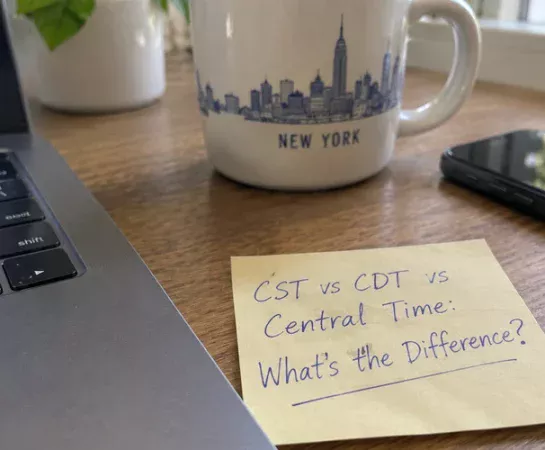
CST vs CDT vs Central Time: What’s the Difference
Central Standard Time (CST) is UTC−6. Central Daylight Time (CDT) is UTC−5. Central Time (CT) is the name of the zone itself, and it means whichever of the two is in force on a given date. The difference matters more than most people realize. In

Why New York and London Are Only Four Hours Apart for One Week
For most of the year, London is five hours ahead of New York. For one week every autumn, and for two or three weeks every spring, the gap is only four hours. In autumn 2026 that week ran from Sunday, October 25, when the United

Why Europe Still Changes Its Clocks Despite Voting to Stop
On Sunday, October 25, 2026, clocks across the European Union will go back one hour, exactly as they have every autumn since the 1980s. That is seven and a half years after the European Parliament voted to end seasonal clock changes by 2021. Many Europeans

India vs US Time Difference: Why the Gap Changes Twice a Year
For most of the year, India is 9 hours 30 minutes ahead of New York. From November 1, 2026 to March 14, 2027, it is 10 hours 30 minutes ahead. India's clocks do not change in either case. The whole difference comes from the United

When to See the Leonid Meteor Shower in 2026
The Leonids reach their regular maximum around 23:45 UTC on November 17, 2026, according to the International Meteor Organization (IMO). For most of the Northern Hemisphere, that makes the best window the hours after midnight on the night of November 17 into the morning of

Civil, Nautical and Astronomical Twilight: What Each One Means
Sunset is not the moment the light goes out. After the Sun drops below the horizon, the upper atmosphere is still sunlit and scatters that light down to the ground, so the sky dims gradually instead of switching off. Astronomers divide this fading into three

Why the Earliest Sunset Comes Before the Winter Solstice
In New York, the Sun sets earliest on Monday, December 7, 2026, at about 4:28 PM. The shortest day comes two weeks later. The solstice falls at 20:50 UTC on December 21 (3:50 PM EST), and on that day New York gets roughly 9 hours

When Does Winter Start: Meteorological vs Astronomical Seasons
Winter 2026 starts twice in the Northern Hemisphere. Meteorological winter begins on Tuesday, December 1, 2026. Astronomical winter begins at the December solstice, on Monday, December 21, 2026 at 20:50 UTC, which is 3:50 p.m. Eastern and 12:50 p.m. Pacific. Both answers are correct. They
Time Tools
All time tools
Time Zone Converter
Compare cities and plan meetings
World Clock
Your cities as live clocks
Time Zones
Abbreviations and UTC offsets
Clock Widget
A free clock for your website
Timer
Countdown with an alarm
Stopwatch
Measure time with laps
Unix Timestamp
Convert epoch time to a date
Age Calculator
Exact age from a date of birth
Days Between Dates
Count the days between two dates
Work Hours
Weekly timecard and payroll hours


