Current Time in UTC-8
15:18:08
Saturday, 21 November 2026
UTC Offset:
UTC-8 (GMT-8)
IANA zone:
America/Los_Angeles
About:
UTC-8 is 8 hours behind UTC.
It is used in Mexico, Pitcairn and United States; the largest cities on it: Los Angeles, Tijuana and San Diego.
Related:
PST
whole country only part of the country cities on UTC-8
Who Uses UTC-8 During the Year
Some countries keep UTC-8 all year. Others reach it only while their clocks are on summer or winter time, so the list of places on UTC-8 changes with the seasons. Next 12 months, in each country's local dates.
All year
Part of the year
- until 14 Mar 2027, from 7 Nov 2027: Mexico, United States
- 14 Mar – 7 Nov 2027: United States
Time Difference from UTC-8
Compare time in UTC-8 with major cities worldwide.
Same time
+2h
+2h
+3h
+3h
+5h
+5h
+8h
+9h
+9h
+9h
+9h
+10h
+12h
+15h
+16h
+16h
+17h
+19h
When the Time Difference with UTC-8 Changes
Clocks change on different dates around the world, so the gap between UTC-8 and these places is not the same all year. Next 12 months; dates in UTC-8 time.
Los Angeles
Same time until 14 Mar 2027
+1h 14 Mar – 7 Nov 2027
Same time from 7 Nov 2027
Chicago
+2h until 14 Mar 2027
+3h 14 Mar – 6 Nov 2027
+2h from 6 Nov 2027
New York, Toronto
+3h until 13 Mar 2027
+4h 13 Mar – 6 Nov 2027
+3h from 6 Nov 2027
London
+8h until 27 Mar 2027
+9h 27 Mar – 30 Oct 2027
+8h from 30 Oct 2027
Paris, Berlin, Madrid, Rome
+9h until 27 Mar 2027
+10h 27 Mar – 30 Oct 2027
+9h from 30 Oct 2027
Sydney
+19h until 3 Apr 2027
+18h 3 Apr – 2 Oct 2027
+19h from 2 Oct 2027
Best Time to Call UTC-8
Business hours on UTC-8 (9 AM-5 PM local time) fall at these local times elsewhere:
- New York: 12:00 PM - 8:00 PM ( Partial overlap · 5 h shared)
- Los Angeles: 9:00 AM - 5:00 PM ( Convenient · 8 h shared)
- London: 5:00 PM - 1:00 AM (next day) ( Outside normal hours)
- Dubai: 9:00 PM - 5:00 AM (next day) ( Outside normal hours)
- Mumbai: 10:30 PM - 6:30 AM (next day) ( Outside normal hours)
- Tokyo: 2:00 AM (next day) - 10:00 AM (next day) ( Partial overlap · 1 h shared)
- Sydney: 4:00 AM (next day) - 12:00 PM (next day) ( Partial overlap · 3 h shared)
in UTC-8 today, it is:
- New York: 3:00 PM working hours
- Los Angeles: 12:00 PM working hours
- London: 8:00 PM outside working hours
- Dubai: 12:00 AM (next day) night
- Mumbai: 1:30 AM (next day) night
- Tokyo: 5:00 AM (next day) night
- Sydney: 7:00 AM (next day) outside working hours
Times are for today. Clock changes shift them on some dates: see when the time difference changes.
Clock and Sun on UTC-8
UTC-8 is set to the sun at 120.0° W, but the places that use it spread far to the east and west of that line, so the sun is highest at very different clock times.
| City (100,000+ people) | Longitude | Sun highest at about |
|---|---|---|
| Eugene (westernmost) | 123.1° W | 12:12 |
| Henderson (easternmost) | 115.0° W | 11:40 |
Between the two, solar noon by the clock differs by about 32 minutes: mornings stay dark longer in Eugene and evenings get dark earlier in Henderson.
Mean solar time from longitude. Over the year the real solar noon moves up to about 16 minutes earlier or later.
Changes to UTC-8 Since 1970
Countries whose standard time moved onto or off UTC-8, newest first. Summer time changes are not counted.
- 1 Nov 2026: Canada (part of the country) moved from UTC−8 to UTC−7
- 1 Nov 2020: Canada (part of the country) moved from UTC−8 to UTC−7
- 20 Jan 2019: United States (part of the country) moved from UTC−8 to UTC−9
- 4 Nov 2018: United States (part of the country) moved from UTC−9 to UTC−8
- 1 Nov 2015: United States (part of the country) moved from UTC−8 to UTC−9
- 8 Mar 2015: Canada (part of the country) moved from UTC−8 to UTC−7
- 27 Apr 1998: Pitcairn moved from UTC−8:30 to UTC−8
- 30 Oct 1983: United States (part of the country) moved from UTC−8 to UTC−9
- 28 Oct 1979: Canada (part of the country) moved from UTC−8 to UTC−7
- 28 Oct 1973: Canada (part of the country) moved from UTC−9 to UTC−8
- 30 Aug 1972: Canada (part of the country) moved from UTC−8 to UTC−7
From the IANA time zone database.
About UTC-8
Pacific Standard Time
UTC−8 is the winter clock of the US West Coast: California, Oregon, Washington and Nevada use Pacific Standard Time from the first Sunday of November to the second Sunday of March. So does the Mexican state of Baja California, which follows the US schedule so that Tijuana keeps the same time as San Diego.
The zone lost its largest Canadian member in 2026. British Columbia stayed on UTC−7 when the clocks went back on 1 November 2026, leaving UTC−8 unused in Canada. Vancouver is now an hour ahead of Seattle in winter.
Pitcairn Island
The only inhabited place that keeps UTC−8 all year is Pitcairn Island, the British territory in the South Pacific settled by the Bounty mutineers in 1790. Its few dozen residents moved from UTC−8:30 to UTC−8 in 1998.
In Summer
From March to November UTC−8 is Alaska Daylight Time, used in Anchorage, Fairbanks and Juneau.
UTC−8 is 8 hours behind London in winter, and 3 hours behind New York all year for the places on Pacific Time. Tokyo is 17 hours ahead of the West Coast in winter.
Beyond the Clock

Election Night 2026: Poll Closing Times Across US Time Zones
On Tuesday, November 3, 2026, the first polls close at 6 p.m. Eastern Time and the last at 1 a.m. Eastern on Wednesday. That seven-hour stretch is not a quirk of state law. Almost every state closes its polls at 7 or 8 p.m. local

Countries That Don’t Use Daylight Saving Time (and the Ones That Recently Quit)
Most of the world never changes its clocks. About 70 countries observe daylight saving time (DST) in at least part of their territory, according to National Geographic. Out of roughly 195 countries, that is about one in three. The list of places giving it up

Why Morocco Changed Its Clocks for Ramadan, and Why It Stopped in 2026
For eight years, Morocco ran one of the strangest clock systems in the world. The country kept GMT+1 all year as its working time, then set its clocks back to GMT for roughly a month around Ramadan, and moved them forward again after Eid al-Fitr.

Europe Time Zones Explained: WET, CET and EET and Why the Map Doesn’t Match
Most of Europe runs on three standard time zones: Western European Time (WET), Central European Time (CET) and Eastern European Time (EET). On paper they are one hour apart and centered on the meridians at 0°, 15° E and 30° E. In practice, the borders

When to See the Geminids in 2026 and Why They Come From an Asteroid
The Geminids are the strongest annual meteor shower, and 2026 gives them close to ideal conditions. The International Meteor Organization (IMO) predicts the maximum for Monday, December 14, 2026, at about 14:00 UT, with a zenithal hourly rate (ZHR) of 150. The Moon is new

Why Days Get Shorter Fastest Around the Equinox
In London, the day loses about four minutes of daylight every 24 hours in late September. Three months later, around the winter solstice, it changes by only a few seconds a day. The shortening is not steady, and at most latitudes it is not fastest

Full Moon Names by Month: Where Beaver Moon and Cold Moon Come From
The November 2026 full moon, the Beaver Moon, peaks at 9:53 AM Eastern Time on Tuesday, November 24. The December full moon, the Cold Moon, follows at 8:28 PM Eastern on Wednesday, December 23. In UTC that moment already falls on December 24, so in
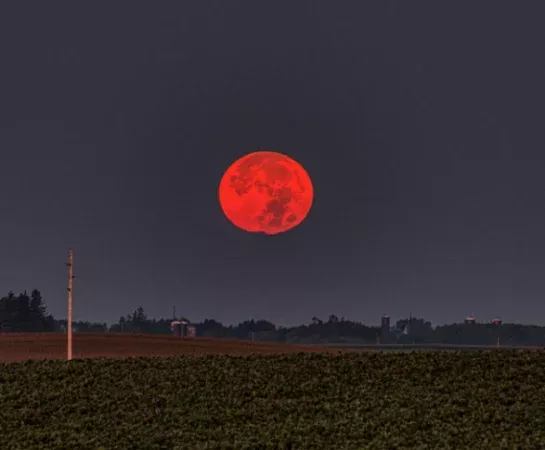
What Is a Blood Moon and Why Does the Moon Turn Red
On the night of August 27, 2026, the Moon came within a hair of disappearing entirely. Earth's shadow covered 96.2% of its surface, a partial eclipse so deep that skywatchers across the Americas, Europe, and Africa watched it turn a rusty, almost total red without
Time Tools
All time tools
Time Zone Converter
Compare cities and plan meetings
World Clock
Your cities as live clocks
Time Zones
Abbreviations and UTC offsets
Clock Widget
A free clock for your website
Timer
Countdown with an alarm
Stopwatch
Measure time with laps
Unix Timestamp
Convert epoch time to a date
Age Calculator
Exact age from a date of birth
Days Between Dates
Count the days between two dates
Work Hours
Weekly timecard and payroll hours


