Current Time in UTC-2
21:18:07
Saturday, 21 November 2026
UTC Offset:
UTC-2 (GMT-2)
IANA zone:
America/Nuuk
About:
UTC-2 is 2 hours behind UTC.
It is used in Brazil, Greenland and South Georgia and the South Sandwich Islands; the largest cities on it: Nuuk and Grytviken.
whole country only part of the country cities on UTC-2
Who Uses UTC-2 During the Year
Some countries keep UTC-2 all year. Others reach it only while their clocks are on summer or winter time, so the list of places on UTC-2 changes with the seasons. Next 12 months, in each country's local dates.
All year
Brazil (part), South Georgia and the South Sandwich Islands
Part of the year
- until 28 Mar 2027, from 30 Oct 2027: Greenland
- 14 Mar – 7 Nov 2027: Saint Pierre and Miquelon
(part): only some regions of the country use UTC-2.
Time Difference from UTC-2
Compare time in UTC-2 with major cities worldwide.
-6h
-4h
-4h
-3h
-3h
-1h
-1h
+2h
+3h
+3h
+3h
+3h
+4h
+6h
+9h
+10h
+10h
+11h
+13h
When the Time Difference with UTC-2 Changes
Clocks change on different dates around the world, so the gap between UTC-2 and these places is not the same all year. Next 12 months; dates in UTC-2 time.
Los Angeles
-6h until 14 Mar 2027
-5h 14 Mar – 7 Nov 2027
-6h from 7 Nov 2027
Chicago
-4h until 14 Mar 2027
-3h 14 Mar – 7 Nov 2027
-4h from 7 Nov 2027
New York, Toronto
-3h until 14 Mar 2027
-2h 14 Mar – 7 Nov 2027
-3h from 7 Nov 2027
London
+2h until 27 Mar 2027
+3h 27 Mar – 30 Oct 2027
+2h from 30 Oct 2027
Paris, Berlin, Madrid, Rome
+3h until 27 Mar 2027
+4h 27 Mar – 30 Oct 2027
+3h from 30 Oct 2027
Sydney
+13h until 3 Apr 2027
+12h 3 Apr – 2 Oct 2027
+13h from 2 Oct 2027
Best Time to Call UTC-2
Business hours on UTC-2 (9 AM-5 PM local time) fall at these local times elsewhere:
- New York: 6:00 AM - 2:00 PM ( Partial overlap · 5 h shared)
- Los Angeles: 3:00 AM - 11:00 AM ( Partial overlap · 2 h shared)
- London: 11:00 AM - 7:00 PM ( Convenient · 6 h shared)
- Dubai: 3:00 PM - 11:00 PM ( Partial overlap · 2 h shared)
- Mumbai: 4:30 PM - 12:30 AM (next day) ( Partial overlap · 30 min shared)
- Tokyo: 8:00 PM - 4:00 AM (next day) ( Outside normal hours)
- Sydney: 10:00 PM - 6:00 AM (next day) ( Outside normal hours)
in UTC-2 today, it is:
- New York: 9:00 AM working hours
- Los Angeles: 6:00 AM night
- London: 2:00 PM working hours
- Dubai: 6:00 PM outside working hours
- Mumbai: 7:30 PM outside working hours
- Tokyo: 11:00 PM night
- Sydney: 1:00 AM (next day) night
Times are for today. Clock changes shift them on some dates: see when the time difference changes.
Changes to UTC-2 Since 1970
Countries whose standard time moved onto or off UTC-2, newest first. Summer time changes are not counted.
- 26 Oct 2024: Greenland (part of the country) moved from UTC−1 to UTC−2
- 25 Mar 2023: Greenland (part of the country) moved from UTC−3 to UTC−2
- 27 Sep 1981: Greenland (part of the country) moved from UTC−2 to UTC−1
- 25 Nov 1975: Cabo Verde moved from UTC−2 to UTC−1
From the IANA time zone database.
About UTC-2
Islands in the South Atlantic
UTC−2 is one of the least populated offsets. It is used all year on Fernando de Noronha, a Brazilian archipelago about 350 kilometres off the country's northeastern coast, which stays an hour ahead of mainland Brazil, and on South Georgia and the South Sandwich Islands, whose only residents are scientists and government staff.
Greenland's New Clock
The offset gained its largest user in 2023, when Greenland moved most of its territory, including the capital Nuuk, from UTC−3 to UTC−2. Since 2024 Greenland has used UTC−2 in winter and UTC−1 in summer, changing its clocks on the European Union's dates, so that Nuuk is now three hours behind Copenhagen in winter rather than four. Ittoqqortoormiit on the east coast follows the same clock.
In Summer
In the northern summer UTC−2 is also the daylight time of the French islands of Saint-Pierre and Miquelon, south of Newfoundland.
UTC−2 is 2 hours behind London in winter and 3 hours in the British summer.
Beyond the Clock
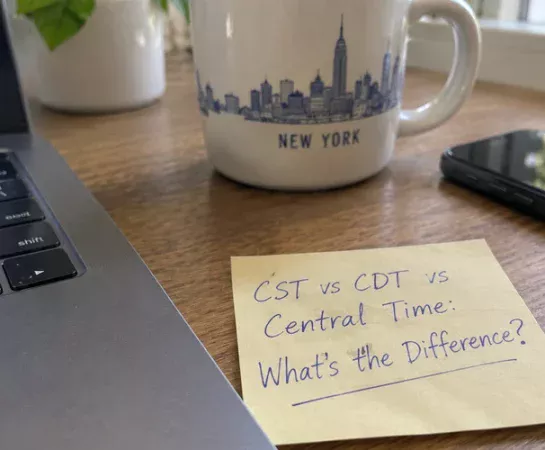
CST vs CDT vs Central Time: What’s the Difference
Central Standard Time (CST) is UTC−6. Central Daylight Time (CDT) is UTC−5. Central Time (CT) is the name of the zone itself, and it means whichever of the two is in force on a given date. The difference matters more than most people realize. In

Why New York and London Are Only Four Hours Apart for One Week
For most of the year, London is five hours ahead of New York. For one week every autumn, and for two or three weeks every spring, the gap is only four hours. In autumn 2026 that week ran from Sunday, October 25, when the United

Why Morocco Changed Its Clocks for Ramadan, and Why It Stopped in 2026
For eight years, Morocco ran one of the strangest clock systems in the world. The country kept GMT+1 all year as its working time, then set its clocks back to GMT for roughly a month around Ramadan, and moved them forward again after Eid al-Fitr.

Why Europe Still Changes Its Clocks Despite Voting to Stop
On Sunday, October 25, 2026, clocks across the European Union will go back one hour, exactly as they have every autumn since the 1980s. That is seven and a half years after the European Parliament voted to end seasonal clock changes by 2021. Many Europeans

Why Presidents’ Day Can Never Fall on Washington’s Birthday
The federal holiday honoring George Washington falls on the third Monday in February, and the third Monday in February can only land between February 15 and 21. Washington was born on February 22. The holiday can therefore never fall on the date it commemorates, in

Why Advent Starts on a Different Date Every Year
Advent always begins on a Sunday, and that is the whole reason its date moves. The season is defined as the four Sundays before Christmas, but Christmas is fixed to a date, December 25, not to a day of the week. As Christmas drifts through

Three Kings Day: Why Epiphany Falls on January 6
On the morning of Wednesday, January 6, 2027, children across Spain will open what are traditionally the main presents of the holiday season. In Spain the gifts come not from Santa Claus but from the Three Kings. In Puerto Rico, children leave grass in shoeboxes

Why Orthodox Christmas Falls on January 7, Not December 25
Millions of Orthodox Christians open presents and attend Christmas liturgy on January 7. They aren't celebrating a different holiday, and they aren't twelve days behind on purpose. They're marking December 25 on a calendar that stopped syncing with the seasons centuries ago and was never
Time Tools
All time tools
Time Zone Converter
Compare cities and plan meetings
World Clock
Your cities as live clocks
Time Zones
Abbreviations and UTC offsets
Clock Widget
A free clock for your website
Timer
Countdown with an alarm
Stopwatch
Measure time with laps
Unix Timestamp
Convert epoch time to a date
Age Calculator
Exact age from a date of birth
Days Between Dates
Count the days between two dates
Work Hours
Weekly timecard and payroll hours


