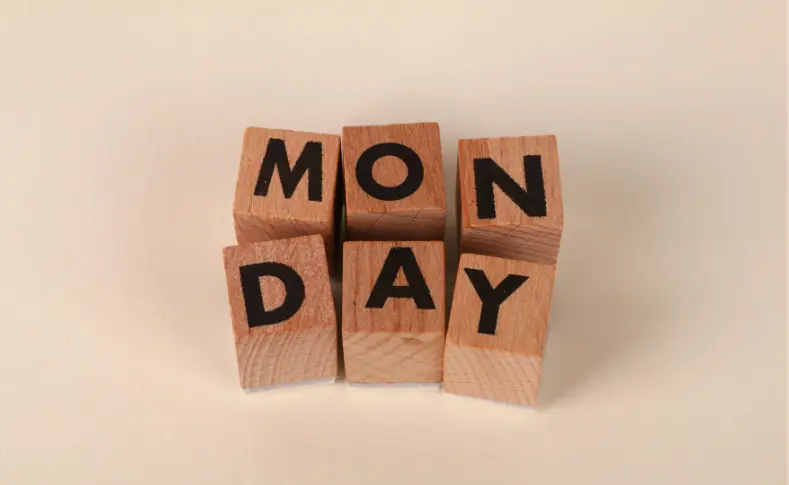
Open a calendar app on a phone bought in Dallas and Sunday sits in the leftmost column. Open the same kind of app in Berlin, and Monday takes that spot instead. Neither calendar is malfunctioning. What’s actually on display is the visible edge of a genuine, centuries-deep disagreement that runs through three separate religious traditions, an international standards body, a language that still counts its weekdays the way ancient Judea did, and the literal meaning of the word “weekend.”
Three Sabbaths, Three Different First Days
The disagreement starts with which day of rest a tradition considers the week’s true anchor. In Jewish practice, the Sabbath falls on Saturday, the seventh day, which by simple counting makes Sunday the first day of the week that follows it. Early Christianity inherited that same numbering logic from Judaism, then layered its own reason on top: Sunday marked the day of Christ’s resurrection, making it the natural day of worship and, by extension, a fresh start to the week rather than its close. Islam anchors its own week differently again, treating Friday, the day of congregational prayer known as Jumu’ah, as the pivotal day. In several Muslim-majority countries, that shifts the weekend itself to Friday and Saturday, which pushes the calendar’s first day back to Saturday rather than Sunday or Monday. Three religious traditions, each built around a different day of rest, produced three genuinely different answers to the same question, and all three are still in active daily use somewhere in the world today.
A Language That Still Counts From Sunday
The Sunday-first tradition left a mark that’s survived far longer than most people realize. Hebrew and Aramaic weekday names are, quite literally, ordinal numbers counted from Sunday: the first day, the second day, and so on through the week. That counting system passed into early Christian usage, and one modern language preserves it almost intact today. In Portuguese, Monday is segunda-feira, “second day,” Tuesday is terça-feira, “third day,” continuing all the way through Friday, sexta-feira, “sixth day.” Sunday itself isn’t numbered at all; it’s domingo, “the Lord’s day,” standing as the unstated reference point that the entire numbered sequence counts forward from. Every time a Portuguese speaker says the ordinary word for Tuesday, they’re using a counting system that treats Sunday as day one, a linguistic fossil from a debate most speakers have never consciously thought about.
Where Monday’s Claim Comes From
Monday’s case rests on a completely different kind of authority: a deliberate international standard rather than an inherited religious tradition. Adopted in 1988, ISO 8601 explicitly designates Monday as the first day of the week and Sunday as the seventh and last, specifically to give international business, banking, and software systems one shared, unambiguous convention rather than a patchwork of local habits. The reasoning connects to something surprisingly recent: the word “weekend” itself wasn’t coined until 1878, and it was defined from the start as the period closing one week and opening the next, Saturday and Sunday bundled together at the end. Once “weekend” became a culturally recognized single unit, keeping it intact as one block at the close of the week, rather than splitting it across a week boundary, gave Monday a genuinely practical claim to being day one that had nothing to do with anyone’s Sabbath.
A weekend can’t credibly be both the end of one week and the start of the next. Somewhere along the way, one of those two claims had to give. worldtimedata
The World Splits Roughly Along Continental Lines
Laid out on a map, the two dominant conventions cluster more predictably than the underlying religious history might suggest. Almost every country across North and South America keeps Sunday as the calendar’s first day, a legacy of the Christian and Jewish traditions that shaped the continent’s colonial-era calendars. Europe and Oceania run almost entirely the opposite way, overwhelmingly Monday-first, tracking the ISO standard that most of the region’s governments and industries formally adopted. Africa and Asia, the world’s two most populous continents, don’t lean either direction; they split close to evenly between the two conventions, a reflection of just how many distinct religious and colonial histories intersect across those two land masses. The seven-day week itself has one shared origin story, but which day gets to open it turned out to be a separate argument entirely, one that never fully resolved along with the length of the week itself.
One Country, Two Contradicting Answers
The split doesn’t always fall neatly along national borders either; several countries argue with themselves. Canada officially adopted ISO 8601’s Monday-first convention as a matter of national standard, yet everyday Canadian usage, in casual speech, printed calendars, and plenty of consumer software, still commonly treats Sunday as the week’s opening day, a contradiction Canadians who work internationally run into constantly. Japan shows a related but distinct version of the same split: printed calendars there conventionally begin on Sunday, following the same broad cultural pattern as North America, while Monday functions as the actual first day of the business and school week regardless of what the calendar grid displays. In both cases, the “first day of the week” turns out to have at least two different, simultaneously correct answers depending on whether the question is about a printed calendar or an actual working rhythm.
The Technical Rule Behind “Week 1”
ISO 8601 doesn’t stop at picking Monday; it also defines something most calendars never bother to specify, exactly which week counts as the first week of a given year. The rule isn’t simply “whichever week contains January 1st.” Instead, week one is defined as the week containing the year’s first Thursday, which works out to being the same as the week containing January 4th. A year doesn’t divide evenly into whole weeks in the first place, and this Thursday-anchored rule is part of how the standard handles that leftover. The practical consequence trips people up regularly: a handful of days at the very end of December can technically belong to week one of the following year, while the first day or two of January can still belong to the last week number of the year that just ended, an entirely logical outcome of the rule that nonetheless looks like an error the first time anyone actually notices it on a printed schedule.
When the Working Week and the Calendar Week Disagree
Even within a single religious tradition, the calendar’s first day and the working week’s first day don’t always line up. The Maldives offers one of the clearest examples: as an Islamic country, Friday is the day of rest and prayer, and the weekend there does fall on Friday and Saturday like much of the Muslim world. But unlike several other Muslim-majority regions, the Maldives never shifted its printed calendar to open on Saturday; Sunday remains a normal business day and the first day of the working week, even though the same country’s weekend sits on the opposite end of the calendar from where Europe or North America would place it. Several Gulf states show a related but different layering: a Saturday-first printed calendar convention coexisting with a working week that actually runs Sunday through Thursday, or in some cases Monday through Friday. The calendar grid a country prints and the days its offices are actually open turn out to be two separate decisions that happen to align in some places and quietly diverge in others.
The mismatch shows up at a much smaller scale too, inside a single household or office rather than a whole country. A calendar app defaulted to Sunday-first can quietly shift how someone reads their own week without them noticing right away: glance at a schedule expecting Monday to anchor the grid, and a meeting that actually falls on the second day of the displayed week can look, at a glance, like it’s still comfortably days away. School districts and workplaces that mix systems, a Monday-first scheduling tool paired with Sunday-first parent or client communications, run into the identical confusion on a recurring basis, which is exactly why the honest answer to “when does the week start” usually needs a follow-up question: for what purpose, exactly.
Four Questions Wearing One Name
Almost all of the confusion around this traces back to a single habit: treating “the first day of the week” as though it only ever meant one thing. It doesn’t. There’s the first day according to a religious calendar, the first day printed at the top of a wall calendar, the first day of an actual working week, and the first day used for calculating week numbers in software and logistics, and depending on the country, those four answers can point in three or four different directions at once. None of them is more correct than the others in any absolute sense. They’re simply answering different questions that happen to share the exact same phrasing, which is reason enough, the next time a calendar app defaults to a day that feels wrong, to stop assuming it’s broken and start asking which of the four questions it was actually built to answer.