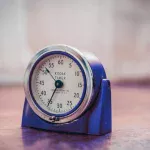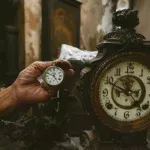
We say “o’clock” because it is a shortened form of the older phrase “of the clock.” When someone says “three o’clock,” the original meaning is close to “three of the clock” or “three according to the clock.”
That may sound unusual today because clock time is normal in modern life. But the phrase comes from a time when people did not always tell time by mechanical clocks. They also used the Sun, church bells, prayer times, work rhythms, meals, and natural daylight. Saying “of the clock” helped make clear that the time came from a clock, not from a looser daily reference.
This is why “o’clock” is more than a strange old expression. It is a small fossil of timekeeping history. It reminds us that clock time had to become a social habit before it became invisible.
The Short Answer: “O’Clock” Means “Of the Clock”
“O’clock” is a contraction of “of the clock.” The apostrophe shows that letters have been left out. Over time, “of the clock” became shorter in everyday speech, eventually turning into the familiar form “o’clock.”
So when we say “six o’clock,” we are not adding a random word after the number. We are using a shortened historical phrase that once meant the hour shown by the clock.
This matters because older time expressions were not always as exact as modern clock readings. People might speak of dawn, noon, sunset, evening, or the first bell. A clock reading was a more specific way to name the hour. “Six of the clock” meant the clock showed six.
Today, the phrase survives even though people rarely think about its original structure. It feels like one word, but historically it is a compressed sentence fragment.
Why People Needed to Say “Of the Clock”
The phrase makes more sense if we remember that clocks were not always the only way people organized time. Before precise public time became normal, daily life was often shaped by natural and social signals. People used sunrise, darkness, church bells, market hours, work routines, and seasonal daylight.
In that world, saying “of the clock” helped separate clock time from other kinds of time. It marked the difference between an hour measured by a device and a looser part of the day.
For example, “morning” is not a precise time. “After sunrise” depends on the season. “At the bell” depends on a local signal. But “five of the clock” points to a numbered hour on a clock face.
This shift is part of a larger story about how people moved from natural time to measured time. The article on how people measured time before clocks explains that earlier societies used the Sun, shadows, water clocks, hourglasses, and other systems before mechanical clock time became dominant.
How “Of the Clock” Became “O’Clock”
English often shortens common phrases. Words that are used frequently tend to become faster and easier to say. “Of the clock” became “o’ clock” and then “o’clock” because people said it often enough for the phrase to compress.
The same kind of shortening appears in other English forms. “Do not” becomes “don’t.” “I am” becomes “I’m.” “Of the clock” became “o’clock.” The apostrophe in “o’clock” marks the missing part of the phrase.
What makes “o’clock” interesting is that the original phrase is no longer obvious. Most English speakers understand “don’t” as “do not,” but fewer people immediately hear “o’clock” as “of the clock.” The expression became so familiar that its origin became hidden.
That is common in language. Everyday words often carry old meanings that are no longer visible unless we look at their history. “O’clock” is one of those cases: simple on the surface, historical underneath.
Why We Use “O’Clock” Only for Exact Hours
In modern English, “o’clock” is usually used only with exact hours. We say “three o’clock,” “seven o’clock,” or “twelve o’clock.” We do not normally say “three thirty o’clock” or “seven fifteen o’clock.”
That is because “o’clock” points to the hour shown by the clock, not to every possible minute. When minutes are included, the phrase usually disappears. People say “three thirty,” “seven fifteen,” or “quarter past seven.”
This makes “o’clock” a marker of a clean hour. It works when the minute hand is at the top of the hour, or when the time is being given approximately as a whole hour.
That connection between hours, minutes, and seconds is part of the structure of modern clock time. To understand why clocks divide the day this way, it helps to read about why time is divided into hours, minutes, and seconds.
Why We Say “12 O’Clock” for Noon and Midnight
The phrase “12 o’clock” can refer to either noon or midnight, depending on context. That is because a 12-hour clock repeats the number 12 twice each day: once at the middle of the day and once at the start of the next day.
This is where “o’clock” can become less precise unless we add more information. “I will call you at 12 o’clock” may be clear in conversation, but in writing or scheduling it may need “noon,” “midnight,” “12 PM,” or “12 AM.”
The confusion comes from the structure of the 12-hour clock, not from the word “o’clock” itself. The phrase simply says the clock shows 12. It does not automatically say which half of the day we mean.
This is why understanding what AM and PM mean matters. AM and PM help separate the two halves of the day when the same clock numbers repeat.
Why “O’Clock” Can Sound Formal or Simple Today
In everyday speech, “o’clock” can feel slightly formal, old-fashioned, or childlike depending on the situation. A parent might say “bedtime is at eight o’clock.” A teacher might say “class starts at nine o’clock.” A formal invitation might say “at six o’clock in the evening.”
But in casual adult speech, people often drop it. Instead of saying “I’ll be there at four o’clock,” many people simply say “I’ll be there at four.” The meaning is clear because modern society already assumes clock time.
That is the key difference between the past and the present. Earlier speakers needed to mark the clock as the source of the time. Modern speakers usually do not. Clocks, phones, calendars, and digital schedules have made clock time the default.
So “o’clock” survives, but it no longer does the same work it once did. It adds clarity, rhythm, or style, rather than being necessary in every time expression.
Why “O’Clock” Still Matters
“O’clock” still matters because it shows how deeply clock time changed language. The phrase comes from a period when clock readings were becoming important enough to need a special expression. Over time, the expression became normal, then almost invisible.
That is how timekeeping often works. A technical or social change becomes part of daily speech. People first need to explain it, then they use it casually, then they forget it was ever unusual.
The same pattern appears in many time expressions. Words like “hour,” “minute,” “second,” “AM,” “PM,” “weekday,” and “calendar date” feel ordinary because modern life depends on them. But each one carries a history of measurement, convention, and social agreement.
“O’clock” is a small phrase, but it points to a larger truth: time is not only something we measure. It is something language helps us organize.
The Clean Way to Understand “O’Clock”
The cleanest way to understand “o’clock” is to hear the older phrase inside it. “Three o’clock” means “three of the clock.” It originally pointed to the hour shown by a clock, distinguishing clock time from other ways of describing the day.
Today, the phrase is mostly used for exact hours. It can sound formal, traditional, or simple, but it remains clear and widely understood. It survives because it is short, useful, and deeply built into English time speech.
So the next time someone says “five o’clock,” they are using more than a time expression. They are using a small piece of history from the moment when clock time became part of everyday language.