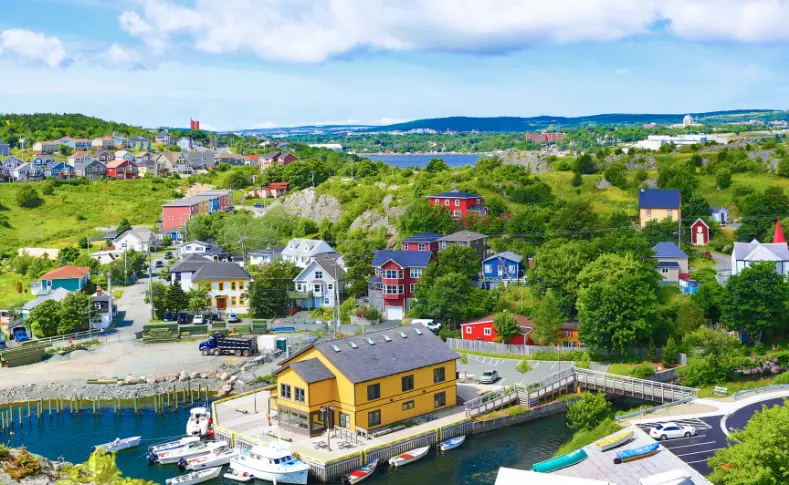
Every other time zone in North America sits cleanly on the hour. Drive from Vancouver to Halifax and the clock always jumps by a full sixty minutes at each border crossing. Then it reaches Newfoundland, and the jump is thirty. St. John’s runs half an hour ahead of its nearest Canadian neighbor, the only place on the entire continent that does this, and the reason has nothing to do with stubbornness or eccentricity for its own sake. It has to do with the fact that Newfoundland wasn’t part of Canada at all when the rest of the continent agreed on how to divide up the clock, and by the time it finally joined, giving up that half hour had already become something the province simply wasn’t willing to do.
A Dominion, Not a Province, When the Clock Was Drawn
When standard time zones were established across North America in the late nineteenth and early twentieth centuries, Newfoundland wasn’t a Canadian province falling in line with its neighbors. It was the Dominion of Newfoundland, a self-governing British territory with its own government, its own currency, and its own authority to set its own clock, entirely separate from Canada. In 1935, the Newfoundland Commission of Government formalized that authority into law with a Standard Time Act, fixing the dominion’s official time at three and a half hours behind Greenwich Mean Time. Canada, meanwhile, had already sorted its own provinces into zones tied to the same railway-driven standard-time system the United States had adopted decades earlier, and Newfoundland was never part of that arrangement, because it had never been part of Canada in the first place.
A Half-Hour That’s Actually More Accurate
The offset isn’t an arbitrary compromise either. St. John’s sits at roughly 52.7 degrees west longitude, and the true solar mean time at that meridian works out to almost exactly three hours and thirty-one minutes behind Greenwich, a near-perfect match for the zone Newfoundland actually uses today. Half-hour offsets around the world usually trace back to political or historical decisions rather than astronomical ones, but Newfoundland’s case flips that framing on its head: forcing the island onto the clean-hour Atlantic Time used by its mainland neighbors would actually pull local clocks further from true solar noon, not closer to it. The “odd” half-hour zone is, in this one case, the more honest reading of where the sun actually sits overhead.
A Narrow Vote to Join, Then a Firmer Line on the Clock
Newfoundland’s path into Canada was closer than the eventual outcome might suggest. Two referendums were held in 1948 to decide the dominion’s future: the first produced no clear majority for any single option, and the second, months later, narrowly favored joining Canadian Confederation over reverting to direct British governance or continuing as an independent dominion, by a margin of roughly 52 to 48 percent. Newfoundland officially became Canada’s tenth province on April 1, 1949, on the strength of a vote that had barely crossed the finish line. Nothing about that merger required keeping a separate time zone. The province could have adopted Atlantic Standard Time, the same UTC-4 offset used across Nova Scotia, New Brunswick, and Prince Edward Island, and folded quietly into the rest of Atlantic Canada’s clock. It didn’t. In 1960, the provincial legislature went the other direction entirely, passing its own Newfoundland Standard Time Act and writing the three-and-a-half-hour offset explicitly into post-Confederation law rather than letting it drift toward the mainland’s system.
Confederation absorbed Newfoundland’s government, its currency, and its postal service. It never managed to absorb its clock. worldtimedata
The clearest test of how firmly that clock was held came in 1963, when the provincial government floated a plan to abandon Newfoundland Time and align with Atlantic Time like every other Atlantic province. The proposal met immediate and forceful public opposition and was withdrawn before it ever took effect. More than a decade after a vote to join Canada that had barely passed, Newfoundlanders had already made clear that giving up thirty minutes on the clock was not a small administrative tweak. It read as giving up one of the last visible pieces of a distinct identity that had predated Confederation altogether, at a moment when the memory of nearly not joining at all was still well within living memory.
Even Inside the Province, the Clock Splits in Two
The province is officially named Newfoundland and Labrador, and most people outside it assume that name describes a single time zone. It doesn’t. Labrador, the much larger mainland portion of the province, sits geographically closer to Atlantic Canada than to the island of Newfoundland, and most of it keeps Atlantic Time, UTC-4, in step with Nova Scotia and New Brunswick rather than with St. John’s. Only the southeastern tip of Labrador, roughly the stretch from the community of Black Tickle southward, follows Newfoundland Time along with the island itself.
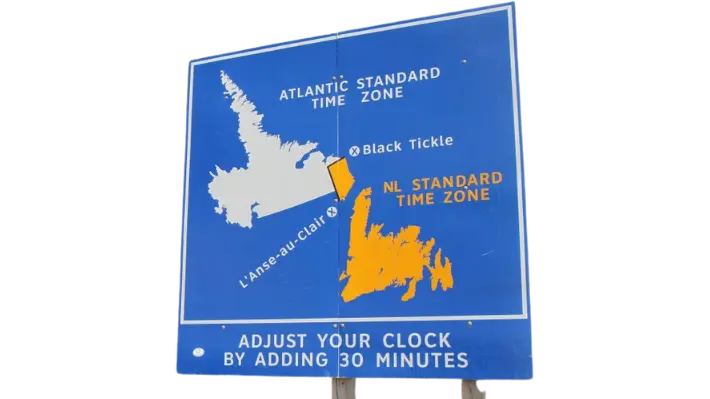
It’s a small-scale version of a pattern that shows up elsewhere too: a single town quietly running on a neighboring region’s clock instead of the one its official borders would suggest. A province whose name implies one unified clock is, in practice, operating on two, and the dividing line runs through the middle of its own mainland rather than along any provincial border.
The Only Half-Hour Zone on the Continent
Outside Newfoundland, North America is uniform. The United States, Mexico, and the rest of Canada all sit squarely on the hour relative to UTC, without exception. Half-hour offsets exist elsewhere in the world: India runs on UTC+5:30, Iran on UTC+3:30, Afghanistan on UTC+4:30, and central Australia on UTC+9:30, with New Zealand’s Chatham Islands going even further at a 45-minute offset from the rest of the country. But Newfoundland is the only place on the entire North American continent that breaks the clean-hour pattern. For a province of roughly half a million people, that produces a steady, low-grade amount of friction: television broadcasts, flight schedules, and conference calls originating anywhere else in North America all have to account for a thirty-minute gap that exists nowhere else on the map they’re using.
The friction isn’t only human. Plenty of software written with North American time zones in mind quietly assumes every offset lands on a whole hour, a shortcut that works for the other 99 percent of the continent and breaks the moment a Newfoundland address enters the system. Scheduling tools, booking platforms, and older databases have all, at various points, mishandled the thirty-minute offset by rounding it away entirely, the same category of edge-case failure that shows up whenever a system is built around an assumption that holds almost everywhere except the one place that matters to the person using it. It’s a small, recurring reminder that Newfoundland isn’t just an outlier on a map. It’s an outlier in code as well, wherever that code was written on the assumption that hours are the smallest unit a time zone ever needs.
It’s friction the province has clearly decided, repeatedly and deliberately, is worth living with. Anyone checking Canada’s current time zone by zone will find every other region lined up neatly on the hour, and then St. John’s sitting thirty minutes off to the side of all of them, exactly where it’s sat since long before Confederation.
A Clock That Outlasted the Country It Was Set In
Newfoundland Standard Time predates Canadian Confederation by over a decade, survived a narrow vote that could easily have gone the other way, and has turned back at least one formal attempt to fold it into the mainland’s tidier system. The offset happens to be more astronomically accurate than the alternative, which helps the argument but was never really the point. St. John’s runs thirty minutes ahead of its neighbors because Newfoundland was setting its own clock while it was still its own country, and joining Canada, even by the narrowest of margins, was never going to be reason enough to give that up.