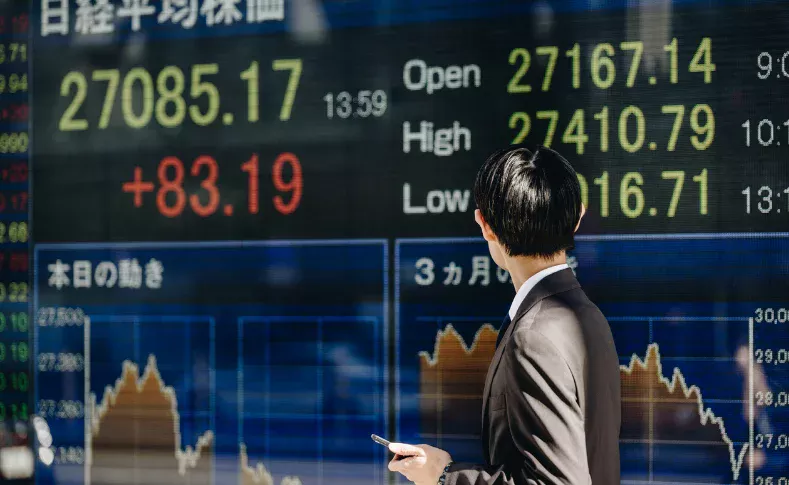
Every trading day starts in Asia. Long before New York opens and hours before London’s first order hits the book, the Nikkei 225 and the Hang Seng set the tone for how the rest of the world reads risk. Understanding how time zones determine when you can trade international stocks starts here, with the two benchmarks that open the global session. Here’s exactly when each one opens, closes, and overlaps, translated into the time zones people actually live in.
Tokyo Stock Exchange: How the Nikkei 225 Session Is Built
The Tokyo Stock Exchange runs its cash equity market Monday through Friday in three blocks. The morning session opens at 9:00 AM Japan Standard Time and runs until 11:30 AM. A one-hour lunch break follows, from 11:30 AM to 12:30 PM, during which no continuous trading occurs. The afternoon session then resumes at 12:30 PM and closes at 3:30 PM, with a closing auction built into the final five minutes, from 3:25 to 3:30 PM, to concentrate liquidity at the settlement price.
That 3:30 PM close is relatively new. Until November 5, 2024, TSE closed at 3:00 PM, giving Tokyo one of the shortest trading days among major exchanges. The 30-minute extension was aimed at reducing end-of-day order congestion and edging Tokyo’s session length closer to Hong Kong’s, which had already run longer.
One detail that trips up a lot of readers converting session times: Japan’s time zone does not shift for daylight saving. It hasn’t since 1951. JST stays fixed at UTC+9 all year, which means the Nikkei’s local opening time never moves, only the reader’s local conversion does.
Hong Kong Exchange: The Hang Seng’s Four-Part Day
HKEX structures its day with more moving pieces. A pre-opening session runs from 9:00 to 9:30 AM Hong Kong Time, where orders are entered and matched to set the opening price but not continuously traded. Continuous trading then runs 9:30 AM to 12:00 PM, breaks for lunch until 1:00 PM, resumes 1:00 to 4:00 PM, and closes with a ten-minute closing auction from 4:00 to 4:10 PM.
That lunch break used to be two hours, the longest of any major exchange in the world. HKEX shortened it to one hour and moved the morning open 30 minutes earlier back in 2011, partly to align more closely with mainland Chinese exchanges and reduce the gap that let Singapore-listed products capture volume during Hong Kong’s downtime. For a side-by-side breakdown of both bourses, the Asian trading session overview covers how Tokyo and Hong Kong compare to the rest of the region.
Hong Kong does not observe daylight saving either. HKT sits fixed at UTC+8 year-round, one hour behind JST at all times, never more, never less.
Two exchanges built on fixed, non-DST time zones produce a more predictable daily overlap than most Western market pairs ever manage. worldtimedata
Converting Both Sessions to Major Time Zones
Because neither Tokyo nor Hong Kong shifts for clock changes, the exchanges’ relationship to each other never moves. What moves is how they map onto zones that do observe DST. Below are the full session windows, open to close, as they read right now in late August 2026, when US and UK clocks are on daylight time and Australia is on standard time.
| Local time zone | Nikkei 225 window (9:00 AM to 3:30 PM JST) | Hang Seng window (9:00 AM to 4:10 PM HKT) |
|---|---|---|
| Tokyo (JST) | 9:00 AM to 3:30 PM | 10:00 AM to 5:10 PM |
| Hong Kong (HKT) | 8:00 AM to 2:30 PM | 9:00 AM to 4:10 PM |
| Mumbai (IST) | 5:30 AM to 12:00 PM | 6:30 AM to 1:40 PM |
| London (BST) | 1:00 AM to 7:30 AM | 2:00 AM to 9:10 AM |
| New York (EDT) | 8:00 PM to 2:30 AM (prev. day) | 9:00 PM to 4:10 AM (prev. day) |
| Los Angeles (PDT) | 5:00 PM to 11:30 PM (prev. day) | 6:00 PM to 1:10 AM (prev. day) |
| Sydney (AEST) | 10:00 AM to 4:30 PM | 11:00 AM to 6:10 PM |
What Happens When the Clocks Change
Tokyo and Hong Kong stay fixed. New York and London don’t. When US clocks fall back to EST in early November and UK clocks revert to GMT, every conversion above shifts one hour earlier in local terms, a pattern covered in more depth in how daylight saving time affects stock market hours. So the Nikkei’s New York window moves from 8:00 PM to 2:30 AM back to 7:00 PM to 1:30 AM, and the Hang Seng’s London window moves from 2:00 AM to 9:10 AM back to 1:00 AM to 8:10 AM. Sydney runs the opposite direction: Australian daylight saving starts in October, so once AEDT kicks in, both windows there shift one hour later than what’s shown, not earlier. If you’re setting a recurring calendar alert around either session, build it around JST or HKT directly rather than your own local time, since that’s the only reference point in this pair that never moves.
Where the Two Sessions Actually Overlap
This is the number that matters most for anyone trading both markets, running an Asia-Pacific ETF book, or watching cross-listed names react to news in real time. Because Tokyo opens 30 minutes before Hong Kong’s pre-open and closes 20 minutes after Hong Kong’s closing auction, but both take separate, non-aligned lunch breaks, the actual simultaneous trading window is split into two segments rather than one continuous block. The same layered logic applies further west, where New York, London, and Tokyo trading hours overlap in their own separate, narrower window.
Out of a 6.5-hour Nikkei day and roughly 6-hour Hang Seng trading day, that 4.5 hours of genuine overlap is substantial, close to 70% of Tokyo’s session. The first segment runs while Hong Kong is mid-morning and Tokyo hasn’t yet broken for lunch. The second, larger segment covers Tokyo’s full afternoon session against Hong Kong’s afternoon session, since both markets, after their respective lunch breaks, are trading continuously at the same time from 3:30 to 6:30 UTC. That’s the window where a move in one market has the clearest chance of showing up in the other before either closes, useful for anyone tracking Hong Kong-listed ADRs against their Tokyo-listed peers, or running pairs strategies across the two indices.
A Scheduling Risk Neither Time Zone Table Captures
Static conversion tables assume both exchanges trade every scheduled minute, and that assumption breaks more often in Hong Kong than in Tokyo. HKEX has a standing rule tied to severe weather: if a Typhoon Signal No. 8 or a Black Rainstorm Warning is still in effect at 9:00 AM local time, the entire morning session is cancelled outright, not delayed. If the warning lifts before noon, afternoon trading resumes roughly two hours after the signal is lowered, but if it’s still active at noon, the whole day is scrapped. Hong Kong sits directly in a typhoon corridor, and these suspensions aren’t rare edge cases, they recur most years during the June to October storm season. Tokyo carries no equivalent weather-based halt in its rulebook, which means the Nikkei side of any overlap calculation is far more reliable than the Hang Seng side during those months, regardless of what the clock says.