Days in Tokyo are currently getting shorter, about 10 minutes shorter than a week ago.*
* Calculated from sunrise and sunset times; actual visible daylight can vary slightly with weather, elevation and atmospheric conditions.
Key Facts About Time in Tokyo
- Last moved its clocks forward for summer in 1951.
- Replaced local solar time with a standard time zone on 1 January 1888.
Time Difference from Tokyo
Compare time in Tokyo with major cities worldwide.
When the Time Difference with Tokyo Changes
Clocks change on different dates around the world, so the gap between Tokyo and these places is not the same all year. Next 12 months; dates in Tokyo time.
Best Time to Call Tokyo
Business hours in Tokyo (9 AM-5 PM local time) fall at these local times elsewhere:
- New York: 7:00 PM (previous day) - 3:00 AM ( Outside normal hours)
- Los Angeles: 4:00 PM (previous day) - 12:00 AM ( Partial overlap · 1 h shared)
- London: 12:00 AM - 8:00 AM ( Outside normal hours)
- Dubai: 4:00 AM - 12:00 PM ( Partial overlap · 3 h shared)
- Mumbai: 5:30 AM - 1:30 PM ( Partial overlap · 4 h 30 min shared)
- Sydney: 11:00 AM - 7:00 PM ( Convenient · 6 h shared)
in Tokyo today, it is:
- New York: 10:00 PM (previous day) night
- Los Angeles: 7:00 PM (previous day) outside working hours
- London: 3:00 AM night
- Dubai: 7:00 AM outside working hours
- Mumbai: 8:30 AM outside working hours
- Sydney: 2:00 PM working hours
Times are for today. Clock changes shift them on some dates: see when the time difference changes.
Public Holidays Affecting Tokyo
Official national holiday observed in Japan.
Daylight saving time in Tokyo
Tokyo uses the IANA time zone identifier Asia/Tokyo. The current local offset is UTC+9 / JST.
Tokyo does not observe daylight saving time in 2026. The UTC offset remains stable throughout the year.
Time Zone History of Tokyo
Tokyo follows the Asia/Tokyo time zone. According to the IANA time zone database, these are the standard times it has used:
- Until 1 January 1888: local mean time, UTC+9:19
- From 1 January 1888: UTC+9, the current standard time
Daylight saving time was used in 4 years between 1948 and 1951. The last switch to summer time was in 1951, and none is scheduled now.
About Time in Tokyo
When an Hour Changed Length with the Seasons
Until the end of 1872, an hour in Tokyo, then still widely called Edo, was not a fixed amount of time. Japan used a system of temporal hours: the daylight between dawn and dusk was split into six equal parts and the night into another six. A daytime hour in June was therefore much longer than one in December. Japanese clockmakers adapted European mechanisms to cope with this, building clocks known as wadokei with movable hour markers or two balance bars that switched between day and night rates. Temple bells rang the hours across the city, and people named the hours after animals of the zodiac rather than numbers alone.
The Meiji government ended all of this with remarkable speed. In late 1872 it announced that the lunar calendar would be dropped, that the day would be divided into 24 equal hours, and that the third day of the twelfth month of the fifth year of Meiji would become 1 January 1873. Almost a whole month of the old year simply vanished from the calendar. One practical result, often mentioned by historians, was that the government avoided paying officials a thirteenth monthly salary in a lunar leap year.
The Noon Gun Called "Don"
From 1871 a cannon in the grounds of the former Edo Castle, today the Imperial Palace, fired a blank charge every day at noon. Tokyoites called it simply "Don", after the sound, and people across the central districts set their watches by it. The gun stayed in service until April 1929, when a siren took over. The cannon itself survives and is displayed at the Edo-Tokyo Open Air Architectural Museum in Koganei.
A Meridian That Misses Tokyo
Japan Standard Time was created by an imperial ordinance issued in July 1886, and it came into force at midnight on 1 January 1888, when the time was telegraphed from Tokyo to stations across the country. The ordinance accepted Greenwich as the prime meridian and chose 135 degrees East as the national standard, exactly nine hours ahead of Greenwich. The line runs through the city of Akashi near Kobe, which calls itself the "Town of Time" and has a planetarium built directly on the meridian.
Tokyo lies almost five degrees further east, at about 139°45′. Before 1888 the capital's own mean time, measured at the old Tokyo Astronomical Observatory, was roughly 9 hours and 19 minutes ahead of Greenwich. Today that difference means the sun is always ahead of the clock: on average it crosses the meridian at about 11:41 in Tokyo, and sunrise on the longest days of June comes at around 4:25. In early December the sun sets at about 16:30.
The shape of the country adds to the effect. Hokkaido and the eastern islands see sunrise well before Kyushu and Okinawa, yet the whole of Japan has used one time zone since 1937, when a separate western zone that had been used in Taiwan and parts of Okinawa was abolished.
Summer Time That Lasted Four Summers
Japan does not change its clocks today, but it once did. Between 1948 and 1951, during the Allied occupation, clocks were moved forward by one hour each spring. The measure had been introduced quickly and with little public debate, and many workers felt that the longer evenings simply meant longer working days. A government poll in 1951 found that 53 percent of people wanted to scrap it, against 30 percent who wanted to keep it, and the Diet abolished summer time soon after. Proposals to bring it back have surfaced several times since, including discussions linked to the Tokyo 2020 Olympics, without success.
The Day Japan Celebrates Time
Every 10 June Japan marks Toki no Kinenbi, or Time Day. It is not a public holiday, but schools and companies use it to talk about punctuality. The date comes from the Nihon Shoki, Japan's oldest official history, which records that in 671 Emperor Tenji installed a water clock and began announcing the hours with bells and drums. The modern observance was created in 1920, after a popular exhibition on time at the Tokyo Education Museum, the forerunner of today's National Museum of Nature and Science in Ueno, encouraged a public that was not yet used to watching the clock.
Time Day has collected other milestones. On 10 June 1999 the signal that keeps radio controlled clocks across eastern Japan accurate began broadcasting from the Ohtakadoya-yama transmitter in Fukushima Prefecture. The atomic clocks behind that signal belong to the National Institute of Information and Communications Technology, whose headquarters are in Koganei, in western Tokyo.
Living on JST
Japan Standard Time is UTC+9 all year. Tokyo shares it with Seoul and Pyongyang and is one hour ahead of Beijing, Shanghai, Hong Kong, Singapore and Manila. Because Japan never shifts its clocks, the gap with Europe and North America changes twice a year instead: Tokyo is 9 hours ahead of London in winter and 8 hours in summer, and 14 or 13 hours ahead of New York. A video call at 9:00 in Tokyo falls at midnight or 1:00 in London and on the previous evening in New York.
The rhythm of the city reflects its clocks in other ways too. Trains are timetabled to the quarter minute, and in many neighbourhoods loudspeakers play a short melody every evening, usually at 17:00, a daily test of the public warning system that also tells children it is time to go home. In Ginza, the clock tower on the Wako building, built in 1932 for the watchmaker Hattori, the company that became Seiko, remains one of the city's best known meeting points.
Sun & Daylight in Tokyo
Tokyo lies at 35.69° N, 139.69° E in the Northern Hemisphere and the Eastern Hemisphere, about 3,973 km (2,469 mi) from the Equator, in the temperate latitude zone.
Sun Time vs Clock Time
Standard time in Tokyo, UTC+9, is based on the 135° E meridian, while the city lies at 139.69° E. So on standard time the clock runs about 19 minutes behind local solar time.
Solar noon, the moment the sun is highest in the sky, comes as early as 11:24 (around November 3) and as late as 11:55 (around February 11) by the local clock.
Golden Hour & Blue Hour Today
Approximate times from today's sunrise and sunset; the light itself depends on weather.
Airports Serving Tokyo
Tokyo Haneda International Airport (HND / RJTT) is the main airport serving Tokyo: a major airport about 18 km (11 mi) from the city centre.
Current local time at the airport is 08:09:56.
Other airports within 80 km:
- Narita International Airport (NRT) - major, 64 km
Antipode of Tokyo
The point on Earth exactly opposite Tokyo lies at 35.69° S, 40.31° W, in the South Atlantic Ocean. The nearest populated place is Cidreira, Brazil, about 1,110 km away. The nearest major city is Porto Alegre, Brazil, about 1,200 km away.
When it is noon by the sun in Tokyo, it is midnight by the sun at its antipode.
Frequently Asked Questions
What time zone is Tokyo in?
Tokyo follows the Asia/Tokyo time zone, the official IANA identifier used by computers and databases worldwide to track local time accurately. Right now, this puts Tokyo at UTC+9.
What time is it in Tokyo right now?
The current local time in Tokyo is 08:09:56 on Sunday, 22 November 2026. The clock at the top of this page shows the live time and updates every second.
Does Tokyo observe daylight saving time?
No. Tokyo stays on UTC+9 (JST) all year and does not change its clocks.
How far ahead or behind UTC is Tokyo?
Tokyo is currently UTC+9, meaning local time is 9 hours ahead of Coordinated Universal Time (UTC).
When did Tokyo stop using daylight saving time?
The last switch to summer time in Tokyo was in 1951. In total, clocks were moved forward for summer in 4 years, the first time in 1948. No change is scheduled now, so the clock stays on UTC+9 all year.
Which airport serves Tokyo?
Tokyo Haneda International Airport (HND) is the main airport serving Tokyo, about 18 km away. The current local time at the airport is 08:09:56.
Beyond the Clock

Why Greenland Moved Its Clocks Forward an Hour in 2023
On the evening of Saturday, March 25, 2023, most of Greenland set its clocks forward one hour, as it had every spring for more than four decades. The difference came in October: the clocks never went back. With that non-event, Nuuk moved its standard time
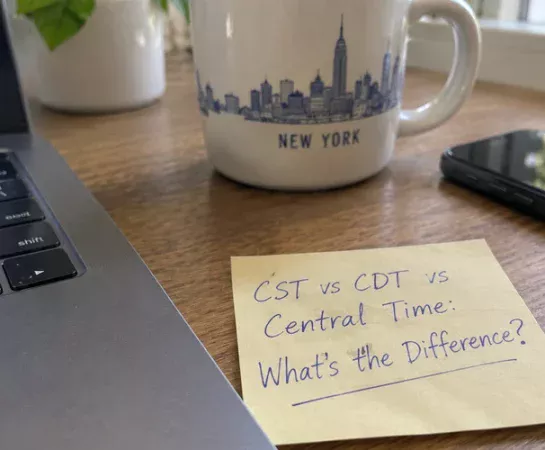
CST vs CDT vs Central Time: What’s the Difference
Central Standard Time (CST) is UTC−6. Central Daylight Time (CDT) is UTC−5. Central Time (CT) is the name of the zone itself, and it means whichever of the two is in force on a given date. The difference matters more than most people realize. In

Why New York and London Are Only Four Hours Apart for One Week
For most of the year, London is five hours ahead of New York. For one week every autumn, and for two or three weeks every spring, the gap is only four hours. In autumn 2026 that week ran from Sunday, October 25, when the United

Why Europe Still Changes Its Clocks Despite Voting to Stop
On Sunday, October 25, 2026, clocks across the European Union will go back one hour, exactly as they have every autumn since the 1980s. That is seven and a half years after the European Parliament voted to end seasonal clock changes by 2021. Many Europeans
How to Count Working Days Between Two Dates (and Why Holidays Break the Formula)
Counting working days looks like simple arithmetic: count the weekdays between two dates, then subtract the holidays. From Tuesday, November 10, 2026 to Thursday, December 31, 2026, that gives 38 weekdays minus three US federal holidays, or 35 working days. Most wrong answers come from
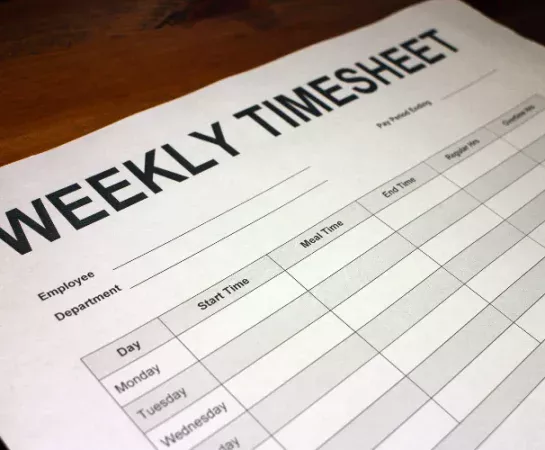
How to Convert Minutes to Decimal Hours for Timesheets
To convert minutes to decimal hours, divide the minutes by 60. Thirty minutes is 30 ÷ 60 = 0.5 hours, so 7 hours 30 minutes is 7.5 hours, not 7.3. That single rule covers every case, but payroll errors rarely come from not knowing it.
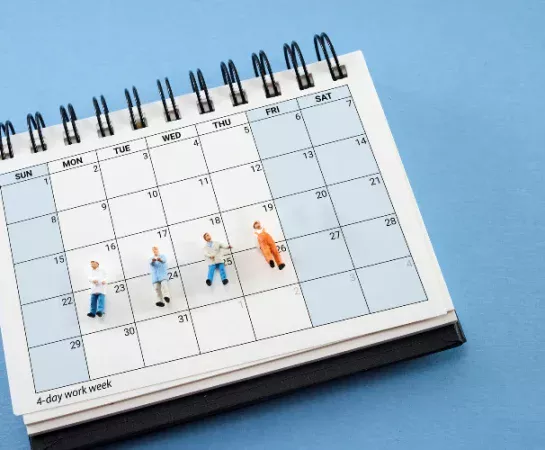
The Four-Day Work Week: What the Trials Actually Measured
When the largest four-day week trial ended in December 2022, 56 of the 61 participating UK companies kept the policy. That 92% figure is widely quoted. It is accurate, but it answers a narrower question than most readers assume. It shows that companies which volunteered

Daylight Saving Time and Productivity: What Studies Found About the Monday After
Two Mondays a year carry a reputation for lost focus, extra mistakes and sleepy offices. The reputation is only half earned. The research on clock changes splits sharply by season: the Monday after clocks spring forward shows measurable costs in sleep, injuries and errors, while


