Major Airports in Seychelles
- Seychelles International Airport (SEZ) - 01:31:22
Daylight saving time in Seychelles
Seychelles has 1 listed IANA time zones. None of them observe daylight saving time in 2026. The UTC offset remains stable throughout the year.
Best Time to Call Seychelles
Business hours in Seychelles (9 AM–5 PM local time) fall at these local times elsewhere:
- Beijing: 1:00 PM – 9:00 PM ( Partial overlap)
- Paris: 7:00 AM – 3:00 PM ( Partial overlap)
- Toronto: 1:00 AM – 9:00 AM ( Outside normal hours)
- Seoul: 2:00 PM – 10:00 PM ( Partial overlap)
- Mexico City: 11:00 PM (previous day) – 7:00 AM ( Outside normal hours)
- Cairo: 8:00 AM – 4:00 PM ( Convenient)
- Bangkok: 12:00 PM – 8:00 PM ( Partial overlap)
Times shown reflect current UTC offsets and may shift by up to an hour around daylight saving transitions.
Time Difference from Seychelles
Compare time in Seychelles with other countries.
Countries in the Same Time Zone as Seychelles
Most Popular Cities in Seychelles
Holidays in Seychelles
Official national public holidays. Regional and religious observances may vary by area.
About Time in Seychelles
A Seed That Refuses to Hurry
The coco de mer, a palm found growing wild nowhere on Earth except two granite islands of the Seychelles, Praslin and Curieuse, produces the largest and heaviest seed known to science, a single nut that can weigh as much as forty pounds. Almost everything about the plant's life cycle is stretched out to a scale that makes ordinary garden timelines look rushed. A fertilised fruit takes six to ten years just to ripen on the tree, and once it finally falls, the seed inside can take up to two more years to germinate. The seedling that eventually emerges is in no hurry either: a coco de mer palm typically needs twenty-five to fifty years of growth before it flowers for the first time.
Long before anyone traced the tree to its actual home, the nuts were already travelling the Indian Ocean on their own schedule, drifting ashore in the Maldives, along the coast of India and across East Africa, where they were prized as curiosities and believed by some to grow on invisible submarine trees, since no one had yet found the source. Left undisturbed by fire, disease or human harvesting, individual coco de mer palms are thought capable of continuing to flower and fruit for as long as eight hundred years, a lifespan so far beyond ordinary human planning horizons that conservationists managing the surviving wild population, concentrated in the UNESCO-listed Vallée de Mai on Praslin, describe losing even a single mature tree as a loss no replanting effort can meaningfully undo within several human lifetimes.
A Species That Outlives Empires
The giant tortoises native to the Seychelles and its outlying Aldabra Atoll are among the longest-lived land animals known, with an average life expectancy for the species estimated at around a century and a half, a figure some individuals have gone on to substantially outlast. The largest remaining wild population survives today on Aldabra Atoll itself, a UNESCO World Heritage Site whose isolation has allowed tens of thousands of the tortoises to persist relatively undisturbed since long before the islands were permanently settled by people at all.
The most famous individual of the species, a tortoise named Jonathan, was born in the Seychelles around 1832, decades before the archipelago had any regular administration of its own, and was later given as a gift to the governor of the remote South Atlantic island of Saint Helena in 1882, when he was already an estimated fifty years old. He has lived there ever since, and by 2026 his age was estimated at somewhere around 193 to 194 years, making him, by most authoritative accounts, the oldest confirmed tortoise and the oldest known living land animal on Earth, a single creature whose lifespan has stretched across the entire span of Seychelles' modern political history, from British crown colony to independent republic, despite having left the islands of his birth almost a century and a half ago.
The Clock That Strikes Every Hour Twice
At the heart of Victoria, the Seychelles' small capital, stands a cast-iron clock tower known locally as Lorloz, a Creole rendering of the French l'horloge, inaugurated on 1 April 1903 by the colony's governor, Ernest Bickham Sweet-Escott. It was built as a memorial to Queen Victoria following her death two years earlier, cast by the English foundry Gillett and Johnston and funded partly by public subscription, with the government covering the remainder of its roughly $735 cost, and it doubled, by design and by coincidence, as a marker of the moment Seychelles was formally elevated from a dependency of Mauritius into its own separate British Crown Colony.
The tower is a scaled-down copy of a similarly named clock, Little Ben, that still stands near Victoria Station in London, though few visitors to either city realise the connection runs both ways. Seychelles' own Lorloz has one distinctive quirk unrelated to its London namesake: it strikes each hour not once but twice, a peculiarity local enough to have worked its way into a well-known Creole folk song about the islands. More than a century after its installation, the clock tower remains largely unchanged in appearance, having only recently undergone its first major structural and mechanical restoration, carried out, fittingly, by the direct successor firm to the same Croydon clockmakers who originally built it.
Frequently Asked Questions
How many time zones does Seychelles have?
One. The whole of Seychelles follows Indian/Mahe, so every city shows the same local time as the capital, Victoria.
Is Seychelles ahead of or behind GMT?
Seychelles is currently 4 hours ahead of GMT (UTC+4).
Does Seychelles use summer time?
No. Seychelles does not observe daylight saving time, so its clocks stay at UTC+4 all year. Its time difference with countries that do change their clocks still shifts by an hour in spring and autumn.
How many public holidays does Seychelles have in 2026?
Seychelles has 14 national public holidays in 2026, when banks and government offices are usually closed. Some regions may also have their own local holidays.
How do I dial a phone number in Seychelles from abroad?
From a mobile phone, type +248 and then the local number without the leading 0 used for domestic calls, if it has one. From a landline, replace the plus sign with your exit code: 011 from the US and Canada, or 00 from most of Europe, for example 00 248 followed by the number.
What language is spoken in Seychelles?
The main languages of Seychelles are English and French.
Beyond the Clock

Friday the 13th: How Often It Happens and Why It Falls on a Friday Most Often
November 13, 2026 is the third Friday the 13th of the year, after February 13 and March 13. That won't happen again until 2037. The next one after November comes on August 13, 2027, and then the calendar produces the longest possible drought: 14 months

When Is Eid al-Fitr and How Its Date Depends on Ramadan’s Final Moon Sighting
Eid al-Fitr never sits on a fixed date, and it isn't confirmed until the night before it happens. Unlike Christmas or New Year's Day, locked to the Gregorian calendar months in advance, the first day of Shawwal depends on whether a sliver of crescent moon
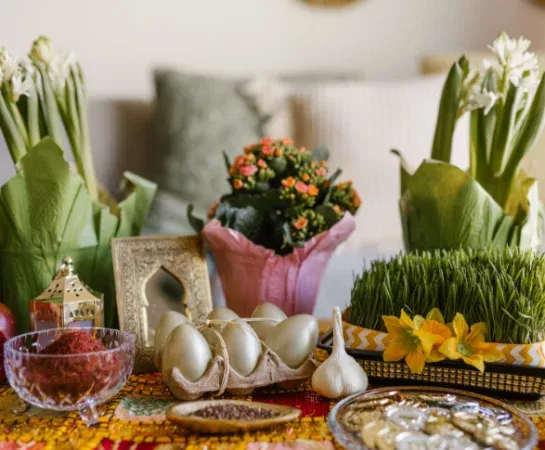
What Is Nowruz and Why It Always Falls on the Spring Equinox
Nowruz is the Persian New Year, celebrated by more than 300 million people across Iran, Afghanistan, Central Asia, the Caucasus, and Kurdish communities, and it begins at the exact astronomical instant of the March equinox rather than on a fixed date on any calendar grid.
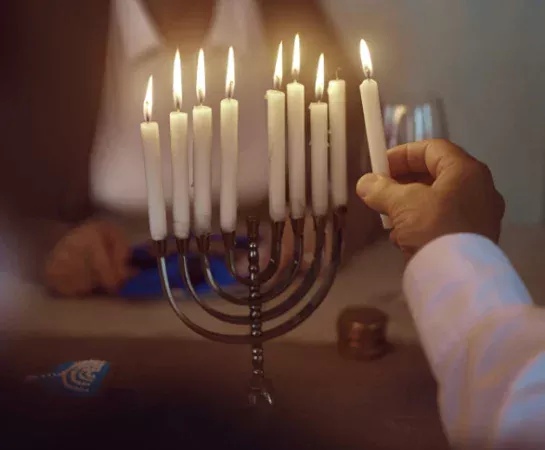
Why Hanukkah’s Date Moves Every Year on the Solar Calendar
In 2013, the first candle of Hanukkah was lit on the night before Thanksgiving, a coincidence rare enough that it won't happen again until 2070. Eleven years later, in 2024, the first candle fell on the evening of December 25 itself, the same alignment that

Why the Moon’s Phases Don’t Actually Change Its Size
A thin crescent looks small enough to disappear. A full moon looks like it's swelling on the horizon. Neither impression is true. The Moon's diameter is 3,474 kilometers on every night of the month, whether it's a sliver or a full disc, and nothing in
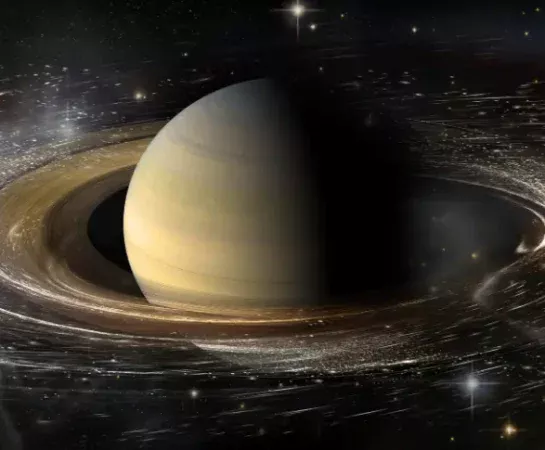
Why Saturn’s Rings Are Disappearing From View in 2025 and 2026
Saturn's rings turned edge-on to Earth on March 23, 2025, at 12:04 p.m. EDT, and for weeks the planet looked like a plain yellow ball through backyard telescopes. This is not decay or destruction. It is a geometric alignment called a ring plane crossing, and
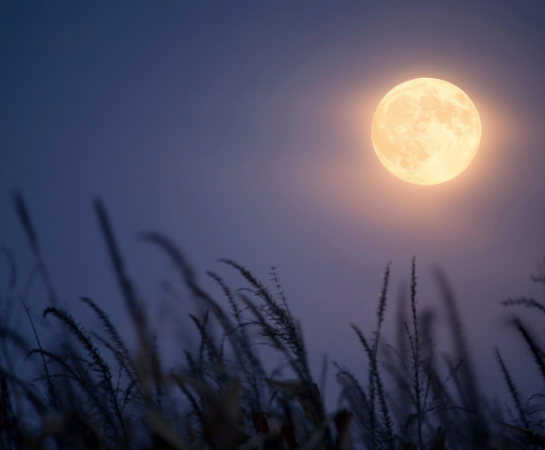
What Is a Harvest Moon and Why It Rises at Almost the Same Time Several Nights Running
On most nights of the year, the Moon rises roughly 50 minutes later than it did the night before. Around the Harvest Moon, that gap collapses to as little as 10 minutes in parts of the UK and Canada, and rarely more than 30 minutes
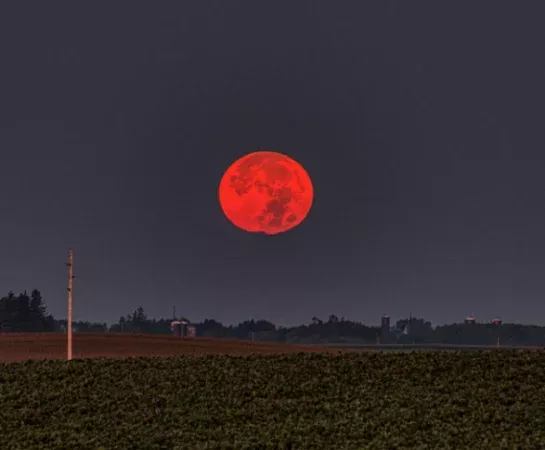
What Is a Blood Moon and Why Does the Moon Turn Red
On the night of August 27, 2026, the Moon came within a hair of disappearing entirely. Earth's shadow covered 96.2% of its surface, a partial eclipse so deep that skywatchers across the Americas, Europe, and Africa watched it turn a rusty, almost total red without
Time Tools
Quick access to timers, stopwatch, world clock and time zone tools.
Time Guides
Read useful guides about time zones, calendars, finance and astronomy.


