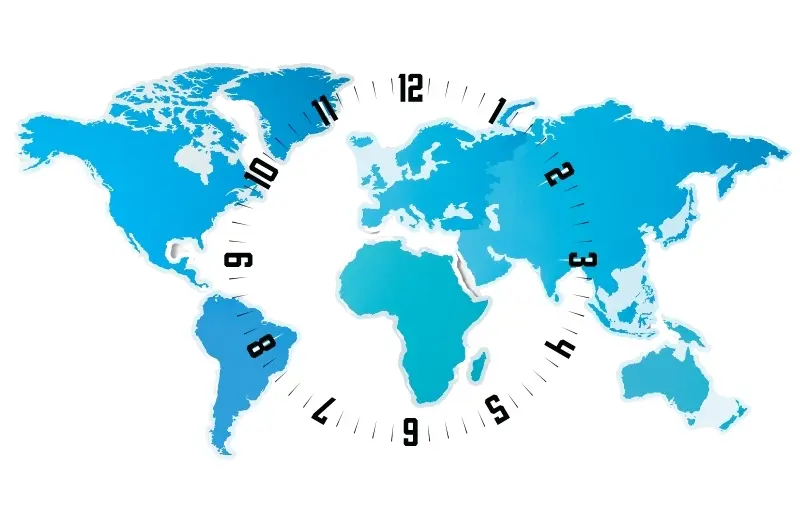
Global time may seem like a simple system. There are countries, time differences, and a map of time zones. But in reality, it is one of the most important invisible systems that keeps everything synchronized across different parts of the world.
Why this matters: global time affects flights, online meetings, financial markets, and even how data is stored on servers. Without a shared time reference, none of these systems would work reliably.
The core idea is simple: at any given moment, there is a single reference point. It does not depend on a city or a country. Everything is built around it. If you want a deeper understanding, this system is explained in a detailed guide about UTC.
One moment, different displays
When it is 18:00 in Sydney, it may be 01:00 in Seattle and 10:00 in Madrid. These are not different moments. It is the same moment, shown differently depending on location.
| City | Local Time | UTC Offset |
|---|---|---|
| Sydney | 18:00 | UTC+10 |
| Seattle | 01:00 | UTC-7 |
| Madrid | 10:00 | UTC+2 |
| Buenos Aires | 05:00 | UTC-3 |
These are not separate points in time. It is one single moment displayed through different time zones. If you want to see how this looks in real time, visit the current world time page.
Time zones were created as a practical solution. The Earth rotates, and daylight reaches different regions at different times. To avoid chaos, the planet was divided into zones, each with its own offset from the base time.
But this is not only about geography. Time is also shaped by decisions made by governments. Some countries use a single time across their entire territory, even if they are very large. Others adjust time during the year by applying daylight saving time.
This means the difference between two cities is not always fixed. It can change depending on the season. That is why local time cannot simply be memorized once and forever.
Interesting fact: not all time zones follow whole-hour offsets. Some regions use values like UTC+5:30 or UTC+9:30, which makes global time slightly more complex than it appears.
How systems actually handle time
From a technical perspective, the system is straightforward. Any system first takes UTC as the base. Then it applies the offset of a specific time zone and, if needed, adjusts for seasonal changes.
In most systems, time is stored as a UTC-based timestamp. Instead of saving local time, systems keep a universal value and convert it only when displaying it to users. This avoids errors caused by time zone differences or daylight saving changes.
For example, if a system receives 10:00 UTC, it may display:
The moment itself does not change. Only the way it is displayed does
This is why global systems do not rely directly on local time. It is too unstable. UTC provides consistency, while time zones make that time usable for people.
Global time is not a collection of different clocks. It is a single system that allows the entire world to operate as one synchronized network.
There is only one moment in time. Everything else is just how different parts of the world choose to display it.