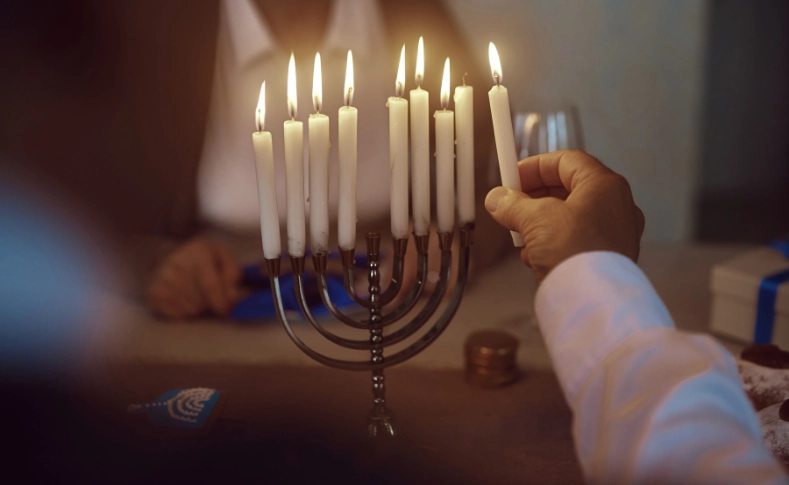
In 2013, the first candle of Hanukkah was lit on the night before Thanksgiving, a coincidence rare enough that it won’t happen again until 2070. Eleven years later, in 2024, the first candle fell on the evening of December 25 itself, the same alignment that had occurred only once before in the prior fifty years, in 2005. Same eight-day festival, same religious calculation behind it, landing more than three weeks apart on the Gregorian calendar depending on the year. Diwali and Ramadan move for reasons rooted in real-time observation of the Moon. Hanukkah moves for a stranger reason: its date has been locked in place by pure arithmetic since the year 359 CE, and no rabbi has had to look at the sky to calculate it since.
Understanding why Hanukkah shifts on the Gregorian calendar means understanding a Hebrew calendar that isn’t watching the Moon in real time at all, but running a fixed mathematical formula that a Roman-era patriarch published to keep a scattered, persecuted community synchronized without needing to send messengers from Jerusalem.
The Rule: 25 Kislev, Every Year, No Exceptions
Hanukkah begins on the 25th day of Kislev, the ninth month of the Hebrew calendar’s religious year, and ends eight days later on the 2nd or 3rd of Tevet depending on how that particular year’s months fall. Kislev typically corresponds to a window spanning late November through December, but the 25th of Kislev itself has no fixed relationship to any Gregorian date whatsoever, exactly the same structural situation that governs Diwali’s shifting date in the Hindu lunisolar calendar.
The Same Eleven-Day Gap Every Lunisolar Calendar Has to Solve
The Hebrew calendar is lunisolar. Its months follow the Moon, alternating between 29 and 30 days to track the roughly 29.53-day lunar cycle, while its years have to stay roughly aligned with the 365.24-day solar year so that Passover keeps falling in spring rather than drifting into winter.
1 solar year ≈ 365.24 days
Annual shortfall ≈ 11 days
Left uncorrected, a calendar built purely on twelve lunar months drifts backward through the seasons by about eleven days every year, the pattern that governs how Ramadan drifts steadily earlier on the Gregorian calendar year after year, since the Islamic calendar makes no correction for the solar year at all. The Hebrew calendar, like the Hindu calendar behind Diwali, corrects for that gap by periodically inserting an entire extra lunar month. What’s different is how, and how rigidly, that correction gets applied.
A 19-Year Cycle Fixed by Math, Not by Watching the Moon
The correction is called the Metonic cycle, named for the Greek astronomer Meton of Athens, who identified around 432 BCE that 19 solar years correspond almost exactly to 235 lunar months. Within that 19-year cycle, the Hebrew calendar designates seven years as leap years, specifically years 3, 6, 8, 11, 14, 17, and 19 of the cycle, and in each of those years an entire extra month, Adar I, is inserted before the regular month of Adar, which becomes Adar II. A leap year on the Hebrew calendar runs 13 months and roughly 384 days; a common year runs 12 months and roughly 354 days.
What makes this genuinely different from Diwali’s calendar is that the Hindu Adhik Maas insertion is calculated fresh, astronomically, for each cycle based on the actual positions of the Sun and Moon. The Hebrew calendar’s 19-year cycle is fixed and predetermined, the same seven leap-year slots repeating every 19 years without any need to observe anything, a purely arithmetic rule locked in place centuries ago.
Why a Roman-Era Patriarch Had to Fix It in Place
For most of ancient Jewish history, the start of each new month was determined by direct observation. Witnesses would report sighting the new crescent Moon to the Sanhedrin, the rabbinic court in Jerusalem, which would then formally sanctify the new month and relay word to Jewish communities through hilltop signal fires and, later, messengers. That system required a functioning central authority in the land of Israel and enough time for word to travel before a holiday arrived.
Roman persecution in the 4th century made that system increasingly untenable, disrupting travel and threatening the Sanhedrin’s ability to operate at all. Around 358 or 359 CE, the patriarch Hillel II published a fixed, calculated calendar based on the 19-year cycle, essentially codifying the mathematics so that Jewish communities anywhere in the world could calculate the date of any future new moon and holiday without waiting for word from Jerusalem. It was the Sanhedrin’s last major act before it was dissolved entirely, and the calendar it left behind, with a handful of postponement rules layered on top to keep certain holidays from landing on inconvenient days of the week, is essentially the same one used today.
What Actually Happened on 25 Kislev, 164 BCE
The holiday itself predates its fixed calendar by roughly 500 years. In 167 BCE, the Seleucid king Antiochus IV Epiphanes outlawed core Jewish religious practices and desecrated the Second Temple in Jerusalem, reportedly dedicating it to Zeus. A priest named Mattathias and his sons, who became known as the Maccabees, led an armed revolt against Seleucid rule. After retaking Jerusalem, the Maccabees, led by Judah Maccabee, cleansed and rededicated the Temple on the 25th of Kislev in 164 BCE, and celebrated with an eight-day festival.
The now-famous story of a single day’s supply of oil miraculously burning for eight nights in the rededicated Temple doesn’t appear in the earliest sources, the Books of the Maccabees. It shows up centuries later, in a portion of the Talmud compiled between roughly 450 and 550 CE, well after the holiday itself and even after Hillel II’s fixed calendar were already in place.
How Far the Date Actually Swings
| Year | Hanukkah begins |
|---|---|
| 2024 | December 25 (sundown) |
| 2025 | December 14 (sundown) |
| 2026 | December 4 (sundown) |
Over the past 50 years, the earliest recorded first night of Hanukkah fell on November 27, in both 1994 and 2013, and the latest fell on December 26, in 1986. The 2013 date created what the media nicknamed “Thanksgivukkah,” since it landed the night before Thanksgiving’s own moving date, itself calculated independently as the fourth Thursday of November. Getting both holidays’ independent calculation systems to align that closely is rare enough that the next overlap isn’t projected until 2070.
The overlap with Christmas’s fixed date works differently, since December 25 never moves on the Gregorian calendar while Hanukkah’s start date does. The two calendars happened to align exactly in 2005 and again in 2024, a coincidence the media dubbed “Chrismukkah,” and the next projected alignment isn’t until 2035.
A Calendar Accurate Enough to Barely Need Fixing, for Now
Hillel II’s fixed arithmetic produces an average Hebrew year length of approximately 365.2468 days, compared to the true solar year of approximately 365.2422 days, a gap of roughly 0.0046 days per year. That sounds negligible, and over a human lifetime it is. But it’s not zero, and the tiny accumulated drift means the calculated new moon used by the Hebrew calendar, called the molad, slowly separates from the actual astronomical new moon over the centuries, edging Hebrew holidays a fraction of a day later relative to the true solar year with each cycle that passes. The gap is measured in a full day roughly every two centuries, not something any living person will notice, but a real, ongoing divergence built into a system that was never designed to be adjusted again after a Sanhedrin no longer exists with the authority to change it. The 4th-century math still works. It just isn’t perfect, and it was never going to be.