Día de los Muertos lasts two days because it sits on top of two separate Catholic feasts: All Saints’ Day on November 1 and All Souls’ Day on November 2. Mexican tradition gave each day its own guests. November 1 belongs to children who have died, often called angelitos, and November 2 belongs to adults. In 2026, that means the children’s day falls on Sunday, November 1, and the adults’ day on Monday, November 2.
The two-day structure is only the core. In many Mexican communities the season starts days earlier, with specific dates set aside for people who died in accidents, by drowning or without being baptized. Understanding why requires two calendars: one written in medieval Rome and a French monastery, and one kept in central Mexico long before either arrived.
The Dates Come From Rome and a Monastery in Burgundy
All Saints’ Day did not always fall on November 1. According to Britannica, the first evidence for that date comes from the reign of Pope Gregory III (731 to 741), who dedicated a chapel in St. Peter’s Basilica in Rome to all the saints. A century later, in the 830s, Pope Gregory IV ordered the feast observed on November 1 throughout the Western Church. In medieval England the day was called All Hallows, which is why the night before it became Hallowe’en, as explained in why Halloween is October 31.
All Souls’ Day came later and from a different source. Sometime between 998 and 1030, Odilo, abbot of the Benedictine monastery of Cluny in France, ordered the monasteries under his authority to pray for all the faithful departed on November 2. The two feasts address different groups. All Saints honors those believed to be already in heaven. All Souls is a day of prayer for all the faithful departed, especially those who, in Catholic teaching, are still in purgatory. Together with Halloween, they form a three-day stretch, October 31 to November 2, that Britannica notes is sometimes called Allhallowtide.
Both are fixed-date feasts, tied to a day of the month rather than to a weekday or the Moon. That is why the Day of the Dead never moves, unlike holidays such as Easter, as covered in why some holidays change date every year.
How Mexico Assigned the Dead to Each Day
When Europeans brought this calendar to Mexico in the sixteenth century, the two Catholic days became the frame for an older practice of welcoming the dead home. The theological split between saints and souls turned into a split by age. The usual explanation is that children who died young were considered innocent, so their souls are received on All Saints’ Day, the day for the saved, while adults are received on All Souls’ Day.
UNESCO, which inscribed the “Indigenous festivity dedicated to the dead” on its Representative List of the Intangible Cultural Heritage of Humanity in 2008 (after first proclaiming it in 2003), describes an even finer system. In indigenous communities, the dead are grouped by cause of death, age, sex and sometimes profession, and each group has its own designated day. That is the logic behind the longer calendar many Mexican families follow today.
| Date | Who is remembered | 2026 weekday |
|---|---|---|
| October 28 | People who died suddenly or violently, including in accidents | Wednesday |
| October 29 | In some regions, people who drowned | Thursday |
| October 30 | In some regions, forgotten souls with no family to remember them | Friday |
| October 31 | Children who died before baptism | Saturday |
| November 1 (All Saints) | Children who died, and those who lived exemplary lives | Sunday |
| November 2 (All Souls) | Adults; the main day for cemetery visits | Monday |
The dates before November 1 vary by region and family, and some newer customs, such as setting aside October 27 for pets, are recent popular additions rather than old tradition. The Government of Mexico’s cultural guidance presents November 1 and 2 as the central days, with offerings in many homes starting several days earlier.
The Older Calendar Underneath
The Mexica (Aztec) solar year, the xiuhpohualli, had 18 periods of 20 days plus 5 extra days. Two of those periods were dedicated to the dead: Miccailhuitontli, the “little feast of the dead,” associated with children, followed by Huey Miccailhuitl, the “great feast of the dead,” for adults. Converted to Gregorian dates, they fell somewhere between July and September, depending on which correlation of the two calendars is used. Scholars still debate how the Mexica year aligned with the solar year, a problem familiar from the history of the Gregorian calendar itself.
The order matches: a smaller feast for children followed by a larger one for adults, exactly the sequence Mexico now observes on November 1 and 2. Whether the old sequence shaped the new one is a reasonable inference, not an established fact. The question of origins is genuinely contested. The INAH historian Elsa Malvido, who ran the institute’s workshop on the study of death for 25 years, argued that the celebration’s dates and structure are essentially Catholic and colonial, and that its framing as a pre-Hispanic festival was emphasized by twentieth-century intellectuals and governments. UNESCO’s description takes the middle ground, presenting the festival as a fusion of pre-Hispanic rites and Catholic feasts brought by Europeans in the sixteenth century.
UNESCO also points to a practical calendar link: the end of October and start of November mark the completion of the annual maize cycle. The return of the dead coincides with the harvest, and families believe the dead can bring an abundant crop, or misfortune, depending on how carefully the rituals are carried out.
What Happens on Each Day
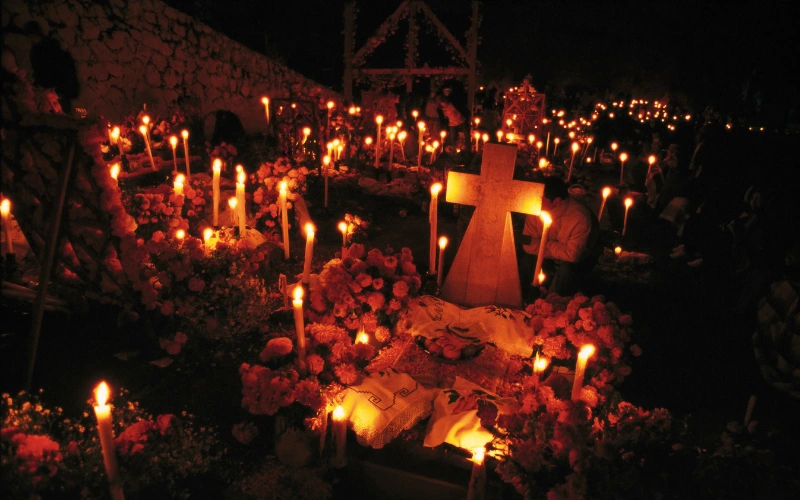
Families build an ofrenda, a home altar with photographs, candles, the favorite foods and drinks of the dead, and paper cut-outs. According to UNESCO, families guide the souls home by laying flower petals and candles along the route from the cemetery to the house. The orange flower used for this is the cempasúchil, a marigold whose petals are scattered to mark the way.
The two days are dressed differently. Offerings for children on November 1 leave out alcohol and spicy sauces, and their altars are often smaller. On November 2, the adults’ day, offerings include the foods and drinks the person enjoyed in life, and it is the main day for families to visit the cemetery, cleaning and decorating graves. The difference follows directly from the age split: each day’s altar is set for the guests expected that day.
A Two-Day Observance That Is Not a Public Holiday
Despite its importance, neither November 1 nor November 2 is a mandatory day off in Mexico. Article 74 of the Federal Labor Law (Ley Federal del Trabajo) lists the days of mandatory paid rest, and the Day of the Dead is not among them. The nearest one is the third Monday of November, observed for Revolution Day; in 2026 that is November 16, since the Mondays of November 2026 fall on the 2nd, 9th, 16th and 23rd. Bills to add November 2 to the list have been introduced in the Chamber of Deputies, but the law’s list of rest days does not include it.
In 2026 the calendar softens that gap: November 1 falls on a Sunday, so only the adults’ day, Monday, November 2, overlaps a normal working day.
The Parade Is Newer Than Most Visitors Think
Mexico City’s large Day of the Dead parade, with giant skeletons and floats through the city center, is not an old tradition. It was first held on October 29, 2016, inspired by a fictional parade invented for the opening scene of the 2015 James Bond film Spectre. Tourism officials worried that visitors who had seen the film would arrive expecting the event, so the city created it.
The parade is scheduled on a weekend near the holiday rather than on November 1 or 2 themselves, and in some years, such as 2023, it took place after them. That keeps it separate from the two days families reserve for home altars and cemeteries, the part of the tradition that UNESCO’s inscription actually describes.