Days in Singapore are currently getting shorter, about 1 minutes shorter than a week ago.*
* Calculated from sunrise and sunset times; actual visible daylight can vary slightly with weather, elevation and atmospheric conditions.
Key Facts About Time in Singapore
- Its standard time has changed 5 times since it first adopted one.
- Its antipode, the point exactly opposite on Earth, is on land, in Ecuador.
- The clock runs about 1 hour 5 minutes ahead of the sun, so solar noon comes as late as 13:18.
- Last moved its clocks forward for summer in 1933.
Time Difference from Singapore
Compare time in Singapore with major cities worldwide.
When the Time Difference with Singapore Changes
Clocks change on different dates around the world, so the gap between Singapore and these places is not the same all year. Next 12 months; dates in Singapore time.
Best Time to Call Singapore
Business hours in Singapore (9 AM-5 PM local time) fall at these local times elsewhere:
- New York: 8:00 PM (previous day) - 4:00 AM ( Outside normal hours)
- Los Angeles: 5:00 PM (previous day) - 1:00 AM ( Outside normal hours)
- London: 1:00 AM - 9:00 AM ( Outside normal hours)
- Dubai: 5:00 AM - 1:00 PM ( Partial overlap · 4 h shared)
- Mumbai: 6:30 AM - 2:30 PM ( Partial overlap · 5 h 30 min shared)
- Tokyo: 10:00 AM - 6:00 PM ( Convenient · 7 h shared)
- Sydney: 12:00 PM - 8:00 PM ( Partial overlap · 5 h shared)
in Singapore today, it is:
- New York: 11:00 PM (previous day) night
- Los Angeles: 8:00 PM (previous day) outside working hours
- London: 4:00 AM night
- Dubai: 8:00 AM outside working hours
- Mumbai: 9:30 AM working hours
- Tokyo: 1:00 PM working hours
- Sydney: 3:00 PM working hours
Times are for today. Clock changes shift them on some dates: see when the time difference changes.
Public Holidays Affecting Singapore
Official national holiday observed in Singapore.
Daylight saving time in Singapore
Singapore uses the IANA time zone identifier Asia/Singapore. The current local offset is UTC+8 / +08.
Singapore does not observe daylight saving time in 2026. The UTC offset remains stable throughout the year.
Time Zone History of Singapore
Singapore follows the Asia/Singapore time zone. According to the IANA time zone database, these are the standard times it has used:
- Until 1 June 1905: local mean time, UTC+6:55
- From 1 June 1905: UTC+7
- From 1 January 1936: UTC+7:20 (mean solar time)
- From 1 September 1941: UTC+7:30
- From 16 February 1942: UTC+9
- From 12 September 1945: UTC+7:30
- From 31 December 1981: UTC+8, the current standard time
Daylight saving time was used only in 1933.
About Time in Singapore
Singapore sits barely 140 kilometres north of the equator, at about 103.8 degrees East. By geography alone its natural time zone would be UTC+7, the same as Bangkok and Jakarta. Instead the island runs on UTC+8, and it reached that number only after an unusually long series of changes. In less than eighty years Singapore's clocks were moved six times, by amounts ranging from under five minutes to an hour and a half.
Six Changes in Under a Century
Here is how the offset from Greenwich has shifted since the early twentieth century:
- Until 31 May 1905: local mean time, 6 hours 55 minutes and 25 seconds ahead of Greenwich, measured for the island's own meridian. From 1901 it was formally known as Singapore Mean Time.
- 1 June 1905: rounded to UTC+7:00, a standard zone time based on the meridian of 105 degrees East.
- 1 January 1933: clocks advanced by 20 minutes under a daylight saving ordinance, giving UTC+7:20. From 1936 this became the permanent standard.
- 1 September 1941: a further 10 minutes, to UTC+7:30, partly to match BBC broadcast schedules.
- 16 February 1942: the day after the British surrender, the Japanese occupation imposed Tokyo time, UTC+9.
- 12 September 1945: back to UTC+7:30 after the occupation ended.
- 1 January 1982: forward 30 minutes to UTC+8, the time used ever since.
Twenty Minutes of Daylight
The most unusual of these changes is the twenty-minute shift of 1933. Near the equator, day length hardly varies through the year, so seasonal summer time makes little sense. The argument in colonial Singapore was different. In 1920 the governor of the Straits Settlements, Sir Laurence Guillemard, who had known British summer time before coming to Malaya, proposed moving the clocks forward by half an hour all year. Business hours would stay the same on paper, but people would wake earlier and have more daylight for leisure after work.
The Legislative Council was not convinced. One member reportedly warned that office workers released earlier into the afternoon sun might get sunstroke, and opponents suggested a much smaller advance of fifteen minutes instead, roughly the difference between Singapore and Penang. The government withdrew the bill. Twelve years later Arnold Robinson, a senior unofficial member of the councils, revived the idea in a milder form, and despite some public opposition a Daylight Saving Ordinance moved the clocks forward by twenty minutes on 1 January 1933. Not everyone benefited: within a year there were complaints that some employers were using the extra light to keep their workers longer.
What began as daylight saving quietly became standard time. By 1936 the extra twenty minutes were simply part of Malaya's normal clock. The further ten minutes added in September 1941 had a very specific purpose: with war approaching, the authorities wanted local time to fit the BBC's overseas broadcasts, which were scheduled in quarter-hour slots. The new offset of seven and a half hours did exactly that.
Tokyo Time in Syonan
Five months later Singapore fell to the Japanese army. The island was renamed Syonan, and public clocks were moved forward by an hour and a half to Tokyo time. Many residents simply ignored it. In February 1944 the occupation newspaper, the Syonan Shimbun, complained that people were still making appointments by "local" time, with confusion and missed meetings as a result. Some historians read this quiet non-compliance as a small form of resistance. The British Military Administration announced on 7 September 1945 that Tokyo time would be abolished, and the island returned to UTC+7:30 after the formal surrender in Singapore on 12 September.
Years later the double clock still caused practical puzzles. In 1985 a newspaper reader asked whether a birth registered during the occupation at 5.30 pm meant Singapore time or Tokyo time. The answer was to request an extract of the record from the National Registration Department.
The Half Hour Added in 1982
The current offset came from Malaysia. Until the end of 1981, Peninsular Malaysia used UTC+7:30 while Sabah and Sarawak on Borneo used UTC+8, so the federation had two times. The Malaysian government decided to unify them on the eastern standard, and on 20 December 1981 Singapore's Ministry of Culture announced that the republic would follow, citing the "many close ties" between the two countries. Business leaders agreed: the president of the Singapore Indian Chamber of Commerce pointed out that even half an hour made a real difference to business done by telephone. On 31 December 1981, when the clocks reached 23:30, they jumped straight to midnight. That New Year's Eve was half an hour shorter than usual.
The move also put Singapore on the same time as Hong Kong, Taipei, Manila, Perth and Beijing, and gave its traders an extra half hour of overlap with Hong Kong, Japan and the west coast of the United States, an advantage for a financial centre whose working day spans much of the globe.
Why Sunrise Is Always Around Seven
Running an hour ahead of its geographical zone has a visible effect. In Singapore the sun reaches its highest point at about 13:00 on average, not at noon. Because the island is so close to the equator, the hours of daylight barely change: sunrise falls between roughly 6:45 and 7:15 throughout the year, and sunset between about 19:00 and 19:20. Children often go to school in the dark and evenings stay bright until well after seven, every month of the year.
Singapore Time Today
Singapore Standard Time, often written SGT, is UTC+8 with no daylight saving. The official reference is maintained by the National Metrology Centre, part of the Agency for Science, Technology and Research. Singapore shares its time with Kuala Lumpur, Hong Kong, Beijing and Perth. It is one hour ahead of Jakarta and Bangkok, one hour behind Tokyo and Seoul, 8 hours ahead of London in winter and 7 hours in British summer, and 13 or 12 hours ahead of New York depending on the season.
The clock tower of the Victoria Theatre and Concert Hall, completed in 1906 near the mouth of the Singapore River, has looked down on the city through almost all of these changes. Few public clocks anywhere can have been reset so many times for reasons that had nothing to do with keeping bad time.
Sun & Daylight in Singapore
Singapore lies at 1.29° N, 103.85° E in the Northern Hemisphere and the Eastern Hemisphere, about 144 km (89 mi) from the Equator, in the tropical latitude zone.
Sun Time vs Clock Time
Standard time in Singapore, UTC+8, is based on the 120° E meridian, while the city lies at 103.85° E. So on standard time the clock runs about 1 hour 5 minutes ahead of local solar time.
Solar noon, the moment the sun is highest in the sky, comes as early as 12:48 (around November 3) and as late as 13:18 (around February 11) by the local clock. Because the clock is well ahead of the sun, mornings stay dark longer and evenings stay light later than the time zone alone would suggest.
Golden Hour & Blue Hour Today
Approximate times from today's sunrise and sunset; the light itself depends on weather.
Airports Serving Singapore
Singapore Changi Airport (SIN / WSSS) is the main airport serving Singapore: a major airport about 17 km (11 mi) from the city centre.
Current local time at the airport is 07:10:00.
Other airports within 80 km:
- Hang Nadim International Airport (BTH), Indonesia - major, 35 km
- Senai International Airport (JHB), Malaysia - major, 44 km
- Seletar Airport (XSP) - regional, 14 km
Antipode of Singapore
The point on Earth exactly opposite Singapore lies at 1.29° S, 76.15° W, on land in Ecuador. The nearest populated place is Boca Suno, Ecuador, about 130 km away. The nearest major city is Quito, Ecuador, about 290 km away.
When it is noon by the sun in Singapore, it is midnight by the sun at its antipode.
Frequently Asked Questions
What time zone is Singapore in?
Singapore follows the Asia/Singapore time zone, the official IANA identifier used by computers and databases worldwide to track local time accurately. Right now, this puts Singapore at UTC+8.
What time is it in Singapore right now?
The current local time in Singapore is 07:10:00 on Sunday, 22 November 2026. The clock at the top of this page shows the live time and updates every second.
Does Singapore observe daylight saving time?
No. Singapore stays on UTC+8 all year and does not change its clocks.
How far ahead or behind UTC is Singapore?
Singapore is currently UTC+8, meaning local time is 8 hours ahead of Coordinated Universal Time (UTC).
Why does the sun rise and set so late by the clock in Singapore?
Singapore's clock runs about 1 hour 5 minutes ahead of local solar time. As a result, solar noon comes as late as 13:18, and sunrise and sunset come later by the clock by about the same amount.
When did Singapore last change its standard time?
On 31 December 1981, standard time in Singapore changed from UTC+7:30 to UTC+8, the offset it uses today.
When did Singapore stop using daylight saving time?
The last switch to summer time in Singapore was in 1933. It was used only that year. No change is scheduled now, so the clock stays on UTC+8 all year.
Which airport serves Singapore?
Singapore Changi Airport (SIN) is the main airport serving Singapore, about 17 km away. The current local time at the airport is 07:10:00.
Beyond the Clock

Parkinson’s Law: Does Work Really Expand to Fill the Time Available?
"Work expands so as to fill the time available for its completion" is one of the most quoted lines in management writing, and it began as a joke. C. Northcote Parkinson, a British naval historian, put it in the opening sentence of an essay in

Do 90-Minute Work Cycles Exist? Ultradian Rhythms and the Evidence
The claim is everywhere in productivity writing: the brain runs on 90-minute cycles during the day, so you should work in 90-minute blocks and rest when the cycle dips. It traces back to a real scientist, the sleep researcher Nathaniel Kleitman, and to a real
The 7-Minute Rule: How Employers Round Time Clock Punches
The 7-minute rule is the usual name for rounding time clock punches to the nearest quarter hour. A punch 1 to 7 minutes past a quarter hour rounds down; a punch 8 to 14 minutes past rounds up to the next quarter. Clock in at

How Long Does It Take to Form a Habit? What the 66-Day Study Actually Found
The most quoted answer, 21 days, has no study behind it. The second most quoted answer, 66 days, does, but it rarely comes with the details that make it meaningful. In the study behind that number, the time for a new daily behavior to become
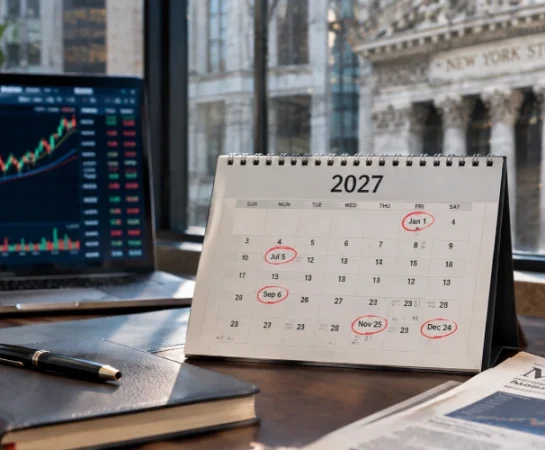
Stock Market Holidays 2027: NYSE and NASDAQ Closure Calendar
US stock exchanges will close on 10 weekdays in 2027 and close early on one. That leaves 251 full or partial trading sessions, the same count as 2026 and 2028. The dates themselves have a few twists, though. Three holidays land on a Saturday or
What Time Does Direct Deposit Hit? ACH Windows and Why Payday Sometimes Arrives Early
A standard direct deposit must be available in your account by 9:00 a.m. local time on payday. That deadline comes from the Nacha Operating Rules, which govern the ACH network that carries direct deposits in the United States, and since September 18, 2026 it applies
What Time Does CPI Come Out: Inflation Report Schedule and Why the Date Moves
The Consumer Price Index comes out at 8:30 a.m. Eastern Time, on a weekday roughly two weeks after the month it measures. The time never changes. The date does: in 2026 and 2027 the release lands anywhere from the 10th to the 14th of the

Stock Market Early Close Days: When Trading Ends at 1 PM
Twice in the last stretch of 2026, the NYSE and Nasdaq will stop trading three hours ahead of schedule. The bell rings at 1:00 PM Eastern instead of 4:00 PM, and a session that normally runs 6.5 hours gets squeezed into 3.5. Anyone with a


