Days in Manila are currently getting shorter, about 3 minutes shorter than a week ago.*
* Calculated from sunrise and sunset times; actual visible daylight can vary slightly with weather, elevation and atmospheric conditions.
Key Facts About Time in Manila
- Its antipode, the point exactly opposite on Earth, is on land, in Brazil.
- Last moved its clocks forward for summer in 1990.
- Replaced local solar time with a standard time zone on 6 September 1899.
Time Difference from Manila
Compare time in Manila with major cities worldwide.
When the Time Difference with Manila Changes
Clocks change on different dates around the world, so the gap between Manila and these places is not the same all year. Next 12 months; dates in Manila time.
Best Time to Call Manila
Business hours in Manila (9 AM-5 PM local time) fall at these local times elsewhere:
- New York: 8:00 PM (previous day) - 4:00 AM ( Outside normal hours)
- Los Angeles: 5:00 PM (previous day) - 1:00 AM ( Outside normal hours)
- London: 1:00 AM - 9:00 AM ( Outside normal hours)
- Dubai: 5:00 AM - 1:00 PM ( Partial overlap · 4 h shared)
- Mumbai: 6:30 AM - 2:30 PM ( Partial overlap · 5 h 30 min shared)
- Tokyo: 10:00 AM - 6:00 PM ( Convenient · 7 h shared)
- Sydney: 12:00 PM - 8:00 PM ( Partial overlap · 5 h shared)
in Manila today, it is:
- New York: 11:00 PM (previous day) night
- Los Angeles: 8:00 PM (previous day) outside working hours
- London: 4:00 AM night
- Dubai: 8:00 AM outside working hours
- Mumbai: 9:30 AM working hours
- Tokyo: 1:00 PM working hours
- Sydney: 3:00 PM working hours
Times are for today. Clock changes shift them on some dates: see when the time difference changes.
Public Holidays Affecting Manila
Official national holiday observed in Philippines.
Daylight saving time in Manila
Manila uses the IANA time zone identifier Asia/Manila. The current local offset is UTC+8 / PST.
Manila does not observe daylight saving time in 2026. The UTC offset remains stable throughout the year.
Time Zone History of Manila
Manila follows the Asia/Manila time zone. According to the IANA time zone database, these are the standard times it has used:
- Until 31 December 1844: local mean time
- From 31 December 1844: UTC+8:04 (mean solar time)
- From 6 September 1899: UTC+8
- From 12 February 1942: UTC+9
- From 4 March 1945: UTC+8, the current standard time
Daylight saving time was used in 6 years between 1936 and 1990. The last switch to summer time was in 1990, and none is scheduled now.
About Time in Manila
The Day Manila Skipped
In the Philippines, Tuesday, 31 December 1844 never happened. For more than three centuries the islands had kept the same calendar date as Mexico, because Spanish rule, trade and the galleons that crossed the Pacific all came from the east, from the Americas. The result was that Manila was a full day behind its Asian neighbours: when it was Monday in Manila, it was already Tuesday in Macau, Batavia and Canton.
As trade with Asia grew, the mismatch became a nuisance. On 16 August 1844 Governor-General Narciso Clavería, after consulting the Archbishop of Manila, José Seguí, decreed that the last day of the year would be removed. Monday, 30 December 1844 was followed directly by Wednesday, 1 January 1845, and the Philippines joined the Asian side of what would later become the International Date Line.
The change happened forty years before the International Meridian Conference of 1884, and it went largely unnoticed abroad. Many European atlases and reference books went on showing the Philippines with the old American reckoning until the early 1890s.
Jesuits, Typhoons and a Time Ball
The institution that brought precise time to Manila began with the weather. In September 1865 a young Jesuit at the Ateneo Municipal, Francisco Colina, recorded the passage of a typhoon, and an account of his observations published in the Diario de Manila led merchants to ask the Jesuits to continue the work. The Manila Observatory grew from those observations. In 1884 the Spanish government made it the official weather service of the islands, and in 1885 it began a time service for ships in the harbour. A time ball was dropped from its roof every day at noon so that captains could check their chronometers.
The observatory still exists, now as a research institute on the campus of Ateneo de Manila University in Quezon City, and its time service was trusted for generations. The government's official time, however, has long since passed to PAGASA, the national weather and astronomical agency.
Juan Time
Filipinos have a phrase, "Filipino time", for the habit of turning up late. In 2013 the government decided to tackle it by law. Republic Act 10535, the Philippine Standard Time Act, signed by President Benigno Aquino III on 15 May 2013, requires all national and local government offices to display Philippine Standard Time on their official clocks, including the bundy clocks used to record attendance, and to synchronise them with the time provided by PAGASA. Television and radio stations must calibrate their clocks too, with penalties for those that do not.
The law also declared the first week of every year National Time Consciousness Week, first observed from 1 to 7 January 2014. The campaign around it was branded "Juan Time", after Juan, the everyman of Filipino culture, and launched with the slogan "Pinoy Ako, On-Time Ako!", "I am Filipino, I am on time".
Manila Time Today
Manila uses Philippine Standard Time, UTC+8, all year, with no daylight saving time. It is on the same time as Beijing, Hong Kong, Taipei, Singapore and Perth, and one hour behind Tokyo and Seoul. The difference with London is 8 hours in winter and 7 during British summer time, and with New York 13 or 12 hours, so the business day in Manila falls during the American night. This is why many of the city's call centre staff work night shifts to serve customers in the United States.
Manila lies almost exactly on the 120th meridian on which its time is based, so solar noon stays close to 12:00, between about 11:40 in late October and 12:10 in late February. The sun rises between about 5:26 in late May and 6:25 in late January, and sets between about 17:24 in November and 18:29 in July.
Sun & Daylight in Manila
Manila lies at 14.60° N, 120.98° E in the Northern Hemisphere and the Eastern Hemisphere, about 1,626 km (1,010 mi) from the Equator, in the tropical latitude zone.
Sun Time vs Clock Time
Standard time in Manila, UTC+8, is based on the 120° E meridian, while the city lies at 120.98° E. So on standard time the clock runs within 4 minutes of local solar time.
Solar noon, the moment the sun is highest in the sky, comes as early as 11:39 (around November 3) and as late as 12:10 (around February 10) by the local clock.
Golden Hour & Blue Hour Today
Approximate times from today's sunrise and sunset; the light itself depends on weather.
Time now in other cities in Philippines
Airports Serving Manila
Ninoy Aquino International Airport (MNL / RPLL) is the main airport serving Manila: a major airport about 11 km (7 mi) from the city centre.
Current local time at the airport is 07:09:57.
Other airports within 80 km:
- Clark International Airport / Clark Air Base (CRK) - major, 79 km
- Subic Bay International Airport / Naval Air Station Cubi Point (SFS) - major, 79 km
Antipode of Manila
The point on Earth exactly opposite Manila lies at 14.60° S, 59.02° W, on land in Brazil. It is near Pontes e Lacerda, Brazil, about 77 km away. The nearest major city is Santa Cruz de la Sierra, Bolivia, about 570 km away.
When it is noon by the sun in Manila, it is midnight by the sun at its antipode.
Frequently Asked Questions
What time zone is Manila in?
Manila follows the Asia/Manila time zone, the official IANA identifier used by computers and databases worldwide to track local time accurately. Right now, this puts Manila at UTC+8.
What time is it in Manila right now?
The current local time in Manila is 07:09:57 on Sunday, 22 November 2026. The clock at the top of this page shows the live time and updates every second.
Does Manila observe daylight saving time?
No. Manila stays on UTC+8 (PST) all year and does not change its clocks.
How far ahead or behind UTC is Manila?
Manila is currently UTC+8, meaning local time is 8 hours ahead of Coordinated Universal Time (UTC).
When did Manila stop using daylight saving time?
The last switch to summer time in Manila was in 1990. In total, clocks were moved forward for summer in 6 years, the first time in 1936. No change is scheduled now, so the clock stays on UTC+8 all year.
Which airport serves Manila?
Ninoy Aquino International Airport (MNL) is the main airport serving Manila, about 11 km away. The current local time at the airport is 07:09:57.
Beyond the Clock

Why Presidents’ Day Can Never Fall on Washington’s Birthday
The federal holiday honoring George Washington falls on the third Monday in February, and the third Monday in February can only land between February 15 and 21. Washington was born on February 22. The holiday can therefore never fall on the date it commemorates, in

Why Advent Starts on a Different Date Every Year
Advent always begins on a Sunday, and that is the whole reason its date moves. The season is defined as the four Sundays before Christmas, but Christmas is fixed to a date, December 25, not to a day of the week. As Christmas drifts through

Three Kings Day: Why Epiphany Falls on January 6
On the morning of Wednesday, January 6, 2027, children across Spain will open what are traditionally the main presents of the holiday season. In Spain the gifts come not from Santa Claus but from the Three Kings. In Puerto Rico, children leave grass in shoeboxes

Why Orthodox Christmas Falls on January 7, Not December 25
Millions of Orthodox Christians open presents and attend Christmas liturgy on January 7. They aren't celebrating a different holiday, and they aren't twelve days behind on purpose. They're marking December 25 on a calendar that stopped syncing with the seasons centuries ago and was never
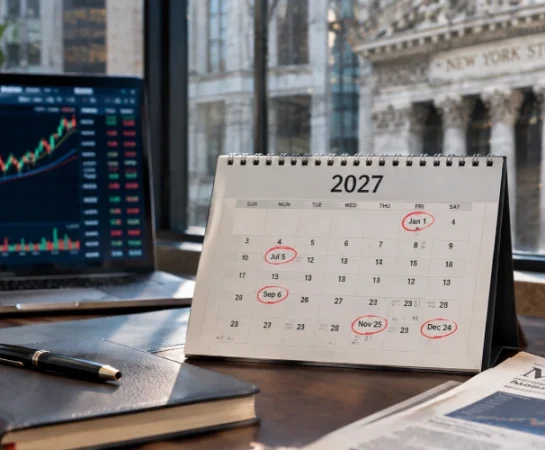
Stock Market Holidays 2027: NYSE and NASDAQ Closure Calendar
US stock exchanges will close on 10 weekdays in 2027 and close early on one. That leaves 251 full or partial trading sessions, the same count as 2026 and 2028. The dates themselves have a few twists, though. Three holidays land on a Saturday or

What Time Does Direct Deposit Hit? ACH Windows and Why Payday Sometimes Arrives Early
A standard direct deposit must be available in your account by 9:00 a.m. local time on payday. That deadline comes from the Nacha Operating Rules, which govern the ACH network that carries direct deposits in the United States, and since September 18, 2026 it applies
What Time Does CPI Come Out: Inflation Report Schedule and Why the Date Moves
The Consumer Price Index comes out at 8:30 a.m. Eastern Time, on a weekday roughly two weeks after the month it measures. The time never changes. The date does: in 2026 and 2027 the release lands anywhere from the 10th to the 14th of the

Stock Market Early Close Days: When Trading Ends at 1 PM
Twice in the last stretch of 2026, the NYSE and Nasdaq will stop trading three hours ahead of schedule. The bell rings at 1:00 PM Eastern instead of 4:00 PM, and a session that normally runs 6.5 hours gets squeezed into 3.5. Anyone with a


