Major Airports in Turkmenistan
- Ashgabat International Airport (ASB) - 04:00:59
- Dashoguz International Airport (TAZ) - 04:00:59
- Türkmenabat International Airport (CRZ) - 04:00:59
Daylight saving time in Turkmenistan
Turkmenistan has 1 listed IANA time zones. None of them observe daylight saving time in 2026. The UTC offset remains stable throughout the year.
Best Time to Call Turkmenistan
Business hours in Turkmenistan (9 AM–5 PM local time) fall at these local times elsewhere:
- Beijing: 12:00 PM – 8:00 PM ( Partial overlap)
- Paris: 6:00 AM – 2:00 PM ( Partial overlap)
- Toronto: 12:00 AM – 8:00 AM ( Outside normal hours)
- Seoul: 1:00 PM – 9:00 PM ( Partial overlap)
- Mexico City: 10:00 PM (previous day) – 6:00 AM ( Outside normal hours)
- Cairo: 7:00 AM – 3:00 PM ( Partial overlap)
- Bangkok: 11:00 AM – 7:00 PM ( Convenient)
Times shown reflect current UTC offsets and may shift by up to an hour around daylight saving transitions.
Time Difference from Turkmenistan
Compare time in Turkmenistan with other countries.
Countries in the Same Time Zone as Turkmenistan
Most Popular Cities in Turkmenistan
Holidays in Turkmenistan
Official national public holidays. Regional and religious observances may vary by area.
About Time in Turkmenistan
Ashgabat's First Recorded Standard-Time Change Was Only 6 Minutes and 28 Seconds
The historical clock record for Ashgabat begins with local mean time at UTC+03:53:32. That awkward offset came from longitude: before standardized zone time, the local clock was tied to the city's solar meridian rather than to an integer number of hours from Greenwich.
On May 2, 1924, the territory moved to UTC+04:00. The difference was just 6 minutes and 28 seconds. Modern tzdb reconstruction places the change at midnight, with 23:59:59 followed by approximately 00:06:28.
The small size of the jump makes it more interesting than a routine one-hour reform. It marks the point where a clock defined to the second by Ashgabat's longitude gave way to a clean regional standard. The pre-1924 value is reconstructed historical data rather than a surviving second-by-second national time service, so its precision should be read in that context.
June 21, 1930 Added a Full Hour, and UTC+05:00 Became the Long-Term Base
Six years after the move to UTC+04:00, another reform changed the scale completely. At the end of June 20, 1930, clocks advanced by one hour. Midnight was followed by 01:00 on June 21, putting Ashgabat on UTC+05:00.
That offset became the durable base around which most of the later history developed. Even when seasonal clock changes appeared in the 1980s, winter time repeatedly returned to UTC+05:00.
The distinction is important because UTC+05:00 was not originally created as a modern Turkmen national standard after independence. It had already been embedded in the civil-time history of the territory for decades. The independent state later returned to the same numerical offset after a short and unusual detour through UTC+04:00.
Turkmenistan's 1991 Spring Transition Changed the Time System but Not the Clock
Seasonal clock changes had been operating since 1981, normally taking Ashgabat from UTC+05:00 in winter to UTC+06:00 in summer. March 31, 1991 broke that pattern.
At 02:00, daylight saving formally began, but the clock did not advance. The underlying standard offset was reduced from UTC+05:00 to UTC+04:00 at the same moment that the seasonal rule added one hour. The two changes cancelled each other, leaving the effective civil offset at UTC+05:00.
Nothing unusual would have been visible on a wall clock. Yet the meaning of that clock reading had changed completely: what had been standard time at UTC+05:00 became daylight time built from a UTC+04:00 base.
The hidden change surfaced on September 29. When daylight saving ended, clocks moved back from 03:00 to 02:00 and the effective offset fell to UTC+04:00. That was the last seasonal clock reversal recorded for Turkmenistan.
Independent Turkmenistan Spent Less Than Four Months on UTC+04:00
When Turkmenistan became independent in October 1991, its civil clock was still on UTC+04:00. That arrangement survived only into the following January.
On January 19, 1992, at 02:00 local time, clocks advanced directly to 03:00. The country moved from UTC+04:00 to UTC+05:00, creating a missing hour between 02:00 and 02:59:59.
This was not a daylight-saving transition. UTC+05:00 became the permanent national standard, and the seasonal system was not restored. Since that January morning, Turkmenistan has kept the same offset through every season.
The sequence from 1991 to 1992 is unusually compact: a spring reform that changed the standard without moving the clock, an autumn change that exposed the new UTC+04:00 base, independence with that offset still in force, and then a permanent one-hour advance only a few months later.
Asia/Ashgabat Has Had No Clock Transition Since January 1992
For modern timestamps, Turkmenistan is now exceptionally simple. The entire country uses UTC+05:00, there is no daylight saving, and IANA records no further offset transition in Asia/Ashgabat after January 19, 1992.
The stability of the current system contrasts sharply with the historical record encoded behind the same identifier: UTC+03:53:32 local mean time, the six-minute standardization adjustment of 1924, the one-hour reform of 1930, a decade of seasonal UTC+06:00 periods, the invisible structural change of March 1991, and the final return to UTC+05:00 in 1992.
Frequently Asked Questions
How many time zones does Turkmenistan have?
One. The whole of Turkmenistan follows Asia/Ashgabat, so every city shows the same local time as the capital, Ashgabat.
Is Turkmenistan ahead of or behind GMT?
Turkmenistan is currently 5 hours ahead of GMT (UTC+5).
Does Turkmenistan use summer time?
No. Turkmenistan does not observe daylight saving time, so its clocks stay at UTC+5 all year. Its time difference with countries that do change their clocks still shifts by an hour in spring and autumn.
How many public holidays does Turkmenistan have in 2026?
Turkmenistan has 13 national public holidays in 2026, when banks and government offices are usually closed. Some regions may also have their own local holidays.
How do I dial a phone number in Turkmenistan from abroad?
From a mobile phone, type +993 and then the local number without the leading 0 used for domestic calls, if it has one. From a landline, replace the plus sign with your exit code: 011 from the US and Canada, or 00 from most of Europe, for example 00 993 followed by the number.
What language is spoken in Turkmenistan?
The main languages of Turkmenistan are Turkmen, Russian and Uzbek.
Beyond the Clock

Which US States Are Split Between Two Time Zones (and Where the Line Runs)
"What time zone is Texas in?" has two correct answers. Houston, Dallas and Austin are on Central Time, while El Paso is on Mountain Time, an hour behind the rest of the state. Florida, Kentucky, Tennessee, Michigan and nine other states work the same way:

India vs US Time Difference: Why the Gap Changes Twice a Year
For most of the year, India is 9 hours 30 minutes ahead of New York. From November 1, 2026 to March 14, 2027, it is 10 hours 30 minutes ahead. India's clocks do not change in either case. The whole difference comes from the United
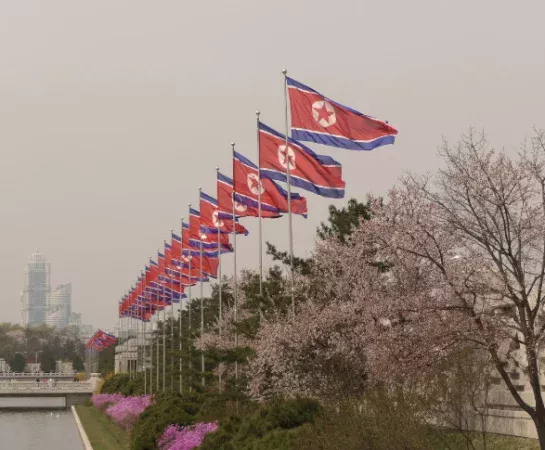
Why North Korea Changed Its Time Zone Twice in One Decade
North Korea turned its clocks back 30 minutes on August 15, 2015, breaking from South Korea and Japan to create its own "Pyongyang Time," then reversed the entire move less than three years later, on May 5, 2018, realigning with Seoul again. Both changes were

Why India’s Time Zone Is Exactly 5:30 Off UTC
India runs on a single clock from the Arabian Sea to the Myanmar border, a stretch of roughly 3,000 kilometers, and that clock sits at a UTC offset almost nobody outside the region can round off in their head. UTC+5:30 isn't a rough approximation or

When Does the Fed Announce Interest Rates: Exact Time and Why It Moves Markets
The Federal Reserve announces its interest rate decision at 2:00 p.m. Eastern Time on the final day of each scheduled Federal Open Market Committee (FOMC) meeting, and the Chair's press conference follows at 2:30 p.m. Those times have been fixed since March 2013. The rest

Why Bitcoin ETFs Close at 4 PM While Bitcoin Never Stops Trading
Bitcoin trades every minute of the year. The ETFs that hold it do not. A US spot bitcoin ETF follows a stock exchange schedule: regular trading from 9:30 AM to 4:00 PM ET on weekdays, thinner extended sessions on either side, and no trading at

What Is the Closing Auction and Why the Last 10 Minutes Move the Market
The 4:00 p.m. bell on the New York Stock Exchange does not simply end the trading day. It triggers the closing auction, a one-time match of buyers and sellers at a single price that becomes each stock's official close, and which NYSE describes as the

Jobs Report Day: Why the First Friday of the Month Moves Every Market at Once
Once a month, at 8:30 a.m. Eastern, currency pairs jump, bond yields snap, and equity futures swing before most traders have settled at their desks. Everyone calls it "the first Friday of the month." Almost everyone is wrong about why it lands there. The date
Time Tools
Quick access to timers, stopwatch, world clock and time zone tools.
Time Guides
Read useful guides about time zones, calendars, finance and astronomy.


